StreamArena benchmark exposes limits of streaming video AI
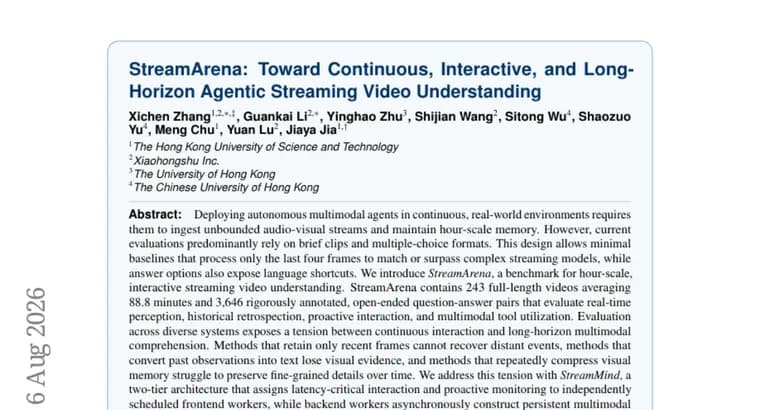
Researchers have introduced StreamArena, a benchmark meant to evaluate how well AI systems understand continuous, hour-scale video streams while interacting with them in real time. The authors argue that deploying autonomous multimodal agents in real-world settings requires ingesting unbounded audio-visual streams and holding memory that spans hours, yet current evaluations mostly rely on brief video clips and multiple-choice question formats. That setup, they say, lets minimal baselines that look only at the last four frames match or surpass complex streaming models, while the multiple-choice answer options themselves expose language shortcuts that let a system guess correctly without actually watching the video.
StreamArena contains 243 full-length videos averaging 88.8 minutes each, paired with 3,646 rigorously annotated, open-ended question-answer pairs. The questions probe four capabilities: real-time perception, historical retrospection, proactive interaction, and multimodal tool utilization.
Running a range of systems on StreamArena exposed a tension between staying responsive during continuous interaction and holding on to long-horizon comprehension. Methods that keep only recent frames cannot recover events from earlier in a stream. Methods that convert past observations into text lose visual evidence. Methods that repeatedly compress visual memory to save space struggle to preserve fine-grained detail over time.
To address that tension, the authors built StreamMind, a two-tier architecture. Frontend workers, scheduled independently, handle latency-critical interaction and proactive monitoring. Backend workers asynchronously build a persistent multimodal memory and carry out historical recall and external search. According to the authors, StreamMind outperforms existing streaming baselines across all four evaluated capabilities and cuts query-to-answer latency by reusing persistent state, though the text does not give specific performance numbers or name the baseline systems it was compared against.
Key facts
- StreamArena contains 243 full-length videos averaging 88.8 minutes, paired with 3,646 rigorously annotated, open-ended question-answer pairs.
- It evaluates four capabilities: real-time perception, historical retrospection, proactive interaction, and multimodal tool utilization.
- On prior benchmarks, a minimal baseline using only the last four frames could match or surpass complex streaming models, and multiple-choice answer options exposed language shortcuts.
- Testing on StreamArena reveals a three-way tension: recent-frame-only methods miss distant events, text-conversion methods lose visual evidence, and memory-compression methods lose fine-grained detail over time.
- StreamMind, a two-tier frontend/backend architecture, outperforms existing streaming baselines on all four capabilities and reduces query-to-answer latency by reusing persistent state.
Why it matters
Most video-understanding benchmarks still test AI systems on short clips with multiple-choice answers. StreamArena raises the bar to hour-scale, continuous video with open-ended questions, and in doing so shows that some existing streaming systems were succeeding on easier benchmarks partly by exploiting shortcuts, such as a baseline that only looks at the last four frames, rather than by genuinely understanding long video.
Who it affects
The benchmark targets researchers and engineers building agents that need to watch and reason over continuous video streams rather than short pre-cut clips, such as systems meant to monitor a live feed, hold a running conversation about what is happening on screen, or recall something seen much earlier in a session.
How to use it
StreamArena is presented as an evaluation benchmark: 243 full videos and 3,646 open-ended question-answer pairs that a streaming system can be run against to measure real-time perception, historical retrospection, proactive interaction, and multimodal tool utilization. The text does not state a release date, licence, or where the dataset or code can be obtained.
How solid is it
The claims come from the paper's own abstract. It reports that StreamMind beats existing streaming baselines on all four StreamArena capabilities and lowers query-to-answer latency by reusing persistent state, but the text gives no author names, no institutions, no publication date, and no numeric scores, only the qualitative claim of outperforming unnamed baseline systems.
Risks and caveats
The three failure modes the authors describe are trade-offs, not solved problems: keeping only recent frames loses distant events, converting video to text loses visual evidence, and compressing visual memory loses fine detail over time. Because the text names neither the compared systems nor any performance numbers, and gives no authors or institutions, the strength of StreamMind's advantage cannot be checked from this source alone.