StreamPI beats pi0.5 by giving robot models temporal memory
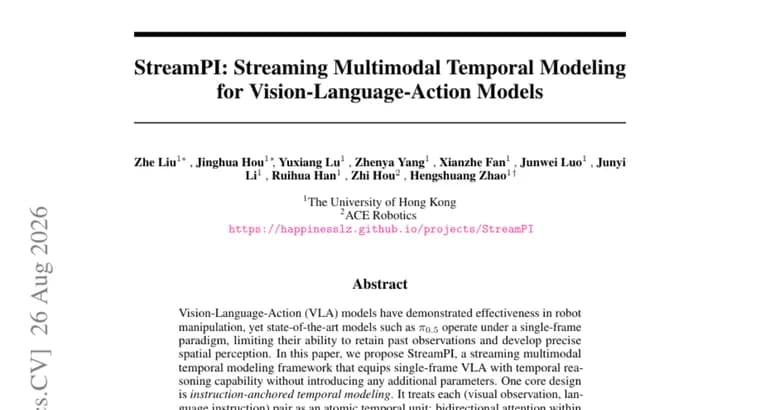
Vision-Language-Action (VLA) models, which let robots turn a camera view and a language instruction into actions, have shown they work for robot manipulation. But the authors note that state-of-the-art VLA models such as pi0.5 operate under a single-frame paradigm: they process one observation at a time and cannot retain past observations, which limits how precisely they can perceive space and remember what already happened during a task.
The paper proposes StreamPI, a streaming multimodal temporal modeling framework meant to equip single-frame VLA models with temporal reasoning without introducing any additional parameters. Its core design is what the authors call instruction-anchored temporal modeling: each (visual observation, language instruction) pair is treated as one atomic temporal unit. Bidirectional attention operates within each pair, fusing the image and the instruction together, while causal attention operates across pairs, preserving autoregressive streaming inference. The language instruction therefore acts as a persistent semantic anchor that stays constant while observations stream in during task execution.
A second piece addresses the mismatch between how these models are trained and how they run on a real robot: training is synchronous, but real-robot deployment is asynchronous. The authors introduce a random-interval streaming training strategy. Sampling a proper inter-frame interval, for example every 3 frames, enables faster and smoother action execution. Randomizing that interval further, rather than fixing it, improves the model's robustness to frame-timing perturbations, which the authors say supports asynchronous deployment in practice.
Because StreamPI is built to exploit the length extrapolation capability of its LLM backbone, it can inherit pretrained single-frame weights directly rather than requiring retraining from scratch, and it supports both single-frame and multi-frame inference depending on the setting.
The authors report experiments on real-robot tasks spanning memory-dependent scenarios and scenarios that require precise perception, as well as on the LIBERO simulation benchmark, and state that StreamPI outperforms pi0.5 across these diverse tasks. The text does not give the numeric size of that improvement, the identity of the authors or their institutions, a publication date, or a more granular breakdown of what the real-robot task set contains beyond the two scenario categories named above.
Key facts
- StreamPI adds temporal reasoning to single-frame VLA models such as pi0.5 without introducing any additional parameters.
- Its instruction-anchored temporal modeling treats each observation-instruction pair as one unit: bidirectional attention within the pair, causal attention across pairs, with the instruction acting as a persistent anchor.
- A random-interval streaming training strategy (e.g. sampling every 3 frames) targets the gap between synchronous training and asynchronous real-robot deployment, and randomizing the interval improves robustness to frame-timing perturbations.
- By leveraging the LLM backbone's length extrapolation, StreamPI reuses pretrained single-frame weights and supports both single-frame and multi-frame inference.
- On real-robot tasks (memory-dependent and precise-perception scenarios) and the LIBERO simulation benchmark, the authors report StreamPI outperforms pi0.5 across diverse tasks, though no numeric margin is given.
Why it matters
Robot manipulation models built on the VLA paradigm, including a state-of-the-art model like pi0.5, currently process one frame at a time and cannot retain earlier observations. That single-frame limit caps how precisely a robot can perceive space and remember task history. StreamPI's contribution is adding temporal memory to that architecture without adding parameters, which is the part of the claim that makes this more than an incremental tweak.
Who it affects
This is squarely a robotics-research contribution: it targets teams building or fine-tuning Vision-Language-Action models for robot manipulation, particularly anyone already working with pi0.5-style single-frame architectures who wants temporal reasoning without a heavier model.
How to use it
Because StreamPI is designed to reuse pretrained single-frame weights via the LLM backbone's length extrapolation, it is positioned as something that can sit on top of existing single-frame VLA checkpoints rather than requiring training from zero, and it supports switching between single-frame and multi-frame inference. No pricing, license or release details are given, consistent with this being a research paper rather than a shipped product.
How solid is it
The method is tested on real-robot tasks split into memory-dependent and precise-perception scenarios, plus the LIBERO simulation benchmark, and the authors report it outperforms pi0.5 across these. That is two evaluation settings, one of them on physical robots rather than simulation alone. What is missing from the source is any numeric result: no success-rate or score figures are given, so the size of the reported advantage over pi0.5 cannot be assessed from the text.
Risks and caveats
No author names or institutions are stated in the text, no publication or submission date is given, and the real-robot task set is described only at the level of two scenario categories rather than itemized. The comparison is against a single baseline, pi0.5, so how StreamPI stacks up against other temporal or streaming approaches is not addressed here. Treat the outperformance claim as the authors' own report pending independent scrutiny.