Study finds finetuning visual encoders for reconstruction hurts diffusion training, proposes x0-prediction fix
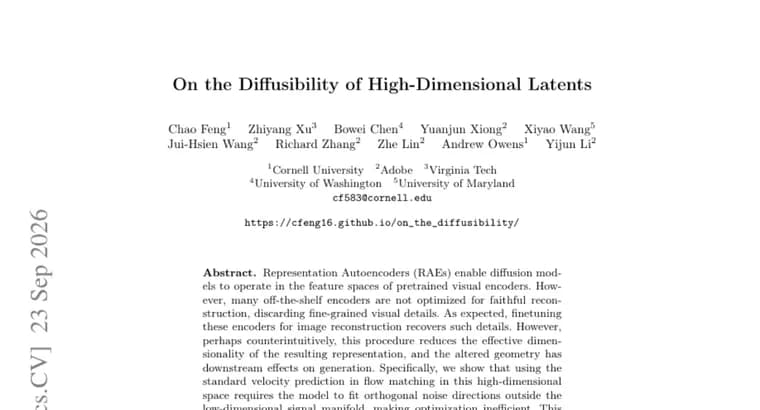
Representation Autoencoders (RAEs) let diffusion models generate images inside the feature space of a pretrained visual encoder rather than raw pixel space. The researchers note that many off-the-shelf encoders are not optimized for faithful reconstruction and discard fine-grained visual details. Finetuning these encoders specifically for image reconstruction recovers those details, as expected. But the authors report a counterintuitive side effect: this finetuning procedure reduces the effective dimensionality of the resulting representation, and the altered geometry has downstream consequences for generation quality. They trace the problem to how diffusion models are trained in this high-dimensional space. Standard velocity prediction, the usual training objective in flow matching, forces the model to also fit noise directions that sit outside the low-dimensional manifold where the actual signal lives, which makes optimization inefficient. As a fix, the authors propose using the clean-data parameterization, known as x0-prediction, instead of velocity prediction. This objective focuses learning on the underlying signal manifold rather than on the orthogonal noise directions. Across experiments with multiple encoders that had been finetuned for strong reconstruction, the authors report that x0-prediction consistently improves text-to-image generation performance compared to standard velocity prediction. The source text is a paper abstract; it does not name the authors, their institutions, the specific encoders tested, numerical benchmark results, datasets used, or a publication timeline.
Key facts
- Finetuning off-the-shelf visual encoders to improve image reconstruction recovers fine-grained visual details that were otherwise discarded.
- That same finetuning reduces the effective dimensionality of the encoder's representation and changes its geometry in a way that affects downstream generation.
- Standard velocity prediction in flow matching forces diffusion models to fit noise directions outside the low-dimensional signal manifold in this high-dimensional space, making training inefficient.
- The authors propose x0-prediction (clean-data parameterization) instead, which focuses learning on the signal manifold.
- Across experiments with multiple strong-reconstruction encoders, x0-prediction consistently improved text-to-image generation performance.
Why it matters
Representation Autoencoders are a way to make diffusion models work directly in a pretrained encoder's feature space instead of pixel space. The paper identifies a subtle trap in this approach: making the encoder better at reconstruction, which sounds like a pure improvement, changes the shape of its representation space in a way that can actively hurt the diffusion model trained on top of it. Identifying the mechanism, and a fix, matters for anyone relying on this class of architecture for image generation.
Who it affects
Researchers and engineers building diffusion-based generative models on top of representation autoencoders, particularly text-to-image systems that use pretrained visual encoders as their latent space.
How to use it
The practical takeaway is a training objective swap: when training a diffusion model on high-dimensional latents from a finetuned, strong-reconstruction encoder, use clean-data (x0) prediction rather than the standard velocity prediction used in flow matching, since the paper reports this consistently improves text-to-image generation quality in that setting.
How solid is it
The claim is backed by the authors' own experiments across multiple encoders finetuned for strong reconstruction, with x0-prediction reported to consistently outperform velocity prediction. The source available here is the paper's abstract-level text; it does not include the specific encoders tested, numerical results, datasets, author names, or institutions, so the scale and rigor of the underlying experiments cannot be independently assessed from this text alone.
Risks and caveats
No benchmark numbers, dataset names, or specific encoder identities are given in the available text, so the magnitude of the reported improvement is unknown. The finding is described as counterintuitive by the authors themselves, and it rests on this particular study; how broadly the effective-dimensionality effect generalizes beyond the tested encoders is not addressed in the source.
“using the standard velocity prediction in flow matching in this high-dimensional space requires the model to fit orthogonal noise directions outside the low-dimensional signal manifold, making optimization inefficient”
— from the paper's abstract