Swift trains stronger diffusion models by extrapolating from a weak guide
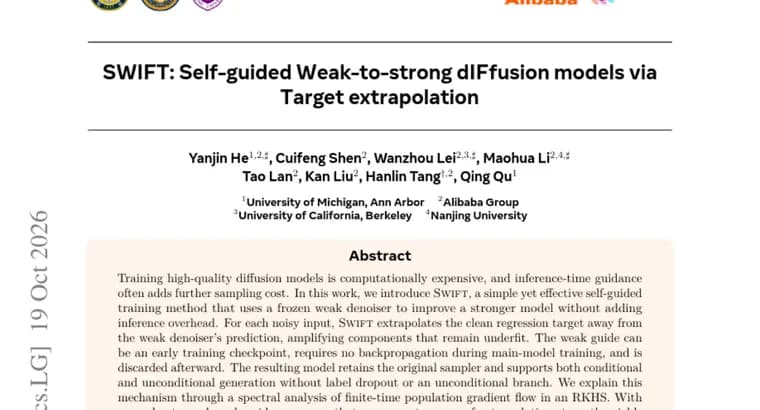
Training high-quality diffusion models is expensive, and inference-time guidance often adds more cost at sampling. A paper titled SWIFT (Self-guided Weak-to-strong dIFfusion models via Target extrapolation) proposes a way to improve a model during training so that nothing extra is needed at inference.
The method, called Swift, is described as a simple self-guided training approach. It uses a frozen weak denoiser to improve a stronger model. For each noisy input, Swift extrapolates the clean regression target away from the weak denoiser's prediction. The idea is to amplify the components of the target that the model still underfits.
The weak guide can be an early training checkpoint of the same model. It requires no backpropagation during main-model training, and it is discarded once training is done. The resulting model keeps the original sampler. It supports both conditional and unconditional generation without label dropout or a separate unconditional branch.
The authors also give a theoretical account. They explain the mechanism through a spectral analysis of finite-time population gradient flow in an RKHS. With an early-stopped weak guide, they prove that a nonempty range of extrapolation strengths yields strictly lower posterior-mean error than matched standard training, even though the regression target is shifted away from the posterior mean.
On the empirical side, experiments on CIFAR-10 and ImageNet-256 show improvements across model scales and representations. In one ImageNet-256 configuration, Swift surpasses the baseline's best FID using roughly half the total training compute, counting guide preparation and training overhead. On RAEv2, it reaches FID 1.15 without inference-time guidance and 0.99 with guidance. The authors conclude that target extrapolation is an effective route to weak-to-strong diffusion training with efficient single-model inference.
Key facts
- Swift extrapolates the clean regression target away from a frozen weak denoiser's prediction, amplifying components the stronger model still underfits.
- The weak guide can be an early training checkpoint, needs no backpropagation during main-model training, and is discarded afterward, so inference cost does not change.
- The trained model keeps the original sampler and handles conditional and unconditional generation without label dropout or an unconditional branch.
- In one ImageNet-256 configuration, Swift beats the baseline's best FID with roughly half the total training compute, including guide preparation and training overhead.
- On RAEv2 the paper reports FID 1.15 without inference-time guidance and 0.99 with guidance.
Why it matters
Diffusion models are costly to train, and guidance techniques that raise quality usually make every sample more expensive to produce. Swift moves the extra work into training instead: the final model is a single network with the original sampler, so the quality gain does not carry a sampling-time bill. The reported compute saving, roughly half the total training compute to pass the baseline's best FID in one ImageNet-256 configuration, counts the cost of preparing the guide.
Who it affects
Researchers and engineers who train image diffusion models, especially those working on CIFAR-10 and ImageNet-256 style benchmarks or on RAEv2 representations. Teams that currently rely on guidance at sampling time, or that need label dropout and an unconditional branch to support both conditional and unconditional generation, are the ones the method speaks to directly.
How to use it
Conceptually, the recipe is: keep a frozen weak denoiser, such as an early checkpoint of your own model; for each noisy input, shift the clean regression target away from that weak model's prediction; train the stronger model on the shifted target; then discard the guide. No backpropagation through the guide is needed during main-model training. The abstract mentions the extrapolation strength as the key knob but gives no recommended values. No code or model release is mentioned.
How solid is it
The source is the paper abstract, so the claims are the authors' own. There is a theoretical result: with an early-stopped weak guide, a nonempty range of extrapolation strengths gives strictly lower posterior-mean error than matched standard training. The empirical claims cover CIFAR-10 and ImageNet-256 across model scales and representations. The headline numbers are FID 1.15 without guidance and 0.99 with guidance on RAEv2, and roughly half the training compute in one ImageNet-256 configuration.
Risks and caveats
The baseline's FID values and the specific model sizes and configurations are not stated, and the ImageNet-256 configuration behind the half-compute result is not specified. No comparison of the RAEv2 FID figures to other published models is given. The theory is stated for an early-stopped weak guide in a spectral, RKHS setting, and how well it carries over to large practical models is not addressed in the abstract. The method has to be judged against the full paper.
“For each noisy input, Swift extrapolates the clean regression target away from the weak denoiser's prediction, amplifying components that remain underfit.”
— Swift paper abstract