TCFM tailors training per task, sets new SOTA on Indic embedding benchmark
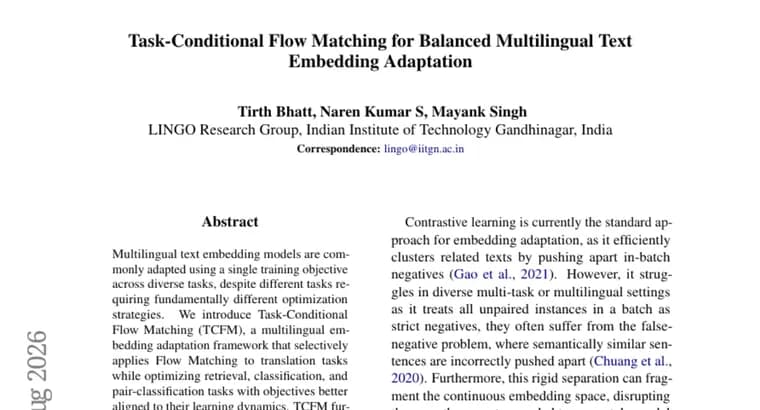
Researchers introduced Task-Conditional Flow Matching (TCFM), a framework for adapting multilingual text embedding models. The starting problem: these models are usually adapted with a single training objective applied across every task, even though different tasks (translation, retrieval, classification, pair-classification) need fundamentally different optimization strategies. TCFM breaks with that one-size-fits-all approach. It applies Flow Matching only to translation tasks, while retrieval, classification, and pair-classification tasks are optimized with objectives the authors describe as better aligned to their own learning dynamics. On top of this task-conditional split, TCFM adds teacher-guided representation preservation and a three-stage training curriculum, which together are meant to keep the adaptation process stable. The authors evaluated TCFM on the Indic Massive Text Embedding Benchmark and report that it establishes a new state of the art there, improving embedding quality consistently across a diverse set of multilingual tasks and generalizing across different embedding model families. The abstract does not give the specific benchmark scores or name which embedding model families or prior methods were used as comparison points. The authors state they will publicly release the codebase and datasets once the paper is accepted.
Key facts
- TCFM applies Flow Matching only to translation tasks in multilingual embedding adaptation
- Retrieval, classification, and pair-classification tasks instead get objectives aligned to their own learning dynamics
- The method adds teacher-guided representation preservation plus a three-stage training curriculum for stable adaptation
- TCFM sets a new state of the art on the Indic Massive Text Embedding Benchmark and generalizes across embedding model families
- Codebase and datasets are planned for public release once the paper is accepted, with no date given
Why it matters
Multilingual embedding models are typically fine-tuned with one training objective stretched across every task they need to handle, from translation to retrieval to classification, even though those tasks call for different optimization strategies. TCFM's premise is that matching the training objective to the task, rather than forcing a single objective to cover all of them, produces better embeddings. That is a training-methodology change, not a new model architecture.
Who it affects
The paper targets researchers and teams building or adapting multilingual text embedding models, with a specific focus on Indic languages, since the evaluation benchmark used is the Indic Massive Text Embedding Benchmark. Anyone working on multilingual retrieval, classification, or translation-heavy embedding pipelines is the intended audience.
How to use it
There is nothing to use yet. The authors say they will publicly release the codebase and datasets, but only once the paper is accepted, and no release date is given beyond that condition.
How solid is it
The result reported is a new state of the art on the Indic Massive Text Embedding Benchmark, with the authors also claiming the improvement holds across a diverse set of multilingual tasks and generalizes across embedding model families. The abstract does not include the actual benchmark scores, the size of the improvement, or the names of the baseline methods or model families compared against, so the strength of the claim cannot be independently checked from the text alone.
Risks and caveats
No author names, institutional affiliations, or publication venue appear in the abstract text. No numeric results are given beyond the claim of a new state of the art. The public release of code and data is conditional on the paper's acceptance, with no committed date, so it may not materialize soon or at all.