Test-time harnesses nearly double weak AI models' performance
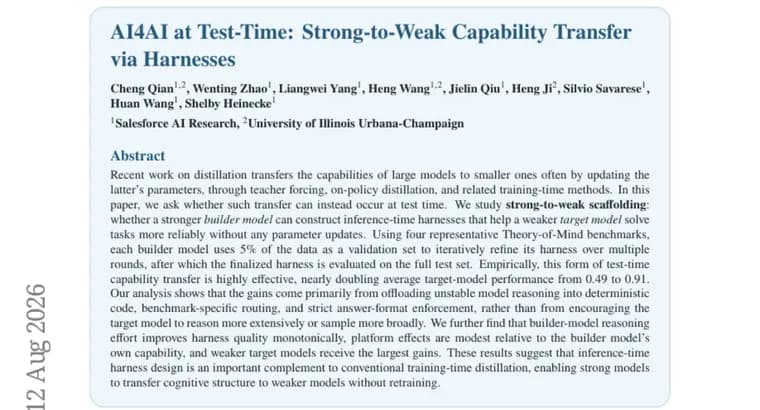
Capability transfer from a strong AI model to a weaker one is normally done through training-time distillation: teacher forcing, on-policy distillation, and related methods that update the weaker model's own parameters. A new paper asks whether the same kind of transfer can instead happen at test time, with the weaker model's weights left untouched.
The setup: a stronger "builder" model constructs an inference-time harness, the deterministic scaffolding and routing logic that wraps around a weaker "target" model, to help that target model solve a given task. Each builder model uses 5% of the data as a validation set and iteratively refines its harness over several rounds; the finished harness is then evaluated on the full test set. The method is tested on four Theory-of-Mind benchmarks; the source text does not name the specific benchmarks, or the builder and target models used.
The result: average target-model performance nearly doubled, rising from 0.49 to 0.91. The paper's analysis attributes the gains primarily to offloading unstable model reasoning into deterministic code, routing that is specific to each benchmark, and strict enforcement of answer format, rather than to getting the target model to reason more extensively or sample more broadly.
Three further findings round out the picture: builder-model reasoning effort improves harness quality monotonically; platform effects are modest relative to the builder model's own capability; and weaker target models receive the largest gains from the technique. The authors frame inference-time harness design as an important complement to conventional training-time distillation, a way for strong models to pass on cognitive structure to weaker ones without any retraining.
Key facts
- A stronger "builder" model can construct test-time inference harnesses, deterministic code, benchmark-specific routing, and strict answer-format rules, that boost a weaker "target" model's performance with no parameter updates.
- Across four Theory-of-Mind benchmarks, this test-time transfer nearly doubled average target-model performance, from 0.49 to 0.91.
- The gains come mainly from offloading unstable reasoning into deterministic code and enforcing benchmark-specific routing and answer formats, not from making the target model reason more or sample more broadly.
- Builder-model reasoning effort improves harness quality monotonically, platform effects are modest relative to the builder's own capability, and weaker target models see the largest gains.
- The authors present inference-time harness design as a complement to training-time distillation, a way to transfer cognitive structure between models without retraining.
Why it matters
Capability transfer from strong to weak models has mostly meant training-time distillation, updating the weaker model's parameters through teacher forcing or on-policy distillation. This paper tests a different route: transferring capability at test time, with no parameter updates at all, by having a stronger builder model design the harness a weaker target model runs inside. That reframes distillation as something that can happen in the scaffolding around a fixed model rather than inside the model's weights, which matters wherever retraining is expensive, slow, or the model's weights aren't accessible to begin with.
Who it affects
Anyone running a smaller or cheaper model in production and looking to lift its reliability without a fine-tuning pipeline. It also speaks to teams building agent harnesses and evaluation scaffolds: the study suggests that how a task gets routed, formatted, and constrained can matter as much as which model executes it.
How to use it
This is a research method, not a released tool. A stronger builder model iteratively refines an inference-time harness for a target task, using 5% of the data as a validation set over multiple rounds, then runs the finished harness on the full test set. The source does not name the builder or target models, the four benchmarks, or any code release, so there is nothing concrete to plug in yet; the paper serves as a proof of concept for the approach rather than a ready recipe.
How solid is it
The result is a controlled, quantified before-and-after comparison: average target-model performance across four Theory-of-Mind benchmarks rising from 0.49 to 0.91, paired with an explanation of where the gains come from, deterministic code and formatting rather than longer reasoning. The source text does not name the builder or target models, the specific benchmarks, or a publication venue, which limits how far the numbers can be checked or generalized beyond what is stated here.
Risks and caveats
The gains are demonstrated specifically on Theory-of-Mind benchmarks; nothing in the source shows the technique generalizing to other task types. The findings themselves point to a limit: weaker target models see the largest benefit and platform effects are modest next to the builder model's own capability, meaning the payoff is tied closely to which builder model is doing the harness-building.