ThinkWorld trains robot VLA models on action-free human video
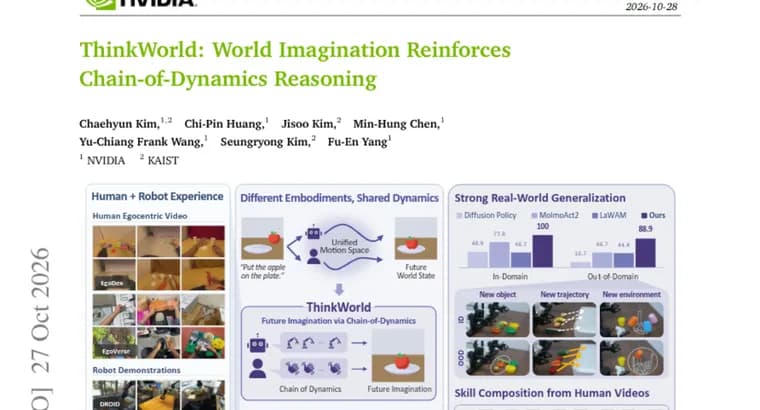
The paper starts from a known limit. Vision-Language-Action (VLA) models have made substantial progress in robotic manipulation, but the authors say their generalization remains constrained by the diversity and coverage of action-labeled robot demonstrations. Human videos offer much broader behavioral and environmental experience. Learning from them, however, faces what the authors call a fundamental trade-off between scalable data and explicit action grounding: the videos are plentiful, but they do not come with robot actions attached.
To get around this, the authors introduce ThinkWorld, a VLA learning framework that grounds action reasoning in world dynamics and strengthens it through reinforcement learning with world imagination. ThinkWorld represents each action thought as a Chain-of-Dynamics (CoD). A CoD is a sequence of discrete motion tokens that captures the intermediate dynamics connecting the current world to a future state. The authors say it serves as a common action representation across embodiments.
Training runs in two steps. First, CoD is initialized with action-labeled demonstrations. Then the model predicts the future induced by each CoD and reinforces those CoDs whose predictions better match the observed outcome. Because the reward comes from comparing predicted and observed outcomes, videos without action annotations can provide direct supervision from observed state transitions. In the authors' words, this lets human and robot experience refine the same reasoning space.
The abstract reports that experiments in simulation and on real robots demonstrate effective human-to-robot transfer and strong generalization to unseen tasks and environments. No numbers, benchmarks or comparisons are given in the abstract.
Key facts
- ThinkWorld is a VLA learning framework that grounds action reasoning in world dynamics and strengthens it with reinforcement learning using world imagination.
- Each action thought is a Chain-of-Dynamics (CoD): a sequence of discrete motion tokens linking the current world to a future state, meant as a common action representation across embodiments.
- Training first initializes CoD with action-labeled demonstrations, then reinforces the CoDs whose predicted futures better match the observed outcome.
- This lets videos without action annotations supply direct supervision from observed state transitions, so human and robot experience refine the same reasoning space.
- The abstract reports effective human-to-robot transfer and strong generalization to unseen tasks and environments, in simulation and on real robots.
Why it matters
Robot VLA models are limited by how many action-labeled demonstrations exist and how varied they are. Human video is far more abundant but carries no robot actions. ThinkWorld's idea is to judge an action thought by whether the future it predicts matches what actually happened, which removes the need for action labels in the later stage of training. If that holds up, ordinary video becomes usable training signal for robot policies.
Who it affects
Researchers working on VLA models, robotic manipulation and learning from human video are the direct audience. The paper's framing, a shared reasoning space for human and robot experience across embodiments, is aimed at anyone trying to transfer behavior from people to robots.
How to use it
The abstract does not point to code or weights, so there is nothing to run yet. The practical takeaway is the recipe: initialize a motion-token representation (CoD) on action-labeled demonstrations, then reinforce the CoDs whose predicted futures match observed outcomes, which allows action-free video to be added.
How solid is it
This is a preprint listed on Hugging Face Papers, and the account here rests on the abstract alone. The headline claims, effective human-to-robot transfer and strong generalization to unseen tasks and environments, are stated by the authors in simulation and on real robots. The abstract gives no benchmark names, success rates or baselines, so the size of the gains cannot be judged from it.
Risks and caveats
The results are the authors' own claims and are not quantified in the abstract. It does not say which robots or simulators were used, or which reinforcement learning algorithm. Model size, training data volume and compute are also not stated. Treat the generalization claims as unverified until the full paper's experiments are checked.