TreeOPSD trains agents without a critic and beats GRPO by 4.97 points on one test
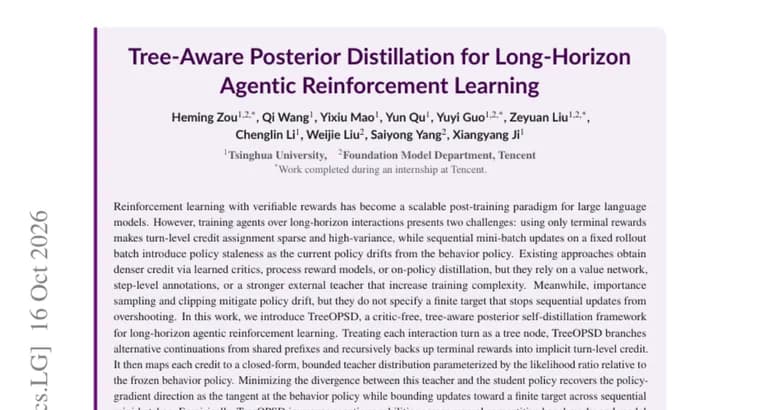
A paper on Hugging Face introduces TreeOPSD, a critic-free, tree-aware posterior self-distillation framework for reinforcement learning on long-horizon agent tasks.
The starting point is that reinforcement learning with verifiable rewards has become a scalable way to post-train large language models. Agents that act over many turns hit two problems. First, if only the final (terminal) reward is available, credit for individual turns is sparse and high-variance. Second, when a fixed batch of rollouts is used for several sequential mini-batch updates, the current policy drifts away from the behavior policy that produced the data, which the authors call policy staleness.
The paper says existing fixes carry costs. Denser credit can come from learned critics, process reward models or on-policy distillation, but these need a value network, step-level annotations or a stronger external teacher, all of which add training complexity. Importance sampling and clipping reduce policy drift, but they do not define a finite target that stops sequential updates from overshooting.
TreeOPSD works as follows. Each interaction turn is treated as a node in a tree. The method branches alternative continuations from shared prefixes and recursively backs up the terminal rewards into implicit turn-level credit. It then maps each credit to a closed-form, bounded teacher distribution, parameterized by the likelihood ratio relative to the frozen behavior policy. Training minimizes the divergence between this teacher and the student policy. According to the authors, this recovers the policy-gradient direction as the tangent at the behavior policy, while bounding updates toward a finite target across sequential mini-batches.
On results, the abstract says TreeOPSD improves agentic capabilities across several competitive benchmarks and model scales, especially for long-horizon tasks. The one concrete figure given: on the Deep Research setting, it raises the average accuracy of Qwen3-30B-A3B-Thinking-2507 by 4.97 points over GRPO.
Key facts
- TreeOPSD is a critic-free, tree-aware posterior self-distillation framework for long-horizon agentic reinforcement learning.
- Each interaction turn is a tree node; alternative continuations branch from shared prefixes and terminal rewards are backed up recursively into implicit turn-level credit.
- Credits are mapped to a closed-form, bounded teacher distribution based on the likelihood ratio to the frozen behavior policy, giving updates a finite target across sequential mini-batches.
- It needs no value network, step-level annotations or stronger external teacher, which the authors say existing denser-credit methods require.
- Reported example: average accuracy of Qwen3-30B-A3B-Thinking-2507 rises by 4.97 points over GRPO on the Deep Research setting.
Why it matters
Training agents over many turns with only a final reward is hard: it is unclear which turn deserved the credit, and repeated updates on the same rollouts push the policy away from the data. TreeOPSD tries to address both at once without the extra machinery (a critic, step-level labels or a stronger teacher) that the paper says other methods depend on. The authors also frame its bounded teacher as a fix for the overshooting that importance sampling and clipping leave open.
Who it affects
Mainly researchers and engineers who post-train language-model agents with reinforcement learning on long, multi-turn tasks such as deep research. Teams that currently rely on GRPO, learned critics or process reward models are the natural audience for the comparison.
How to use it
The abstract describes the method but does not mention a code or model release, so there is nothing to download from the source text. For a practitioner, the recipe is to sample alternative continuations from shared prefixes, propagate terminal rewards back through the tree to get per-turn credit, build the bounded teacher from the likelihood ratio against the frozen behavior policy, and minimize the divergence between teacher and student.
How solid is it
This is a preprint abstract, and the claims are the authors' own. The only number is a single gain of 4.97 points over GRPO for Qwen3-30B-A3B-Thinking-2507 on the Deep Research setting. The abstract does not name the other benchmarks or the model scales tested, and it gives no GRPO baseline score or absolute TreeOPSD score. It also does not say whether 4.97 points is a percentage-point difference in accuracy or on another scale. No author names or institutions are given.
Risks and caveats
The headline result is one example, not a full results table, so the size of the gain elsewhere is unknown from this text. No gains are reported for any model other than Qwen3-30B-A3B-Thinking-2507. No compute cost, training time or code release is mentioned, so the practical overhead of branching extra continuations cannot be judged. The theoretical statements about recovering the policy-gradient direction are the authors' claims as summarized in the abstract.
“we introduce TreeOPSD, a critic-free, tree-aware posterior self-distillation framework for long-horizon agentic reinforcement learning”
— Paper abstract