Trump administration casts AI critics as Chinese-backed foreign agents
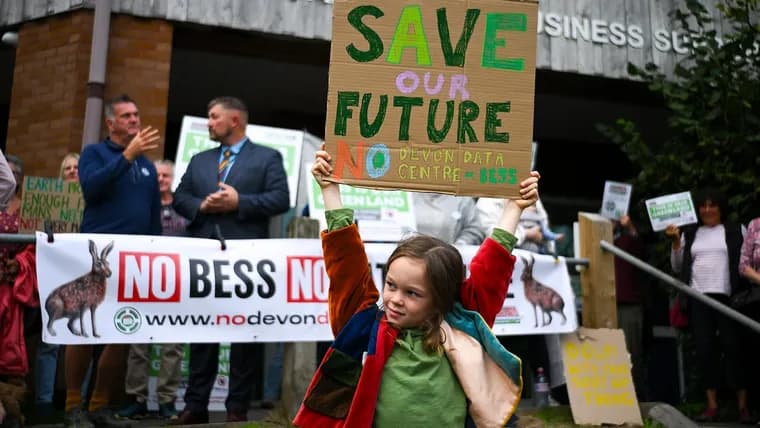
The Justice Department has told "citizens and noncitizens" that anyone furthering the goals of a foreign power in public activity, including public demonstrations, must formally notify the government or face arrest and prosecution. The warning does not name any specific protest or person, but it follows a spate of Trump social media posts tying opposition to AI and data centers to China. On September 14, Trump wrote: "There is a SICK conspiracy going on against AI and Data Centers, and the only one that is happy about it is China. Conspiracy Theorists, Treasonists, Traitors, and Leakers, BEWARE!" He also called people who say AI could harm the world or that data centers hurt neighborhoods "Revolutionaries for a Bad and Evil Cause," and warned that the administration would use "our already existing Criminal and Civil Justice System" against "BAD" actors in the AI space.
Congressional Republicans have pursued the same line separately from the White House. In June, Senate Intelligence Committee chairman Tom Cotton asked then-acting Attorney General Todd Blanche to investigate "foreign influence efforts targeting the buildout of American AI infrastructure," citing what he called a network of foreign actors "led by the Chinese Communist Party" manipulating U.S. opinion on data centers. Cotton's central example was Neville Roy Singham, a Shanghai-based American tech mogul whose network of left-leaning U.S. nonprofits, Cotton claimed, has produced anti-AI-infrastructure content with the Chinese government as its "ultimate paymaster." Cotton complained that no group in this network has been charged under the Foreign Agents Registration Act and asked the DOJ to open a full investigation. Days earlier, House Energy and Commerce Committee Republicans led by Chairman Brett Guthrie had asked FBI Director Kash Patel and the White House for a briefing on alleged foreign influence campaigns against data centers, calling any such effort a matter the administration must take "with a great deal of seriousness."
Figures in Trump's orbit made the same argument before he did. David Sacks, who served as Trump's AI czar before becoming co-chair of the President's Council of Advisors on Science and Technology, said after a Chinese model topped a coding leaderboard in July that "politicians and bureaucrats are banning new data centers" and that this is "how you lose the AI race," later warning on Fox News against moves that would "hand the whole ball game to China." Kevin O'Leary, the "Shark Tank" investor behind a planned $100 billion data center in Utah who met Trump at Mar-a-Lago in January 2025, claimed this spring that hundreds of millions of dollars from China were funding protesters against data centers like his. One target, the Alliance for a Better Utah, replied that "the only foreign interest in this data center is Kevin from Canada." On June 25, O'Leary admitted on X that he had "no evidence" for the claim, and Fox News aired apologies; two of the groups he named have since sued O'Leary and Fox for defamation. A spokesperson for the pro-AI Innovation Council separately told the Daily Caller that the anti-data-center campaign was "a manufactured op by dark anti-American forces and foreign governments."
Polling cited in the piece undercuts the foreign-conspiracy framing. A March Gallup poll found 71 percent of Americans oppose building an AI data center in their area, more than the 53 percent who oppose a local nuclear plant; 48 percent are strongly opposed, and opposition includes 63 percent of Republicans. A February Pew survey of more than 5,000 adults found 40 percent think AI will hurt society over the next 20 years versus 16 percent who think it will help, 63 percent think AI is advancing too quickly, 71 percent think it will make personal information less secure, and 67 percent have little or no confidence in the federal government to regulate it; separate Pew research found 61 percent want more control over how AI is used in their lives.
The piece also links this to an earlier case: in June the Justice Department intervened in an NAACP lawsuit against Elon Musk's xAI over gas turbines run without air permits at a Tennessee data center, asking a judge to dismiss the suit on the grounds it "threatens American national, economic, and energy security." The Pentagon's chief digital and artificial intelligence officer, Cameron Stanley, swore in a court declaration that the xAI system Grok was "a matter of paramount national security." The article ends by saying a follow-up piece will describe a new government entity, modeled on the military, that will formalize this approach.
Key facts
- The Justice Department warned that anyone furthering a foreign power's goals through public activity, including demonstrations, must notify the government or face arrest and prosecution.
- Trump posted repeatedly in September calling AI and data-center opposition a 'SICK conspiracy' tied to China and warned critics would face the 'Criminal and Civil Justice System'.
- Sen. Tom Cotton and Rep. Brett Guthrie separately asked the DOJ and FBI to investigate alleged foreign influence networks behind anti-data-center activism, citing tech mogul Neville Roy Singham.
- A March Gallup poll found 71 percent of Americans oppose a local AI data center, versus 53 percent for a local nuclear plant, with 63 percent of Republicans opposed.
- Investor Kevin O'Leary admitted on X he had 'no evidence' that China was funding protesters against his planned $100 billion Utah data center; two groups he named are now suing him and Fox News for defamation.
Why it matters
The Justice Department's warning and Trump's posts turn ordinary opposition to AI and data centers into a potential national security offense, with officials threatening criminal liability for public demonstrations and pushing Foreign Agents Registration Act investigations against domestic critics rather than engaging with their arguments.
Who it affects
Americans who protest or publicly criticize AI infrastructure, advocacy groups like the Alliance for a Better Utah, nonprofits linked to Neville Roy Singham, and more broadly the large share of the public that polling shows already opposes local data centers, including a majority of Republicans.
How to use it
There is no product here to use; the practical takeaway is that the DOJ's guidance applies to public activity, including demonstrations, and groups or individuals engaged in visible advocacy against AI infrastructure should be aware that officials have signaled they may treat such activity as requiring foreign-agent registration.
How solid is it
The account draws on Trump's own social media posts, a letter from Sen. Tom Cotton, a statement from Rep. Brett Guthrie, on-record remarks from David Sacks, and Kevin O'Leary's own admission of having 'no evidence,' plus named Gallup and Pew polling figures; the source itself gives inconsistent dates and party-state details for some of these items without resolving them, and the byline credits only an editor, William M. Arkin, with no author named in the body.
Risks and caveats
No specific protest, demonstration, or individual has been named as a target of the DOJ warning, and the source reports no arrests or charges resulting from it; the central 'foreign funding' claims rest largely on assertions from Cotton, O'Leary, and industry spokespeople rather than public evidence, and O'Leary has already conceded he had none, a claim now the subject of defamation lawsuits against him and Fox News.
“There is a SICK conspiracy going on against AI and Data Centers, and the only one that is happy about it is China. Conspiracy Theorists, Treasonists, Traitors, and Leakers, BEWARE!”
— Donald Trump, in a September 14 social media post