TurboVLA drops the LLM step to run robot control at 32Hz
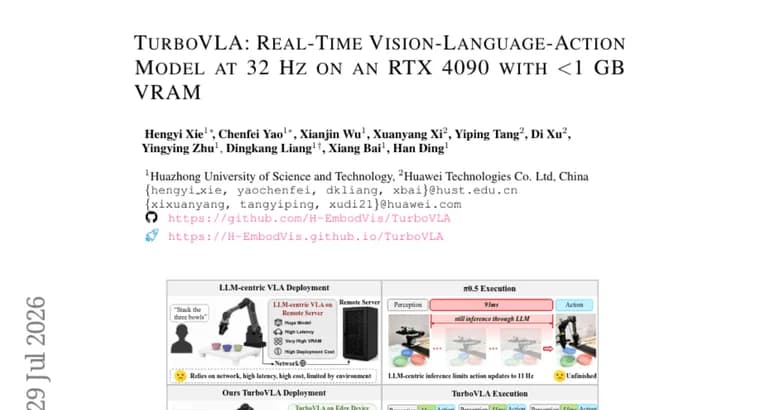
Most vision-language-action (VLA) models used to control robots follow a pipeline that routes camera images through a large language model before converting the result into motor commands: vision to language to action. That routing is accurate but expensive, adding computation and memory cost every time the policy runs. A new paper introduces TurboVLA, which reformulates this as a direct vision-plus-language to action mapping instead. TurboVLA encodes visual observations and language instructions separately, lets the two exchange information through a lightweight bidirectional vision-language interaction step, and then predicts continuous chunks of robot action with a compact decoder, never routing through a large language model at all. On the LIBERO robot-manipulation benchmark, TurboVLA reaches 97.7% average success using only 0.2 billion parameters, with 31.2 millisecond inference latency and 0.9 GB of VRAM on a consumer-grade RTX 4090, a pace of about 32 control decisions per second. The paper reports this matches or beats substantially larger VLA policies built on the LLM-centric design. The authors present TurboVLA as an alternative paradigm for connecting vision, language, and action in robotic manipulation, and have released code on GitHub under H-EmbodVis/TurboVLA.
Key facts
- TurboVLA replaces the standard vision-to-language-to-action pipeline with a direct vision-plus-language to action mapping, cutting out the large language model as the central interface.
- It reaches 97.7% average success on the LIBERO benchmark with only 0.2 billion parameters.
- Inference runs at 31.2 ms per step (about 32 Hz) using 0.9 GB of VRAM on a consumer RTX 4090.
- The paper reports it matches or outperforms substantially larger, LLM-centric VLA policies.
- Code is public on GitHub at H-EmbodVis/TurboVLA.
Why it matters
Robot policies that route perception through a large language model pay for that accuracy in latency and memory at every single action step, which is a real constraint for real-time manipulation. TurboVLA's result suggests a much smaller, LLM-free architecture can hit comparable or better task success while running an order of magnitude leaner, which reframes what the field treats as a necessary cost for competent robot control.
Who it affects
Robotics researchers and engineers building manipulation policies, especially teams trying to deploy VLA models on constrained onboard compute rather than a data-center GPU, since 0.9 GB of VRAM and consumer-card speeds change what hardware a deployment needs.
How to use it
The authors have published code at github.com/H-EmbodVis/TurboVLA, and the model runs inference at 31.2 ms per step on a single RTX 4090, meaning it can be evaluated or built on without specialized inference infrastructure. No pricing or licensing terms are mentioned in the source.
How solid is it
The headline numbers, 97.7% average success, 0.2B parameters, 31.2 ms latency, 0.9 GB VRAM, come from the LIBERO simulation benchmark, a standard but simulated testbed for VLA policies rather than results across varied real-world robots and environments. The paper reports the comparison against larger LLM-centric policies but the source text does not name which specific baselines were matched or exceeded.
Risks and caveats
LIBERO is a widely used benchmark, but strong simulation results do not automatically transfer to physical robots operating in unstructured real-world settings. The source text does not describe testing on real hardware, generalization to tasks or environments outside LIBERO, or any failure modes the smaller architecture might introduce.