VA-Judger judges AI video-audio generation like humans do
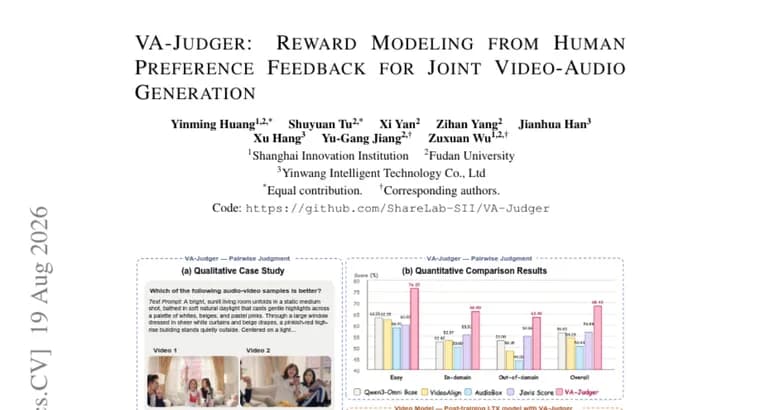
A group of researchers has proposed VA-Judger, a reward model built specifically for post-training AI systems that generate video and audio together. The problem they set out to fix: when reinforcement learning is used to improve these joint generation models, the reward signal is usually built by combining separate metrics for audio quality, visual fidelity, and audio-video synchronization. The authors argue these metrics evaluate each perceptual dimension on its own and miss the overall semantic and temporal coherence among the text prompt, the video, and the audio that actually shapes what a human viewer prefers. Optimizing a model against those split metrics, they write, encourages reward hacking: the model learns to score well on the individual metrics while producing output that looks incoherent or unfaithful to a person watching it. To address this, the team first built VAPref-10K, a human-preference dataset of 9K prompts and 10.3K fine-grained paired comparisons drawn from open-source generation models. They also introduce VA-Judger-Bench, a benchmark that tests both in-domain and out-of-domain model comparisons to check whether a reward model genuinely tracks human preference rather than just gaming known metrics. VA-Judger itself is a chain-of-thought omni-reward model trained in three stages: it first learns from comparison pairs with clear quality gaps to build structured output and coarse preference judgment; it then distills preference explanations for harder, near-quality comparisons through rejection sampling checked against human annotations; and finally it runs dimension-wise reinforcement learning that breaks human feedback into individual quality dimensions, giving denser reward signals than a single binary preference label would. In experiments, the authors report that VA-Judger outperforms metric-based baselines at predicting human preferences on both in-domain and out-of-domain evaluations, and that using its human-aligned rewards to post-train an audio-video generation model produces significant improvements in generation quality. The abstract does not attach specific accuracy or win-rate numbers to these gains, name the open-source models used to build the dataset, or give author names, institutions, or a publication venue.
Key facts
- VA-Judger is a chain-of-thought reward model built to rate joint video-audio AI generations by overall coherence rather than by combining separate audio, visual, and sync metrics.
- The authors built VAPref-10K, a human-preference dataset of 9K prompts and 10.3K fine-grained paired comparisons sourced from open-source generation models.
- A new benchmark, VA-Judger-Bench, checks reward models against both in-domain and out-of-domain comparisons to test genuine alignment with human preference rather than metric gaming.
- Training runs in three stages: coarse discrimination on clear-quality-gap pairs, rejection-sampling distillation on harder near-quality pairs verified against human annotations, then dimension-wise reinforcement learning.
- The authors report VA-Judger beats metric baselines at predicting human preferences and that using it for post-training improves generation quality, though no specific figures are given for either claim.
Why it matters
Joint video-audio generation models are typically improved with reinforcement learning, and that requires a reward signal. Stitching together separate scores for audio quality, visual fidelity, and synchronization is the common approach, but the authors argue it lets models learn to win on the metrics while still producing output that looks or sounds wrong to an actual viewer, a known failure mode called reward hacking. VA-Judger targets that gap directly by training a single model to judge overall coherence the way a human would, rather than reconstructing preference from disjointed sub-scores.
Who it affects
The immediate audience is researchers and teams building or fine-tuning video-audio generation models, who need a reward signal for reinforcement learning post-training. It also matters to anyone building evaluation pipelines for generative audio-video systems, since VA-Judger-Bench is offered as a way to test whether a reward model tracks real human preference rather than just a metric it was tuned against.
How to use it
The paper describes VA-Judger as a reward model plus two accompanying resources: the VAPref-10K preference dataset and the VA-Judger-Bench evaluation benchmark. No pricing, license terms, or release details for code, weights, or data are given in the source text, so availability and terms of use are not established here.
How solid is it
The claims rest on the authors' own experiments comparing VA-Judger against metric-based baselines on both in-domain and out-of-domain evaluations, and on downstream post-training results. The source states that VA-Judger outperforms the baselines and that post-training with its rewards yields significant quality improvements, but it does not report the specific accuracy, win-rate, or percentage figures behind either claim, and no author names, institutions, or venue are given to weigh independently.
Risks and caveats
Key details needed to judge the work independently are absent from the available text: no numeric results back up the stated improvements, the open-source generation models used to build VAPref-10K are not named, and there is no publication venue or release date. The three-stage training procedure is described only qualitatively, without figures attached to any stage, so its actual contribution to the reported gains cannot be assessed from this source alone.