VHD-Play generates 3,300 RL environments that retrain Qwen3.6-35B-A3B
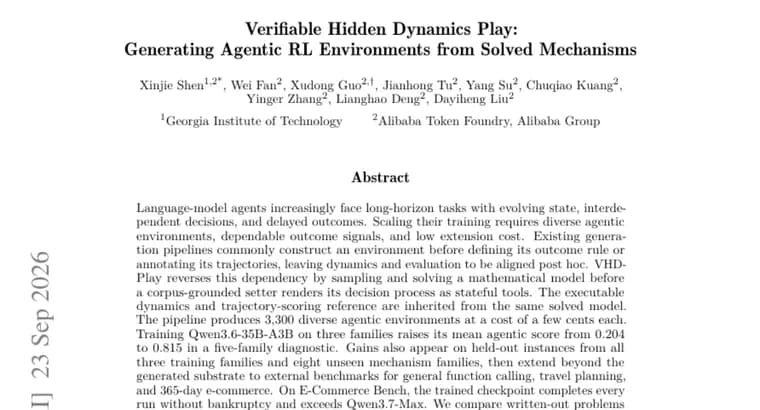
Researchers describe VHD-Play, a pipeline for generating agentic reinforcement-learning environments for language-model agents that has to handle long-horizon tasks, changing state, interdependent decisions and delayed outcomes. Most existing pipelines build an environment first and only later attach an outcome rule or annotate trajectories, so the dynamics and the scoring end up aligned after the fact. VHD-Play reverses that order: it samples and solves a mathematical model first, and only then a corpus-grounded 'setter' renders that model's decision process as stateful tools. Because the executable dynamics and the trajectory-scoring reference both come from the same solved model, they stay consistent by construction.
Using this pipeline, the authors produced 3,300 diverse agentic environments at a cost of a few cents each. They then trained the model Qwen3.6-35B-A3B on three mechanism families, which raised its mean agentic score from 0.204 to 0.815 on a five-family diagnostic. The gains carried over to held-out instances from the same three training families and to eight unseen mechanism families, and extended beyond the generated environments to external benchmarks covering general function calling, travel planning and a 365-day e-commerce simulation. On that e-commerce benchmark, the trained checkpoint completed every run without going bankrupt and beat the model Qwen3.7-Max.
To isolate what the training actually improves, the authors compared written-out versions of problems against stateful versions that either reveal or hide their parameters. The comparison showed that most of the learnable gap comes from stateful interaction itself rather than from the underlying problem-solving. The pipeline can also scale up: a frozen 35B setter model can realize larger environments, and training that keeps the model and environment scale matched retains its gains as the mechanism size and time horizon grow, which the authors read as a sign the approach could serve as an evolving training substrate.
Key facts
- VHD-Play generates agentic RL environments by solving a mathematical model first, then rendering it as stateful tools, instead of building the environment before the outcome rule
- The pipeline produced 3,300 diverse agentic environments at a cost of a few cents each
- Training Qwen3.6-35B-A3B on three mechanism families raised its mean agentic score from 0.204 to 0.815 on a five-family diagnostic, with gains extending to eight unseen mechanism families
- On the 365-day E-Commerce Bench, the trained checkpoint finished every run without bankruptcy and beat Qwen3.7-Max
- A frozen 35B setter model can realize larger environments, and scale-matched training keeps its gains as mechanism size and horizon grow
Why it matters
Training LLM agents for long, multi-step tasks needs environments that are diverse, cheap to build, and reliably scored, but most existing pipelines bolt the outcome rule onto an environment after it's built, so dynamics and evaluation can drift apart. VHD-Play flips the order, solving the underlying model first so the environment's dynamics and its scoring reference come from the same solved source, which the authors argue removes that mismatch.
Who it affects
The work targets researchers and labs building reinforcement-learning training pipelines for agentic language models, particularly those needing large numbers of varied, verifiable environments rather than a handful of hand-built ones.
How to use it
The pipeline generates environments automatically at a cost of a few cents each, producing 3,300 in the described run. A frozen 35B setter model can also be used to realize larger, more complex environments, and the authors report that scale-matched training preserves its gains as environment size and time horizon increase.
How solid is it
The findings come from the paper itself: an internal five-family diagnostic showing the agentic score rising from 0.204 to 0.815, plus transfer to held-out and unseen mechanism families and to external benchmarks including E-Commerce Bench, function calling and travel planning. The source text does not name the authors, their institutions, or a publication date, and does not spell out how the underlying mathematical models are sampled or what domains the 3,300 environments cover.
Risks and caveats
The reported gains rest on the authors' own benchmarks rather than independent replication, and the source gives no detail on the range of domains the generated environments actually span. The authors' own ablation indicates that most of the measured improvement comes from handling stateful interaction rather than from better problem-solving itself, a distinction worth keeping in mind when reading the headline score jump.
“Most of the learnable gap lies in stateful interaction rather than underlying problem solving.”
— the authors of the VHD-Play paper