VibeLifeBench benchmark finds AI agents fail at multi-week life tasks
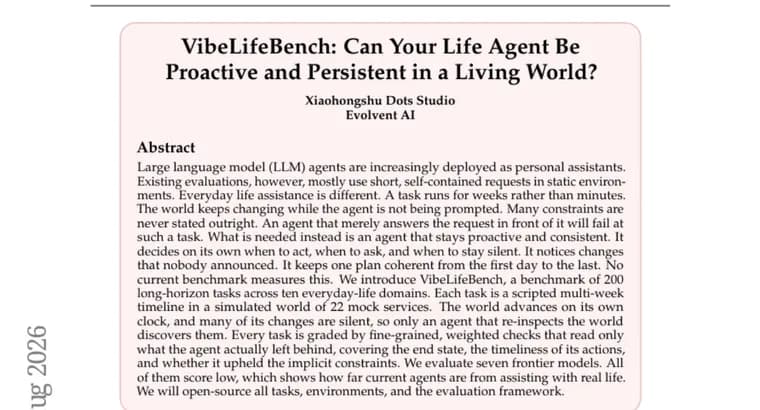
LLM agents are increasingly deployed as personal assistants, but existing evaluations mostly test short, self-contained requests in static environments. Real life is different: a task can run for weeks, the world keeps changing while nobody is prompting the agent, and many constraints are never stated outright. An agent that only answers the request in front of it fails at this kind of task. What is needed is an agent that stays proactive and consistent: one that decides on its own when to act, when to ask, and when to stay silent, notices changes nobody announced, and keeps one plan coherent from the first day to the last. No existing benchmark measured this gap.
To close it, the researchers built VibeLifeBench, a benchmark of 200 long-horizon tasks spanning ten everyday-life domains. Each task unfolds as a scripted multi-week timeline inside a simulated world of 22 mock services. That world advances on its own clock, and many of its changes are silent, so only an agent that actively re-inspects the world discovers them. Every task is graded by fine-grained, weighted checks that look only at what the agent actually left behind, covering three things: the end state it produced, how timely its actions were, and whether it upheld the constraints that were never spelled out.
The team evaluated seven frontier models on VibeLifeBench. All seven scored low, which the authors say shows how far current agents are from being able to assist with real life. The paper does not name which seven models were tested, report their individual scores, or list the ten domains and 22 services by name. The authors plan to open-source all tasks, environments, and the evaluation framework, though no release date is given.
Key facts
- VibeLifeBench is a benchmark of 200 long-horizon tasks across ten everyday-life domains, run inside a simulated world of 22 mock services.
- Each task is a scripted multi-week timeline; the simulated world advances on its own clock and many of its changes are silent, so an agent has to actively re-inspect the world to notice them.
- Every task is graded by fine-grained, weighted checks covering the end state the agent left, the timeliness of its actions, and whether it upheld constraints that were never stated outright.
- All seven evaluated frontier models scored low, which the authors say shows how far current agents are from assisting with real life.
- The authors plan to open-source all tasks, environments, and the evaluation framework, though no release date or link is given.
Why it matters
Most agent benchmarks test short, self-contained requests inside environments that stay still while the agent works. VibeLifeBench targets a different failure mode: assistance that has to persist for weeks, in a world that keeps moving on its own and rarely announces what changed. The authors argue an agent that just answers the prompt in front of it cannot handle that; it also has to decide on its own when to act, when to ask, and when to stay quiet, and hold one coherent plan from day one to the last day. They say no prior benchmark measured this.
Who it affects
Anyone building or evaluating LLM agents meant to work as ongoing personal assistants rather than one-shot chat responders, since the benchmark is built specifically to expose the gap between the two.
How to use it
The authors say they will open-source all 200 tasks, the simulated environments (22 mock services), and the grading framework, so other teams can run their own agents against the same long-horizon setup. No release date or link is given yet.
How solid is it
The setup is concrete: 200 scripted multi-week tasks across ten domains, graded by weighted checks against three explicit dimensions (end state, timeliness, implicit constraints), and tested against seven frontier models rather than a single system. The source text does not name the seven models, their individual scores, or the specific domains and services, so the claim of general difficulty cannot yet be checked model by model.
Risks and caveats
The paper does not disclose which seven models were tested, their individual scores, or the list of ten domains and 22 mock services, so the result is a headline finding without the detail needed to compare it against other agent benchmarks or to see which kinds of tasks specifically break current agents.