ViRDM drops the teacher-critic stack for few-step video diffusion
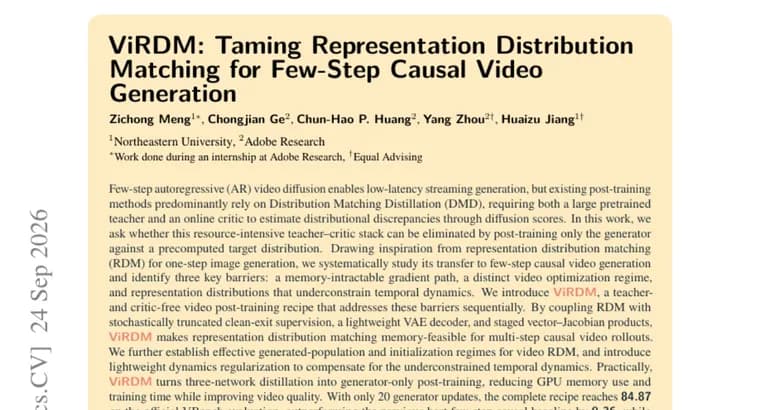
Few-step autoregressive video diffusion allows low-latency streaming video generation, but the standard way to get there, Distribution Matching Distillation (DMD), requires both a large pretrained teacher model and an online critic network to estimate distributional gaps through diffusion scores. Researchers behind a new method called ViRDM ask whether that resource-heavy teacher-critic setup can be eliminated by post-training only the generator against a precomputed target distribution.
The approach builds on representation distribution matching (RDM), a technique previously used for one-step image generation. Applying RDM to few-step causal video generation is harder: the authors identify three barriers, a memory-intractable gradient path, a distinct optimization regime for video compared to images, and representation distributions that do not sufficiently constrain temporal dynamics.
ViRDM addresses these barriers by combining RDM with stochastically truncated clean-exit supervision, a lightweight VAE decoder, and staged vector-Jacobian products, which together make representation distribution matching memory-feasible for multi-step causal video rollouts. The authors also work out effective generated-population and initialization regimes for video RDM and add a lightweight dynamics regularization term to compensate for the underconstrained temporal dynamics.
The result, according to the authors, turns three-network distillation into generator-only post-training, cutting GPU memory use and training time while improving video quality. With only 20 generator updates, the recipe reaches 84.87 on the official VBench evaluation, outperforming what they call the previous best few-step causal baseline by 0.36, while needing 16 A100 GPU-hours of training. The authors also report exploratory results suggesting the same recipe could extend to a lower causal sampling budget and to one-, two-, and four-step bidirectional video generation.
Key facts
- ViRDM replaces the standard Distribution Matching Distillation (DMD) teacher-critic stack with representation distribution matching (RDM) against a precomputed target distribution, training only the generator.
- The recipe reaches 84.87 on the official VBench evaluation with just 20 generator updates, outperforming the previous best few-step causal baseline by 0.36.
- Reaching that result takes 16 A100 GPU-hours of training.
- Three technical additions make RDM workable for video: stochastically truncated clean-exit supervision, a lightweight VAE decoder, and staged vector-Jacobian products, plus a dynamics regularization term for temporal consistency.
- Exploratory results suggest the same recipe may extend to lower causal sampling budgets and to one-, two-, and four-step bidirectional generation.
Why it matters
Compressing video diffusion models into fast, few-step generators has depended on a resource-heavy setup: a large pretrained teacher plus a separate online critic network estimating distributional gaps. ViRDM shows that setup can be replaced with generator-only training that matches representation distributions, cutting GPU memory use and training time while, according to the authors' own benchmark, also improving output quality.
Who it affects
Researchers and engineers building low-latency, streaming autoregressive or causal video diffusion systems, particularly teams currently relying on DMD-style distillation and absorbing its GPU memory and training-time costs from running a teacher and critic alongside the generator.
How to use it
This is a research method rather than a shipped product; the source gives no code or model release timeline. Teams working on few-step causal video diffusion could evaluate the ViRDM recipe, built on stochastically truncated clean-exit supervision, a lightweight VAE decoder, staged vector-Jacobian products, and dynamics regularization, as a lower-cost alternative to DMD-based post-training, working from the technical description in the paper itself.
How solid is it
The reported numbers, an 84.87 VBench score reached with 20 generator updates and 16 A100 GPU-hours, and a 0.36-point margin over what is called the previous best few-step causal baseline, come from the paper's own evaluation. The source does not name that baseline, nor does it name the authors, their institution, or a publication date, so there is no independent context beyond what the abstract states.
Risks and caveats
The extension to a lower causal sampling budget and to one-, two-, and four-step bidirectional generation is explicitly described as exploratory rather than a settled result. The 0.36-point VBench improvement and the training-cost figures should be read as claims from the paper itself, since the comparison baseline is not identified and no independent verification is available.