WeMM-Video releases open omni-modal video models, 2B to 35B-A3B
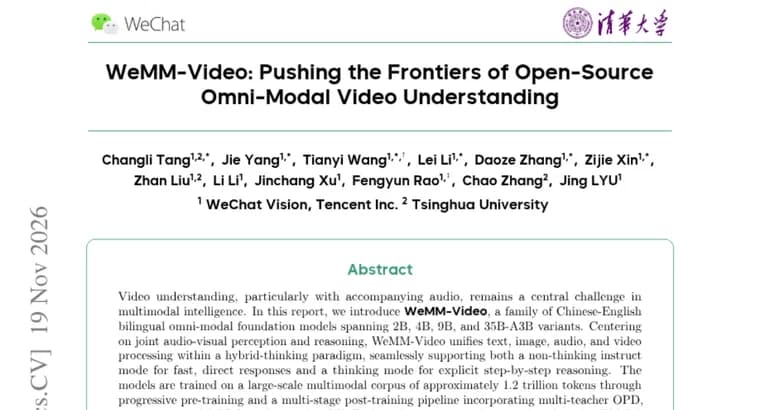
WeMM-Video is a family of Chinese-English bilingual omni-modal foundation models, introduced in a technical report. It comes in four variants: 2B, 4B, 9B and 35B-A3B. The report starts from the point that video understanding, particularly with accompanying audio, remains a central challenge in multimodal intelligence, and the models are built around joint audio-visual perception and reasoning.
The models handle text, image, audio and video in one system, using what the authors call a hybrid-thinking paradigm. A user can pick a non-thinking instruct mode for fast, direct responses, or a thinking mode that produces explicit step-by-step reasoning.
Training used a large-scale multimodal corpus of approximately 1.2 trillion tokens. It went through progressive pre-training and then a multi-stage post-training pipeline that incorporates multi-teacher OPD, anti-repetition MrDPO and specialist RL.
The authors evaluated the models across more than 120 benchmarks. They say WeMM-Video shows superior performance in omni-modal video understanding and reasoning, while staying highly competitive on general audio, silent video, image and text tasks.
Two specific claims stand out. In omni-modal video evaluations, the flagship WeMM-Video-35B-A3B establishes a new open-source state of the art. According to the authors it substantially outperforms the proprietary models Qwen3.5-Omni-Flash and Seed2.0-Mini-0428, while narrowing the gap with the strong Gemini-3.0-Flash. That wording means it does not claim to beat Gemini-3.0-Flash. Separately, the compact WeMM-Video-9B surpasses the larger open-source Qwen3-Omni-30B-A3B-Instruct.
The authors say they publicly release the WeMM-Video family together with their evaluation and reproduction pipeline, to foster further research and development in the open-source community.
Key facts
- WeMM-Video is a Chinese-English bilingual omni-modal model family with 2B, 4B, 9B and 35B-A3B variants, covering text, image, audio and video.
- It supports a fast non-thinking instruct mode and a thinking mode with explicit step-by-step reasoning.
- Training used approximately 1.2 trillion tokens, followed by multi-stage post-training with multi-teacher OPD, anti-repetition MrDPO and specialist RL.
- The authors report that the 35B-A3B sets a new open-source state of the art in omni-modal video evaluations, outperforming proprietary Qwen3.5-Omni-Flash and Seed2.0-Mini-0428 and narrowing the gap with Gemini-3.0-Flash.
- The authors say the 9B model surpasses the larger open-source Qwen3-Omni-30B-A3B-Instruct, and that the models and evaluation and reproduction pipeline are publicly released.
Why it matters
Video with sound is a hard case for multimodal models, and the report is aimed squarely at it. If the claims hold, an open-source family now leads open models on omni-modal video evaluations and gets close to Gemini-3.0-Flash. The claim that a 9B model beats the larger open-source Qwen3-Omni-30B-A3B-Instruct would also show that size is not the only lever, though that rests on the authors' own results.
Who it affects
Researchers and developers working on open-source audio-visual video understanding are the intended audience; the authors say the release is meant to foster further research and development in the open-source community. The four sizes, from 2B to 35B-A3B, give teams with different compute budgets something to try. The Chinese-English bilingual design is relevant to anyone working in those two languages.
How to use it
The authors say the WeMM-Video family is publicly released along with their evaluation and reproduction pipeline, so others can rerun the comparisons. In use, the models offer two modes: a non-thinking instruct mode for fast, direct answers and a thinking mode for explicit step-by-step reasoning. The text gives no licence, download link or repository for the release, so check the project's own pages before building on it.
How solid is it
Everything here is the authors' own account in a technical report. They evaluated across more than 120 benchmarks and release their evaluation and reproduction pipeline, which should let others check the results. But the text names no benchmarks and gives no actual scores; 'substantially outperforming' and 'narrowing the gap' are not quantified. It also names no authors, institution or company behind WeMM-Video.
Risks and caveats
The state-of-the-art claim is scoped to open-source models on omni-modal video evaluations, and the flagship is described as narrowing the gap with Gemini-3.0-Flash, not beating it. The comparison against proprietary Qwen3.5-Omni-Flash and Seed2.0-Mini-0428 is also self-reported. The text does not say that the 35B-A3B is a mixture-of-experts model or how many parameters are active, and it does not expand OPD, MrDPO or RL. No training compute, hardware or cost is mentioned.
“Our flagship WeMM-Video-35B-A3B establishes a new open-source state of the art, substantially outperforming proprietary models such as Qwen3.5-Omni-Flash and Seed2.0-Mini-0428 while narrowing the gap with the strong Gemini-3.0-Flash.”
— WeMM-Video technical report