When2Think cuts reasoning tokens 28% by skipping thought on easy problems
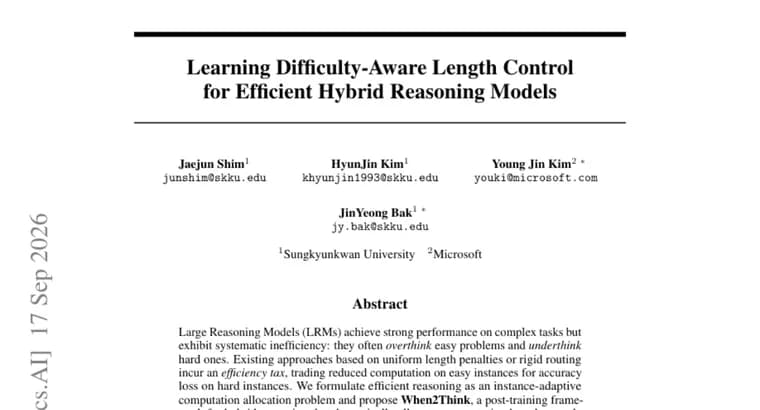
Large reasoning models (LRMs) tend to waste computation: they overthink problems that a direct answer would solve, and underthink problems that need extended reasoning. Prior fixes, uniform length penalties or rigid routing between short and long answers, cut computation on easy cases but pay for it with accuracy loss on hard ones, an outcome the paper calls an efficiency tax. When2Think reframes efficient reasoning as an instance-adaptive computation allocation problem: the model decides, case by case, whether to answer directly (System 1, or NoThink) or reason at length (System 2, or Think).
The core mechanism is Instance-level Difficulty-Aware Control (IDAC), a reward-shaping method that uses pre-computed reference statistics on accuracy and token usage to regulate how deeply the model reasons on a given instance. IDAC is combined with verifier-based rewards and batch-wise standardized advantages, which together allow stable, critic-free optimization: the training does not need a learned reward model or live queries to a reference model. On the AIME24 math benchmark, When2Think raises Pass@3 by 10.0% while reducing token usage by 27.9% relative to the base model. On AIME25, it reaches 40.0% Pass@3, ahead of both compression-based and routing-only baselines tested in the paper.
Key facts
- When2Think is a post-training framework that allocates reasoning depth per problem instance instead of applying a uniform length penalty or a rigid router
- Its core component, IDAC, shapes rewards using pre-computed reference statistics on accuracy and token usage rather than a learned reward model
- Combined with verifier-based rewards and batch-wise standardized advantages, the method trains critic-free, without online queries to a reference model
- On AIME24, Pass@3 increases by 10.0% while token usage drops by 27.9% relative to the base model
- On AIME25, When2Think reaches 40.0% Pass@3, outperforming compression and routing-only baselines
Why it matters
Reasoning models currently spend roughly the same amount of computation regardless of how hard a problem actually is, which means they burn tokens on questions a direct answer would solve and cut reasoning short on ones that need it. The paper argues that fixed-budget fixes such as uniform length penalties or rigid routing between short and long answers cannot escape this: cutting computation on easy cases pays for itself with accuracy loss on hard ones, an efficiency tax the authors set out to remove by making the allocation decision itself instance-adaptive.
Who it affects
The paper targets teams building and training hybrid reasoning models, where inference cost scales directly with how much a model reasons per query. A framework that recovers accuracy while cutting token usage changes that cost curve without requiring a separate router or a hand-tuned length budget, which matters wherever reasoning depth is currently a blunt, uniform setting rather than adapted to the question.
How to use it
When2Think is a post-training procedure, not an inference-time toggle: it is applied to an already-trained hybrid reasoning model. Its IDAC component shapes reinforcement-learning rewards using pre-computed reference statistics (accuracy and token usage) for each problem, and pairs this with verifier-based rewards and batch-wise standardized advantages so that training stays critic-free, without a learned reward model or live reference-model queries. The result is a model that learns, per instance, whether to answer directly or reason at length.
How solid is it
The reported gains come from two math competition benchmarks, AIME24 and AIME25, where When2Think is compared against a base model and against compression-based and routing-only baselines. The source text gives no model size, no identity of the base model, no author names or institutional affiliation, and no results on benchmarks outside AIME24 and AIME25, so how the method performs on other reasoning domains or at other model scales is not established by what is available here.
Risks and caveats
The claims rest on a paper abstract with no disclosed authorship, affiliation, publication date, model scale, or base model identity, and no benchmark coverage beyond two AIME test sets. That narrows how far the reported 10.0% Pass@3 gain and 27.9% token reduction on AIME24, and the 40.0% Pass@3 on AIME25, can be read as general claims about hybrid reasoning models rather than results specific to this setup and these two math benchmarks.