Wonder video model turns one image into an explorable, camera-driven world
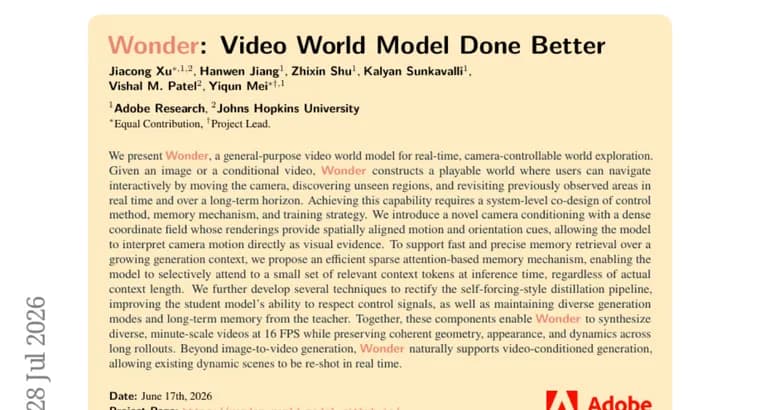
Researchers behind a paper titled "Wonder: Video World Model Done Better" describe a general-purpose video world model built for real-time, camera-controllable exploration. Starting from a single image or a short conditioning video, Wonder builds what the authors call a playable world: a user can move a virtual camera to explore unseen parts of the scene and later return to areas already visited, with the model maintaining consistency over a long-term horizon rather than just a few seconds.
The team, led by Jiacong Xu and co-authors, frames this as a system-level problem that needed three parts solved together: how the camera controls the generation, how the model remembers what it already generated, and how it is trained. For camera control, Wonder uses a dense coordinate field, a rendered signal that gives the model spatially aligned motion and orientation cues so it can read camera movement directly as visual evidence rather than as an abstract instruction. For memory, the authors add a sparse attention-based mechanism that lets the model pull in only a small set of relevant tokens from everything generated so far, so lookup stays fast even as the generated history keeps growing. On the training side, the paper describes fixes to a self-forcing-style distillation pipeline, the process of training a faster student model to imitate a slower teacher model, aimed at making the student follow control signals more faithfully while keeping the teacher's range of generation modes and its long-term memory.
Put together, the authors report that Wonder can generate diverse, minute-scale videos at 16 frames per second while keeping geometry, appearance, and motion coherent across long rollouts. The model is not limited to generating video from a still image: it also accepts an existing video as the conditioning input, which lets a dynamic scene already captured on video be re-shot in real time from new camera angles.
Key facts
- Wonder builds a camera-controllable, explorable world from a single image or a conditioning video, letting users revisit areas they left earlier in real time.
- Camera control comes from a dense coordinate field that gives the model spatially aligned motion and orientation cues, rather than treating camera movement as an abstract instruction.
- A new sparse attention-based memory mechanism retrieves only a small set of relevant tokens from the growing generation history, keeping lookups fast regardless of how long the session runs.
- Fixes to a self-forcing-style distillation pipeline help the faster student model follow control signals while keeping the teacher's diverse generation modes and long-term memory.
- The authors report minute-scale videos at 16 frames per second with coherent geometry and dynamics, plus the ability to re-shoot an existing video from new camera angles.
Why it matters
Video world models that stay coherent over long stretches, and that let a user leave a part of a scene and come back to find it unchanged, are a harder problem than short clip generation: the model has to remember what it built rather than just extrapolate forward. Wonder's contribution is presenting camera control, memory, and training as one co-designed system rather than three separate add-ons, which is what the paper credits for reaching minute-scale, 16 FPS generation with revisit consistency.
Who it affects
The most direct audience is researchers building video and world models, plus teams working on game engines, simulation, and embodied AI or robotics who need an explorable environment generated on demand from a single image rather than hand-built. Anyone working on video editing or reshoots also has a direct interest in the video-conditioned re-shooting capability described in the paper.
How to use it
The source is a research paper, not a product announcement: it gives no price, license, or availability details, and does not state whether code, weights, or a public demo will be released.
How solid is it
The claims come from the paper's own abstract as posted on Hugging Face's paper listing; no benchmark numbers, comparison to prior video world models, or third-party evaluation appear in the text made available here. The described capabilities, real-time control, minute-scale coherent generation, and re-shooting of existing video, are the authors' own characterization of their system.
Risks and caveats
This is a self-reported research description without independent verification in the material reviewed: there are no quantitative benchmarks, no named comparison systems, and no confirmation of release plans for code or a demo. Claims about real-time performance and long-term consistency should be read as the authors' own assessment until independently reproduced.
“Given an image or a conditional video, Wonder constructs a playable world where users can navigate interactively by moving the camera, discovering unseen regions, and revisiting previously observed areas in real time and over a long-term horizon.”
— the paper's abstract