XDOF in talks for $1.2B Series B just three months out of stealth
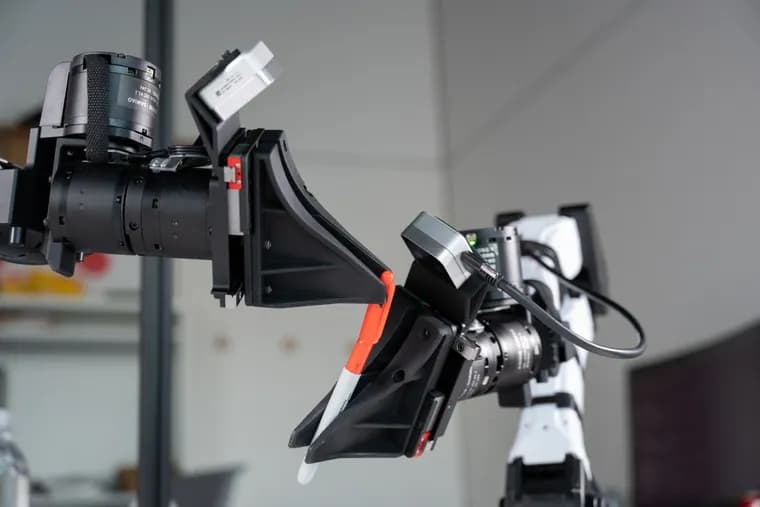
XDOF, a startup that collects real-world teleoperation data to train general-purpose robots, is in late-stage talks to raise a Series B round at a valuation of about $1.2 billion led by 8VC, according to people with knowledge of the deal. The company emerged from stealth less than three months ago. TechCrunch could not learn the total amount being raised or whether the $1.2 billion figure includes the new money, and the terms are not final and could still change. XDOF and 8VC did not respond to requests for comment.
XDOF was co-founded in 2024 by UC Berkeley researchers Philipp Wu, now CEO, and Fred Shentu, now CTO. TechCrunch reported the startup's $70 million Series A in June, backed by Thrive Capital, Andreessen Horowitz, Lux and Spark Capital. According to the people familiar with the talks, XDOF was not planning to raise again so soon after that round, but its rapid growth, with annualized revenue approaching $50 million, drew VCs to approach it about a new one.
The company grew out of GELLO, a low-cost teleoperation system Wu and Shentu built that lets a human operator control a robotic arm remotely to generate training data, work that produced an influential robotics paper. Wu has said that as a PhD student studying how robots learn from large datasets, the lack of large-scale data to work with was a major obstacle to his research. XDOF's pitch is to build the data pipelines, collection tools and annotation systems that frontier AI labs and robotics companies cannot easily build themselves, acting as an outsourced data-supply chain for robotics. Investors now describe it as the Scale AI or Mercor for physical robotics, a reference to the data-labeling companies that helped fuel the AI boom, since unlike large language models, which trained on the entirety of the internet, physical robots have no equivalent real-world dataset to draw on.
To gather data, XDOF combines remote robot teleoperation with human collectors wearing sensors to record everyday tasks such as folding clothes and flattening boxes. It plans to hire and train teams of data collectors worldwide, including teleoperators who steer robots remotely and egocentric operators who capture movement data through body sensors. XDOF has said it already works with 20 customers, including several frontier AI labs, and it is partnering with UC Berkeley's AI Research lab to release a robot training dataset called ABC, which it believes will be the largest high-quality collection of its kind ever assembled. Other startups pursuing real-world robot training data include Mecka AI, alongside human-data platforms such as Scale AI and Micro1 that are expanding beyond language models into robotics.
Key facts
- XDOF is in late-stage talks for a Series B at about a $1.2 billion valuation led by 8VC, less than three months after leaving stealth.
- The company raised a $70 million Series A reported by TechCrunch in June, backed by Thrive Capital, Andreessen Horowitz, Lux and Spark Capital.
- Annualized revenue is approaching $50 million, and XDOF already works with 20 customers, including several frontier AI labs.
- XDOF is partnering with UC Berkeley's AI Research lab to release ABC, a robot training dataset it believes will be the largest high-quality collection of its kind.
- TechCrunch could not confirm the total capital being raised or whether the $1.2 billion valuation includes the new funding, and XDOF and 8VC did not respond to comment requests.
Why it matters
Large language models trained on the entirety of the internet, but physical robots have no equivalent real-world dataset to learn from, which makes collecting that data a critical bottleneck for building general-purpose machines. XDOF positions itself as the outsourced data-supply chain that lets frontier AI labs and robotics companies get that data without building the pipelines, collection tools and annotation systems themselves, and investors now describe it as the Scale AI or Mercor of physical robotics.
Who it affects
Frontier AI labs and robotics companies that need real-world training data are XDOF's customers, 20 of them so far by the company's own count. Its investor base spans 8VC, reportedly leading the new round, and the Series A backers Thrive Capital, Andreessen Horowitz, Lux and Spark Capital. XDOF's hiring plans reach further still: it intends to recruit teleoperators and egocentric operators worldwide to collect the data, and UC Berkeley's AI Research lab is a stated partner on the planned ABC dataset release.
How to use it
XDOF's method combines remote robot teleoperation with human collectors wearing body sensors to record everyday actions such as folding clothes and flattening boxes. The approach traces back to GELLO, the low-cost teleoperation system Wu and Shentu built to let a human control a robotic arm remotely and generate training data, which led to an influential robotics paper before the company existed.
How solid is it
The valuation and the talks come from people with knowledge of the deal, not from XDOF or 8VC directly; neither company responded to TechCrunch's request for comment. TechCrunch states plainly that it could not learn the total amount being raised or whether the $1.2 billion valuation includes the new funding, and it reports the terms of the deal as not yet final.
Risks and caveats
Because the round has not closed, the terms described here could still change, and no timeline for closing is given in the source. The report does not say whether the Series A investors are participating in this round, and the true scale of the raise remains unconfirmed pending any statement from XDOF or 8VC.
“the lack of large-scale data to work with”
— Philipp Wu, co-founder and CEO of XDOF