τ0-VLA robot model searches before acting on long tasks
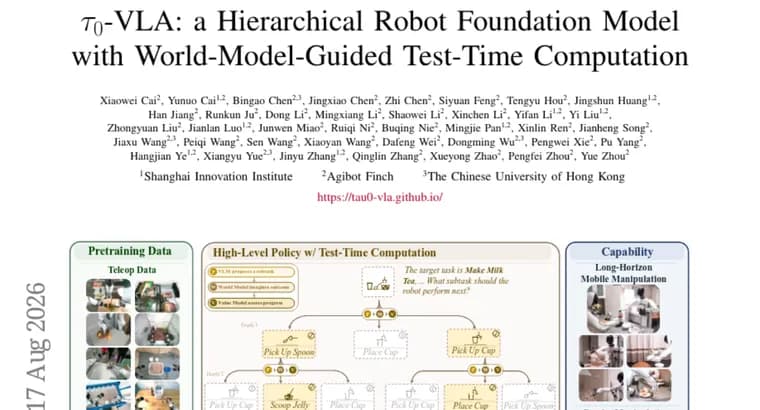
Researchers introduce τ0-VLA, a hierarchical vision-language-action (VLA) robot foundation model built for long-horizon manipulation, tasks that require both executing individual skills reliably and sequencing them coherently over an extended run. Most hierarchical VLA models make each high-level decision with a single forward pass, the authors note, leaving no mechanism to spend additional computation on a difficult or consequential choice. τ0-VLA addresses this by treating high-level subtask generation as a compute-scalable inference problem: at each inference step, its high-level policy uses execution memory to generate a subtask and, when needed, searches over alternative subtasks, guided by a world model, before committing to its final output. A separate low-level policy then executes the chosen subtask, and the system is built to work across multiple robot embodiments rather than a single fixed platform.
The policy was trained on 40,115 hours of heterogeneous real-world data using multimodal co-training. According to the authors, testing across both in-domain settings and settings with distribution shift showed that giving the model more computation at test time substantially improves its accuracy at predicting the next subtask, and that this improvement carries through to higher closed-loop success on long-horizon manipulation tasks. The abstract does not give specific accuracy or success-rate percentages, does not name the robot embodiments, benchmarks or baseline models used for comparison, and does not identify the authors, their institutions, or a release timeline for the model, its data or its code.
Key facts
- τ0-VLA is a hierarchical vision-language-action (VLA) foundation model for robot manipulation that treats high-level subtask generation as a compute-scalable inference problem.
- At each inference step, the high-level policy uses execution memory to generate a subtask and, when needed, searches over alternatives, guided by a world model, before committing.
- A separate low-level policy executes the chosen subtask, and the system works across multiple robot embodiments.
- The policy was trained on 40,115 hours of heterogeneous real-world data with multimodal co-training.
- Across in-domain and distribution-shifted test settings, more test-time computation improves next-subtask prediction accuracy and raises closed-loop success on long-horizon tasks, though no specific percentages are given.
Why it matters
Most hierarchical VLA models decide each high-level step in one forward pass, with no way to spend more effort on a hard or consequential choice. τ0-VLA changes that by letting its high-level policy search over alternative subtasks at test time, guided by a world model, before committing to one. That turns planning from a single-shot decision into something that can scale its own effort to the difficulty of the step, the same idea behind test-time compute scaling in language models, applied here to sequencing physical robot actions.
Who it affects
Robotics researchers and engineers building foundation models for manipulation, especially long-horizon tasks that chain many skills together. Because the low-level policy executes subtasks across multiple robot embodiments, the approach targets teams working with varied robot hardware rather than a single fixed platform. The source text does not name the authors or their institutions.
How to use it
The paper describes the method and training setup rather than a shipped product: the policy was trained on 40,115 hours of heterogeneous real-world data with multimodal co-training. No release date, code or weight availability, or licensing terms are given in the source.
How solid is it
The authors report testing across both in-domain and distribution-shifted settings, finding that extra test-time computation substantially improves next-subtask prediction accuracy and that this translates into higher closed-loop success on long-horizon manipulation tasks. The abstract does not include the specific accuracy or success-rate figures, nor the embodiments, benchmarks or baseline models used for comparison, so the size of the improvement cannot be judged from this text alone.
Risks and caveats
The abstract does not explain how the search over alternative subtasks is implemented or describe the world model's architecture, so the mechanism stays a black box from this source. No authors or institutions are named in the text, and there is no stated timeline for a public release of code, data or model weights.