Xiaomi's Xring O3 chip matches Apple cores single threaded, much faster multithreaded
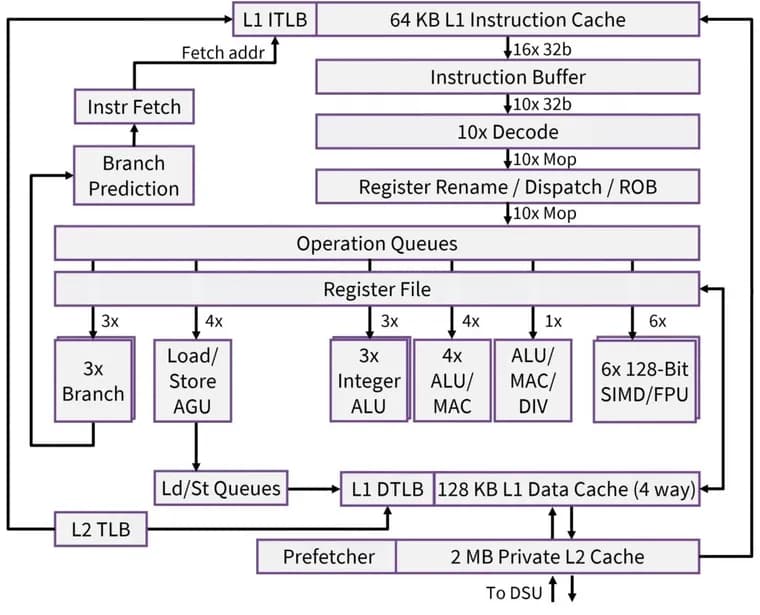
A post on X (Twitter) argues that Xiaomi, the Chinese phone maker whose handsets compete with the iPhone, has built a chip worth discussing: the Xring O3. Its biggest cores, called C1-Ultra, roughly match Apple's cores on single threaded tasks and are much faster in multithreaded execution, according to the post. The author frames this less as a one-off win and more as evidence of a broader trend in CPU design, while flagging two limits up front: Apple may soon announce its next processor, which could erase the O3's current edge, and a phone that actually ships with the O3 may be hard to find.
The headline numbers come from Geekbench. The post reports a single-core score of 3,945 and a multi-core score of 15,221, calling the multi-core result unprecedented.
Design details help explain that multithreaded lead. The chip carries 44 MB of total cache, which the post says is more than most laptop CPUs, and probably, in the author's own hedge ('chances are good'), more than an Intel laptop chip's cache too. The core itself is what the post calls 'astonishingly wide,' with 21 execution ports, six of which support 128-bit SIMD operations, more execution ports, the post says, than a typical Intel or AMD processor carries. The C1-Ultra also supports SME2 (Scalable Matrix Extension 2), used for matrix and AI acceleration, and SVE2, used for SIMD data parallelism.
The post is careful to flag where the O3 still trails. AMD's Zen 5 core can run SIMD operations at 4x512-bit, wider than the 6x128-bit that the post says is the best any ARM chip, including the C1-Ultra, currently manages, adding 'as far as I know' to that claim. The author reads the O3 as one data point in a larger shift: CPU cores across the industry are becoming massively parallel, with more execution units, better SIMD, and more cache, all fed by a growing transistor budget.
Key facts
- Xiaomi's new Xring O3 chip, in particular its C1-Ultra cores, roughly matches Apple's cores in single threaded work and is much faster multithreaded, according to a widely shared post on X.
- The chip posted Geekbench scores of 3,945 single-core and 15,221 multi-core, the latter called unprecedented by the post.
- The chip has 44 MB of total cache, and its C1-Ultra core has 21 execution ports, six of which support 128-bit SIMD, plus SME2 for matrix and AI acceleration and SVE2 for SIMD data parallelism.
- AMD's Zen 5 core still holds a SIMD-width edge, running at 4x512-bit versus the 6x128-bit the post says is the best current ARM chips manage.
- The post cautions that Apple's next processor could erase the O3's current edge, and that a phone carrying the O3 may be hard to find.
Why it matters
Smartphone chips are rarely described as beating Apple's silicon outright, and this post argues Xiaomi's Xring O3 does exactly that in multithreaded work while roughly keeping pace on single threaded tasks. The bigger point is not really about one phone: the post reads the O3's wide, 21-port C1-Ultra core and 44 MB of cache as one example of a broader shift, where chipmakers pour transistor budget into wider execution units and larger caches rather than raw clock speed. The chip's SME2 support for matrix and AI acceleration ties that shift directly to the kind of workloads phones increasingly run.
Who it affects
Xiaomi, whose flagship phones compete directly with the iPhone and whose standing as a chip designer this benchmark bolsters. Apple, held up as the single threaded comparison point, and which the post itself expects may announce a new processor soon. Intel and AMD, cited as the reference points the O3's cache, execution port count, and SIMD width are measured against. And buyers hunting for a high performance Android phone, since the post's own caveat is that a handset carrying the O3 may be hard to find.
How to use it
There is no product, price, or release date here to act on: the post names no phone model, no launch date, and no price for the O3. The practical takeaway is a pair of numbers worth remembering once phones with the chip do ship, a Geekbench multi-core score of 15,221, and SME2 and SVE2 support for AI and data-parallel workloads. Both are worth weighing against whatever chip Apple ships next, since the post itself expects that release to reset the comparison.
How solid is it
The claims trace to a single post on X, not an official statement from Xiaomi, Apple, Intel, or AMD, and the post is credited only to the X account @lemire, with no full name given. It also does not say which Apple chip it is comparing the O3 against, citing only 'Apple cores' generically, and gives no methodology for the Geekbench runs, such as the test device, cooling conditions, or whether the scores are a single run or an average of several. The cache and execution port comparisons against Intel and AMD rest on the author's own general impression rather than a benchmark against a specific named competing chip.
Risks and caveats
The post's own biggest caveat is that Apple's next processor, which it expects soon, may erase the O3's current edge. Two of its other claims are self-hedged rather than stated flat: the cache comparison against Intel laptop chips is only 'chances are good,' and the ARM SIMD-width ceiling is qualified 'as far as I know.' No price, release date, manufacturing process, clock speed, or total core count for the O3 is given, so how these architecture numbers translate into an actual shipping phone is still unclear.
“This is where all the transistors go.”
— the post's author