A percolation model explains sudden subnetwork mergers in SGD training
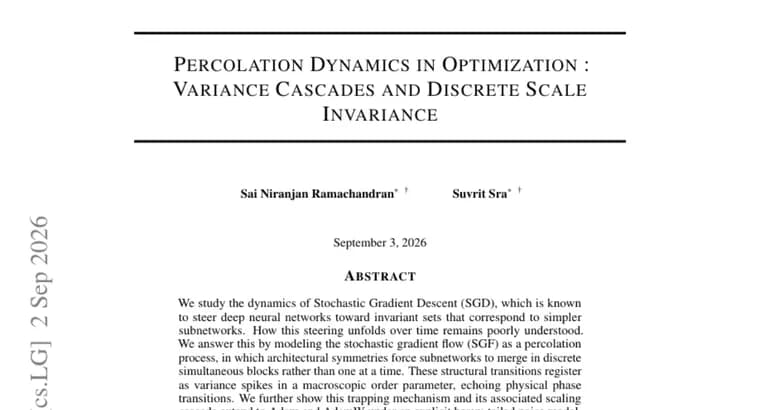
A new paper tackles a question about deep learning that has stayed open despite being widely observed: stochastic gradient descent (SGD) is known to steer deep neural networks toward invariant sets that correspond to simpler subnetworks, but how that steering actually unfolds over time has remained poorly understood. The authors answer this by modeling the stochastic gradient flow, the continuous-time version of SGD, as a percolation process. In this framing, symmetries in the network's architecture do not let subnetworks merge one at a time; instead they force whole blocks of subnetworks to merge simultaneously, in discrete steps. When one of these merger events happens, it shows up as a spike in the variance of a macroscopic order parameter that tracks the network's state, a signature the authors compare to physical phase transitions such as those seen in statistical mechanics. The paper's title also flags 'variance cascades' and 'discrete scale invariance' as part of the same picture: the merger events are not isolated but form a cascading, self-similar structure across scales. The authors then extend the analysis beyond plain SGD, showing that the same trapping mechanism and the same scaling cascade also appear in Adam and AdamW, the optimizers most widely used to train large models today, once an explicit heavy-tailed noise model is introduced into the analysis. The abstract presents this as a mathematical framework rather than an empirical study: no numeric results, benchmark comparisons, specific architectures, datasets, or training-step timescales for when the spikes occur are given in the text.
Key facts
- SGD is known to steer deep neural networks toward invariant sets corresponding to simpler subnetworks, but how this happens over time was previously poorly understood.
- The paper models the stochastic gradient flow as a percolation process to explain the mechanism.
- Architectural symmetries force subnetworks to merge in discrete, simultaneous blocks rather than one at a time.
- These merger events register as variance spikes in a macroscopic order parameter, echoing physical phase transitions.
- The same trapping mechanism and scaling cascade are shown to extend to Adam and AdamW under an explicit heavy-tailed noise model.
Why it matters
Training dynamics are usually described informally, in terms of loss curves going down. This paper instead gives a structural account of a specific, previously unexplained phenomenon: why networks trained with SGD settle into simpler, more symmetric subnetworks, and why that settling happens in abrupt jumps rather than smoothly. Casting the process as percolation, with variance spikes standing in for phase transitions, borrows language from statistical physics to describe something concrete about how optimization actually behaves. That the same mechanism is shown to extend to Adam and AdamW, rather than being a quirk of plain SGD, matters because those are the optimizers behind most large-scale model training today.
Who it affects
This is theory work aimed at researchers studying optimization dynamics and the science of deep learning, not a tool or product for practitioners. Anyone trying to understand why training curves show sudden qualitative shifts, or why networks trained with SGD, Adam or AdamW seem to lock into simpler structures partway through training, is the intended audience.
How to use it
There is nothing to install or run: the abstract describes a mathematical framework, not a released tool, code, or benchmark suite. Per the source, no experimental results, benchmarks, or numeric values accompany the text, so applying the idea currently means engaging with the paper's mathematical argument itself rather than reproducing a reported result.
How solid is it
The claims are framed as a formal result, extended to Adam and AdamW through an explicit heavy-tailed noise model rather than left as a plain-SGD-only observation. That said, the source text itself contains no experimental results, benchmarks, or numeric values, so the abstract alone does not let a reader independently check the claims against data; the strength of the result rests on the underlying mathematical argument, which is not laid out here.
Risks and caveats
The abstract does not name a specific network architecture, dataset, or training-step timescale for when the variance spikes or subnetwork mergers occur, and it gives no author names or institutional affiliation within the article text itself. The mechanism is also explicitly tied to architectural symmetries forcing block mergers, a specific structural assumption whose scope beyond the cases described is not established in the text.