WorldSculpt turns cluttered video into hundreds of separate 3D object meshes
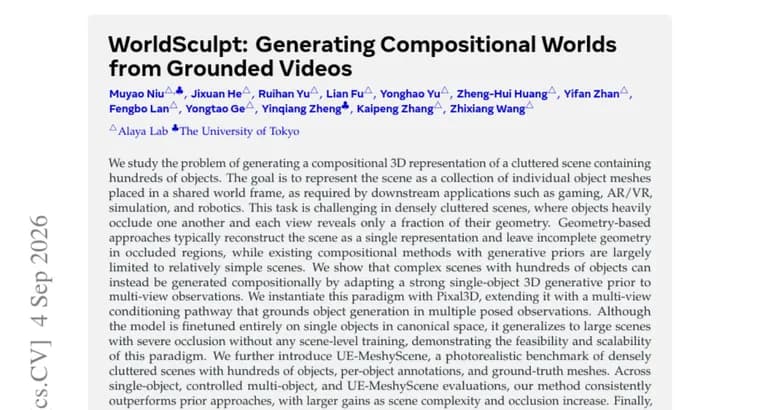
Researchers describe WorldSculpt, a method for turning video observations of a cluttered scene into a compositional 3D representation: a collection of individual object meshes placed in one shared world frame, the format needed by games, AR/VR, simulation and robotics. The problem is hard in densely cluttered scenes because objects heavily occlude each other, so any single camera view only shows a fraction of each object's geometry. Prior geometry-based reconstruction methods build one fused representation and simply leave gaps where occlusion hid the geometry, while earlier compositional methods that use generative priors have mostly only worked on relatively simple scenes with few objects.
The authors' approach is to adapt a strong single-object 3D generative prior to multi-view observations instead of training a model on full scenes. They build this on Pixal3D, an existing single-object 3D generative model, by adding a new multi-view conditioning pathway that grounds the generation of each object in several posed camera views of the same scene. The underlying model is fine-tuned entirely on single objects in a canonical pose, never on full scenes, yet the authors report that it generalizes to large scenes with hundreds of objects and severe occlusion without any additional scene-level training.
To evaluate the method the authors introduce UE-MeshyScene, a new photorealistic benchmark of densely cluttered scenes containing hundreds of objects, with per-object annotations and ground-truth meshes. Across single-object, controlled multi-object and UE-MeshyScene evaluations, they report that their method consistently outperforms prior approaches, with the gap widening as scene complexity and occlusion increase, though the abstract does not give the underlying accuracy or error figures. The authors also show the method working beyond scenes generated from real video: it can take 3D Gaussian splatting worlds produced by other generators, such as Marble and HY-World 2.0, and convert them into compositional mesh scenes as well.
Key facts
- WorldSculpt generates a compositional 3D representation of cluttered scenes with hundreds of objects, as separate meshes placed in one shared world frame.
- It extends Pixal3D, a single-object 3D generative model, with a new multi-view conditioning pathway that grounds each object's generation in multiple posed views of the scene.
- The underlying model is fine-tuned only on single objects in canonical space, yet the authors say it generalizes to large, severely occluded scenes with no scene-level training.
- The authors introduce UE-MeshyScene, a new photorealistic benchmark of densely cluttered scenes with per-object annotations and ground-truth meshes.
- The method can also convert 3D Gaussian splatting worlds generated by other systems, including Marble and HY-World 2.0, into compositional mesh scenes.
Why it matters
Most 3D reconstruction methods turn a scene into one fused representation, which leaves holes wherever objects blocked each other from the camera and cannot be edited object by object afterward. WorldSculpt's contribution is showing that a scene can instead be built as hundreds of separate, complete object meshes, generated by adapting a generative model trained only on single objects rather than training a new model on whole scenes. That distinction matters for any pipeline that needs each object in a scene as its own editable, reusable asset rather than a single indivisible mesh.
Who it affects
The intended audience is researchers and engineers building 3D content pipelines for gaming, AR/VR, simulation and robotics, the applications the authors cite as needing scenes represented as individual object meshes in a shared world frame. It is a research method and benchmark, not a consumer product, so its immediate effect is on people doing 3D scene reconstruction and generation work rather than end users.
How to use it
WorldSculpt is built by extending Pixal3D with a multi-view conditioning pathway, so it takes several posed camera views of a cluttered scene and generates a mesh for each object grounded in those views. It can also be pointed at 3D Gaussian splatting worlds already produced by other generators, including Marble and HY-World 2.0, and convert them into compositional mesh scenes. The source text gives no release details, pricing or licensing for code or model weights, so at this stage it reads as a published method and benchmark rather than a tool available to try.
How solid is it
The authors tested the method across single-object, controlled multi-object and their own UE-MeshyScene evaluations, and report that it consistently outperforms prior approaches, with larger gains as scene complexity and occlusion increase. They also contribute UE-MeshyScene itself, a photorealistic benchmark of densely cluttered scenes with per-object annotations and ground-truth meshes, intended to test methods on harder scenes than prior simple-scene benchmarks. The abstract does not state the actual accuracy or error numbers behind the outperformance claim, so the size of the improvement cannot be quoted here.
Risks and caveats
These are the authors' own results, not an independent evaluation, and the source text gives no numeric benchmark figures for the comparisons against prior approaches, so how large the reported gains actually are cannot be verified from what is available. The source also does not name the authors' affiliations or give a publication date, and it does not say how many objects UE-MeshyScene actually contains beyond describing them qualitatively as 'hundreds.' The headline claim, that a model fine-tuned only on single objects generalizes to full cluttered scenes without scene-level training, is the kind of result that needs concrete numbers to judge properly, and the source text does not supply them.