A-RSI lifts multimodal self-improvement average from 57.77 to 61.05
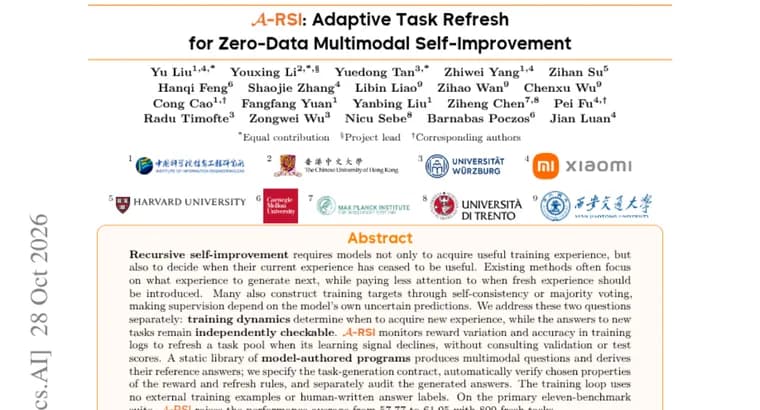
A paper on Hugging Face Papers introduces A-RSI, a method for zero-data multimodal recursive self-improvement. The authors start from a split of the problem into two questions. Recursive self-improvement, they say, requires a model not only to gain useful training experience but also to decide when its current experience has stopped being useful. Existing methods, in their account, mostly focus on what experience to generate next and pay less attention to when fresh experience should be introduced. Many also build training targets through self-consistency or majority voting, which makes supervision depend on the model's own uncertain predictions.
A-RSI treats the two questions separately. Training dynamics decide when to acquire new experience, while the answers to new tasks stay independently checkable. For the timing, A-RSI monitors reward variation and accuracy in the training logs and refreshes its task pool when its learning signal declines. It does this without consulting validation or test scores.
For the tasks themselves, a static library of model-authored programs produces multimodal questions and derives their reference answers. The authors say they specify the task-generation contract, automatically verify chosen properties of the reward and refresh rules, and separately audit the generated answers. The training loop uses no external training examples and no human-written answer labels.
The headline result: on the primary eleven-benchmark suite, A-RSI raises the performance average from 57.77 to 61.05 with 800 fresh tasks. That is a gain of 3.28 points.
Key facts
- A-RSI is a zero-data multimodal self-improvement method that decides when to refresh its task pool by watching reward variation and accuracy in training logs.
- Refreshing is triggered when the learning signal declines, and it does not consult validation or test scores.
- A static library of model-authored programs generates multimodal questions and derives their reference answers, so targets do not rely on self-consistency or majority voting.
- The training loop uses no external training examples or human-written answer labels.
- On the primary eleven-benchmark suite, the performance average rises from 57.77 to 61.05 with 800 fresh tasks.
Why it matters
Self-improving models need two things: a supply of new training tasks and a rule for when to bring them in. The authors argue that prior work concentrates on the first and neglects the second, and that majority-vote targets tie supervision to the model's own uncertain predictions. A-RSI separates the two, using training logs to time refreshes and program-derived answers to keep targets checkable.
Who it affects
Researchers working on recursive or self-improving multimodal models are the direct audience, particularly those building training loops that avoid external data and human labels.
How to use it
The source gives no code or release link, so there is nothing to run from it. The design idea is the portable part: trigger task refreshes from reward variation and accuracy in training logs rather than from validation or test scores, and derive reference answers from programs rather than from majority voting.
How solid is it
The evidence in the source is a single reported result: the performance average on the primary eleven-benchmark suite goes from 57.77 to 61.05 with 800 fresh tasks. The source does not name the benchmarks, the base model, what the 57.77 baseline is, or whether the average is a mean or a median. It does not report comparisons with other self-improvement methods or the results of the answer audit. The authors say they verify properties of the reward and refresh rules automatically and audit the generated answers.
Risks and caveats
With so little detail on the baseline, the model and the benchmarks, the 3.28-point gain is hard to judge. The claim that answers remain independently checkable rests on the authors' own contract, verification and audit, and the audit results are not given in the source. The numbers come from a preprint summary, not an independent evaluation.