EditAgent widens tools and judging for agentic image editing
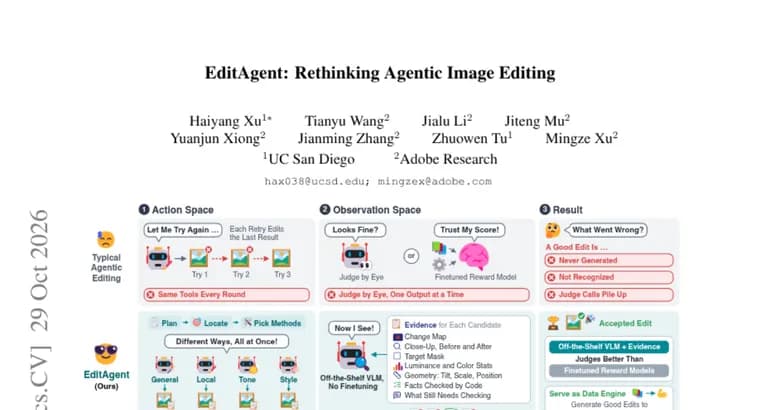
The paper starts from how agentic image editors work today. They break a complex request into steps, but when a step fails they mostly retry with the same narrow set of tools, and a judge scores each output by eye directly. The authors argue that such agents are bounded by two spaces: the action space, meaning what the agent can do, and the observation space, meaning what its judge can see.
To show the problem, they use their own expert-annotated benchmark. On it, a general-purpose editor yields no usable result in over 40% of the cases, and no judge is reliable across edit types.
Their answer is EditAgent, which expands both spaces. On the action side, it routes each step to general editors and to specialized methods. On the observation side, it attaches a verification record to each candidate edit. According to the authors, once the judge has these records, off-the-shelf VLM judges outperform finetuned reward models.
EditAgent also changes how candidates are produced and compared. Candidates are generated in parallel and judged in a single listwise call, rather than refined one after another. Experts prefer this to sequential refinement in 78.5% of decided comparisons, and it uses no more than half the judge calls.
Finally, the authors report that EditAgent improves two open-weight editors on three benchmarks, and that it can serve as a data engine for training stronger editors.
Key facts
- EditAgent expands an editing agent's action space (each step is routed to general editors and specialized methods) and its observation space (each candidate carries a verification record).
- On the authors' expert-annotated benchmark, a general-purpose editor gives no usable result in over 40% of cases, and no judge is reliable across edit types.
- With verification records, off-the-shelf VLM judges outperform finetuned reward models, according to the authors.
- Parallel candidate generation with one listwise judge call is preferred by experts over sequential refinement in 78.5% of decided comparisons, at no more than half the judge calls.
- EditAgent improves two open-weight editors on three benchmarks and can act as a data engine for training stronger editors.
Why it matters
Image-editing agents split a request into steps, yet the paper says they respond to a failed step by retrying with the same narrow toolset and a judge that scores outputs by eye. The authors frame the limit as two spaces: what the agent can do and what its judge can see. Widening both is the central idea. The reported numbers show why they care: on their benchmark a general-purpose editor fails to give a usable result in over 40% of cases, so a single editor is not enough for hard requests.
Who it affects
The work targets people building agentic image-editing pipelines and the judges or reward models that rank edited outputs. The claim that off-the-shelf VLM judges beat finetuned reward models, once given verification records, bears on anyone choosing how to score edits. The data-engine claim is relevant to teams training open-weight editors, since the authors say EditAgent improves two of them.
How to use it
The abstract describes a design pattern more than a product. Route each editing step to the most suitable general or specialized tool, attach a verification record to every candidate, generate candidates in parallel, and have the judge rank them in one listwise call. The source does not mention a code, model or dataset release.
How solid is it
This rests on a paper abstract from a Hugging Face papers page, so the numbers are the authors' own claims on their own expert-annotated benchmark. The 78.5% figure counts decided comparisons only. The source does not name the two open-weight editors, the three benchmarks, or the judges and reward models compared, and it gives no size for the improvement on the three benchmarks.
Risks and caveats
The over 40% figure is for a general-purpose editor on the authors' own benchmark, not a general failure rate. The abstract does not say how many experts annotated the benchmark or how large it is, and it does not say what share of comparisons were undecided. Without the size of the gains or the named baselines, the strength of the improvement cannot be judged from the abstract alone.
“such agents are bounded by two spaces: the action space of what the agent can do, and the observation space of what its judge can see”
— EditAgent paper abstract