AI Engineer Notebooks teaches applied LLM skills without frameworks
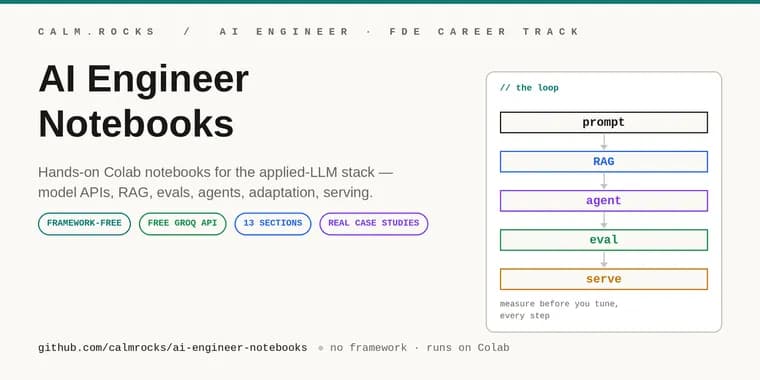
AI Engineer Notebooks is a new open-source project offering a set of runnable Colab notebooks that teach the applied-LLM stack: the skill set for an AI Engineer or Forward Deployed Engineer (FDE) role. The material targets backend or full-stack engineers moving into AI Engineer, FDE, Applied AI, or Solutions Engineer (AI) roles, titles the project describes as different names for largely the same job: building working systems on top of foundation models using model APIs, RAG, evals, agents and adaptation.
Every notebook is built on raw model API calls rather than a framework such as LangChain or LlamaIndex. The project frames this as deliberate: learners write the agent loop, the RAG pipeline and the evals themselves first, so they understand what a framework like LangChain or LlamaIndex actually does before reaching for one, and can judge when not to. The stated reasoning, repeated twice in near-identical wording across the material, is that "patterns are durable; wrappers churn." Evaluation is treated as central rather than an afterthought: the principle "measure before you tune" is introduced early and, per the project, returns in every section, described as the habit that separates an engineer who has shipped a working system from one who has only built a demo.
The whole curriculum is designed to run for free: every notebook runs end to end on the free Groq API, with no credit card required. Two topics the free Groq API cannot host, LoRA fine-tuning (section 06) and self-hosted serving (section 09), are instead taught concept-first, each with an optional, fenced appendix that runs on a Colab GPU; both appendices are described as having been verified on a real Colab T4 GPU.
Every pattern taught is described as OpenAI-compatible throughout, said to transfer directly to OpenAI's API and, with small changes, to Anthropic's, simply by swapping the base URL.
The material is organized as a sequence of numbered sections, meant to be worked top to bottom: 00 Setup, 01 Model APIs, 02 Evals I (measuring outputs), 03 RAG, 04 Evals II (described as "the differentiator"), 05 Agents, 06 Adapting the model, 07 Security, 08 Operations, 09 Serving and inference performance, 10 ML system design and performance, 11 Customer craft (described as the FDE differentiator), and 12 Case Studies and Capstone.
Section 12 brings the earlier material together in three end-to-end case studies, worked under what the project calls real constraints: a support assistant debugged in production, a cost comparison between a pipeline and an agent approach, and a red-team robustness benchmark. Case studies are framed as being for learning; a capstone project that follows is framed as being for hiring, with a brief that calls for a deployed repository the learner builds themselves, including a serving component and an evaluation report, meant to go on a resume.
Each notebook is self-contained: its first cell installs dependencies, and its second cell calls a small setup helper, from aien import setup; client, MODEL = setup(), that loads an API key from Colab's own secrets manager or a local environment variable, so there is no hidden state carried between notebooks. That helper lives in a tiny shared package in the repository called aien, installed automatically by each notebook's first cell. The RAG and evaluation sections share a single corpus, a data folder, so the evals measure the retrieval system the learner actually built rather than a separate, unrelated dataset. Every notebook ends with exercises.
To start, a learner gets a free API key at console.groq.com, no credit card required. Inside Colab, the key icon in the left sidebar adds it as a GROQ_API_KEY secret, with notebook access toggled on; from there, any notebook opens through its badge and runs top to bottom. The project can also run locally: pip install -r requirements.txt and pip install -e . (the second command also installs the aien setup helper), then an exported GROQ_API_KEY environment variable and Jupyter to open the notebooks.
Key facts
- AI Engineer Notebooks is a free, open-source set of Colab notebooks teaching the applied-LLM skill set for AI Engineer and Forward Deployed Engineer (FDE) roles, covering model APIs, RAG, evals, agents, fine-tuning, security, operations and serving.
- Every notebook is written against raw model APIs rather than a framework like LangChain or LlamaIndex, on the stated principle that patterns are durable while wrappers churn.
- The curriculum runs end to end on the free Groq API with no credit card required; the two topics Groq cannot host, LoRA fine-tuning (section 06) and self-hosted serving (section 09), get concept-first treatment with an optional Colab-GPU appendix verified on a real Colab T4.
- Numbered sections 00 through 12 culminate in three end-to-end case studies, a support assistant debugged in production, a pipeline-versus-agent cost comparison, and a red-team robustness benchmark, followed by a capstone project meant for a learner's resume.
- Every pattern taught is framed as OpenAI-compatible, said to transfer directly to OpenAI's API and, with small changes, to Anthropic's, by swapping the base URL.
Why it matters
The project targets a real skills gap: engineers who can already ship production code but have not yet built the applied-model layer on top, for roles the project names as AI Engineer, Forward Deployed Engineer (FDE), Applied AI, and Solutions Engineer (AI), titles it describes as largely the same job. Its rationale for going framework-free is direct: learners write the agent loop, the RAG pipeline and the evals themselves from raw API calls first, so they understand what a framework like LangChain or LlamaIndex actually does before reaching for one, on the stated principle that "patterns are durable; wrappers churn." It also puts evaluation ahead of production polish: the principle "measure before you tune" is introduced early and, per the project, returns in every section, framed as the line between an engineer who has shipped a working system and one who has only built a demo. All of this runs free end to end on the Groq API, with no credit card required, which keeps the barrier to entry low for anyone willing to work through the material.
Who it affects
Backend and full-stack engineers moving into AI Engineer, Forward Deployed Engineer, Applied AI, or Solutions Engineer (AI) roles are the stated audience; the project frames these as different titles for largely the same job of building production systems on top of foundation models. Anyone preparing for interviews in that space is a direct beneficiary, since the material is pitched as teaching the stack "the way you'll actually be interviewed on it." The framework-free design also targets engineers who already use LangChain or LlamaIndex day to day but want to understand what those wrappers are actually doing underneath, so they can judge for themselves when to use one and when not to.
How to use it
The curriculum runs top to bottom across sections numbered 00 through 12: Setup, Model APIs, Evals I (measuring outputs), RAG, Evals II (the differentiator), Agents, Adapting the model, Security, Operations, Serving and inference performance, ML system design and performance, Customer craft (the FDE differentiator), and Case Studies and Capstone. Each notebook installs its own dependencies in its first cell and, in its second, calls a small shared helper, from aien import setup; client, MODEL = setup(), which reads an API key from Colab secrets or a local environment variable, so nothing carries over between notebooks. Getting started needs only a free API key from console.groq.com, no credit card required: in Colab, the key icon in the sidebar adds it as a GROQ_API_KEY secret with notebook access toggled on, and any notebook opens via its badge and runs top to bottom. Running locally instead needs pip install -r requirements.txt and pip install -e . (the second command also installs the aien setup helper), an exported GROQ_API_KEY variable, and Jupyter to open the notebooks in. Every notebook ends with exercises, meant to be done before moving on.
How solid is it
The material available here is the project's own description of itself, read directly from its repository text, not an independent review. Its claims about running "end to end" on the free Groq API and about the Colab-GPU appendices being "verified on a real Colab T4" are the project's own account of its own testing, with no outside confirmation in the text. The repository's own text does not identify its author or maintainer. The GitHub handle under which the project was submitted to Hacker News, calmrocks, appears only in the submission URL and site metadata, not in the material itself. The submission drew modest engagement on Hacker News: 76 points and 9 comments, which signals some community interest without independently verifying any of the project's claims.
Risks and caveats
The text gives no quantitative benchmark, accuracy figure, or performance number for any of the three case studies, including the red-team robustness benchmark, only their topics; how well the taught techniques actually perform once applied is not measured in what's available here. There is also no comparison, in speed, accuracy or cost, between the framework-free approach taught in the notebooks and using LangChain or LlamaIndex directly, so "patterns are durable; wrappers churn" reads as the project's stated design philosophy rather than a tested result. No price, paid tier, star count, license, or release date for the repository is mentioned anywhere in the material; only the Groq API's free, no-credit-card tier is described.