AMD's Threadripper Halo packs 576GB of HBM3e for local AI research
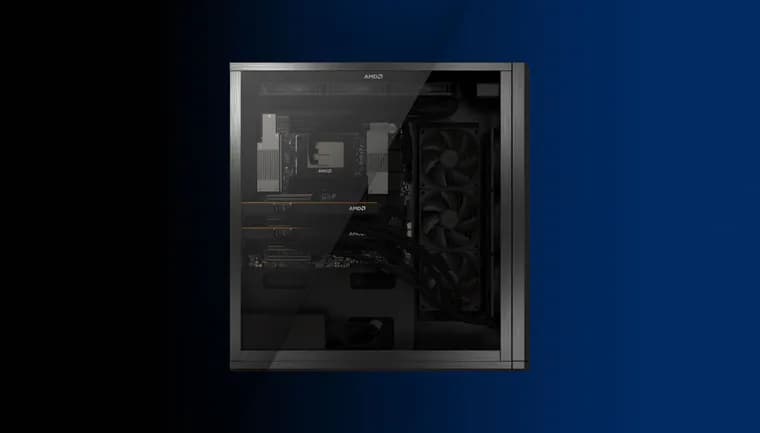
AMD announced the Threadripper Halo at IFA 2026, a liquid-cooled desktop workstation built for local AI research. It is the first time AMD has put its Instinct accelerators into a workstation form factor, and the system is set to launch next year. At the center is a 96-core Threadripper PRO 9995WX CPU, a chip that debuted in 2025, paired with up to 2TB of DDR5 system memory and up to 2.6TB of combined system memory. The box can hold up to four of AMD's PCIe-based Instinct MI350P GPUs, though the units AMD showed off at IFA had only two installed. The MI350P, launched in May, is effectively half of an MI350X squeezed into a PCIe card: each one carries 144GB of HBM3e memory good for 4TB/s of bandwidth and up to 4.6 petaFLOPS of FP4 compute, in a 600W configuration. AMD is expected to run the cards at a more modest 450W inside the Threadripper Halo, though the company has not confirmed the actual shipping power configuration. Combined across up to four GPUs, the system promises up to 576GB of HBM3e memory and 16TB/s of memory bandwidth, enough to hold models exceeding a trillion parameters at four-bit precision entirely in GPU memory, and to run even larger open-weights models, such as Moonshot.AI's 2.8 trillion-parameter Kimi K3, by offloading part of the model into system memory. AMD has not disclosed pricing; The Register estimates a fully configured unit would sell for between $100,000 and $150,000. A four-GPU configuration would also strain a standard North American power outlet unless AMD underclocks the cards from 600W to 300W or requires a 20-amp circuit, which The Register suggests may be why only two GPUs were shown at IFA. The obvious rival is Nvidia's DGX Station, announced at GTC 2025, which pairs a 252GB B300 GPU and a 72-core Grace CPU with 496GB of LPDDR5x memory and retails for around $100,000 when in stock. AMD claims the Threadripper Halo offers up to 3.4 times the DGX Station's total system memory and more than twice its memory bandwidth, an advantage The Register says should help LLM inference, provided tensor-parallel operations do not bottleneck on the CPU's PCIe bus.
Key facts
- The Threadripper Halo is the first workstation to carry AMD's Instinct accelerators, announced at IFA 2026 for launch next year.
- A full configuration promises up to 576GB of HBM3e memory and 16TB/s of bandwidth across up to four MI350P GPUs, paired with a 96-core Threadripper PRO 9995WX CPU.
- AMD has not disclosed pricing; The Register estimates $100,000 to $150,000, and a four-GPU setup may need a 20-amp circuit, which could explain why only two GPUs were shown at IFA.
- AMD claims 3.4 times the total system memory and more than twice the memory bandwidth of Nvidia's rival DGX Station, which itself retails around $100,000.
- The extra memory is meant to let researchers run trillion-parameter models like Moonshot.AI's 2.8 trillion-parameter Kimi K3 locally via memory offload.
Why it matters
Running frontier-scale open-weights models has mostly meant renting cloud GPU capacity, because a single accelerator rarely has enough memory to hold a trillion-parameter model. The Threadripper Halo is AMD's attempt to put that capacity on a researcher's desk by pooling memory across up to four Instinct GPUs plus system DDR5, reaching a combined 2.6TB of addressable memory. It is also notable as AMD's first workstation built around Instinct, a product line previously reserved for datacenter accelerators.
Who it affects
The target buyer is a machine-learning researcher or lab that wants to run large open-weights models locally rather than through a cloud provider, and that can absorb both the expected six-figure price and the electrical demands of a multi-GPU system. It also puts AMD in direct competition with Nvidia's DGX Station in the high-end local-AI workstation category.
How to use it
AMD has not announced official pricing; The Register's own estimate for a fully configured unit is $100,000 to $150,000, and the company has not said whether the Threadripper Halo will be available in every market. A four-GPU configuration is expected to require either underclocked cards or a 20-amp electrical circuit, which is not standard in every home or office setting.
How solid is it
The core specifications, the CPU, the GPU count, and the memory and bandwidth figures come from AMD's own announcement at IFA 2026. The pricing estimate and the 450W power figure are explicitly The Register's own inference, not confirmed AMD specifications, and the outlet notes AMD showed only two of the possible four GPUs installed at the event without explaining why.
Risks and caveats
Several load-bearing figures are estimates rather than confirmed AMD specs: the price range, the 450W per-card power setting, and the reasoning tying the 20-amp circuit requirement to why only two GPUs were shown. AMD has also not detailed the software stack or ROCm support that would determine how usable this memory pool actually is for real workloads, and the launch is only dated to 'next year' with no specific quarter.
“A quad MI350P system is going to push the limits of a standard North American power outlet unless AMD either underclocks the cards from 600 W to 300 W or it mandates a 20 amp circuit.”
— Tobias Mann, The Register