WD says AI inference leaves a hidden storage bill, in a sponsored piece
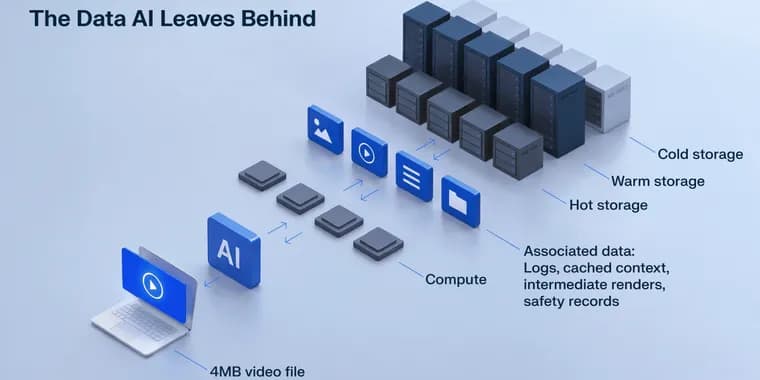
The article is sponsored content. It was produced by WD (Western Digital) and published on MIT Technology Review, and the page says it was not written by the magazine's editorial staff. Its argument: executives picture the cost of AI as GPUs, accelerator racks, gigawatts of power and a waitlist for silicon, but data storage is left out. WD says storage is one of the harder infrastructure costs to plan for and is often overlooked in initial AI infrastructure planning.
The piece contrasts training with inference. A training run is finite: it starts, burns through compute and ends, so it is a project you can budget for and retire. Inference runs continuously, every time a model answers a prompt, and in WD's words "doesn't retire"; every request leaves something behind.
The main example is AI-generated video. From internal measurements, WD says an 8-second clip, returned to the user as a 3.97MB 720p file, left more than 500MB of associated data on the back end. That data included logs, cached context, immediate renders, backups and safety records. WD calls this a 130x increase over the output file size the user saw. It adds that for an enterprise generating longer, higher-resolution video, the back-end footprint grows into the hundreds of gigabytes per clip. That last point is stated as a scaling claim, with no measurement given.
The article then cites growth figures. McKinsey projects AI inference demand will grow at a 35% CAGR through 2030, against 22% for training, making up more than 40% of total data center demand by the end of the decade. A recent WD-sponsored IDC global white paper surveyed 763 IT and business decision makers. Nearly 95% of respondents reported an increase in data volume due to generative AI over the past 12 months, and roughly 61% reported growth of 25% or more. The same survey found 96% of respondents anticipate needing faster archive retrieval to support inference or retrieval-augmented generation (RAG).
An unnamed senior product manager at a hyperscale cloud service provider, quoted in the report, says more storage can be seen as an optimization for keeping GPUs busy, and that hours of GPU idle time become very expensive very fast. The article follows with a hypothetical: if storage spend grows 25% year over year while the compute budget grows in a more predictable cyclical way, storage ends up outpacing the budget line that gets the most attention.
On the data life cycle, WD says compute demand rises and falls with training cycles, product launches and hardware refreshes, but retained data does not fall back with it. Model logs, synthetic outputs and inference results keep accumulating, and organizations hold onto more of them for longer. Archives that once sat untouched can become inputs to future AI workloads. WD says AI workloads need both performance and capacity, and that for the large volumes of data that must be retained and revisited, HDDs provide a cost-effective, high-capacity foundation with a significant cost-per-terabyte advantage. No price figure is given.
For a CFO or CIO, the article says "AI infrastructure spend" may be scoped too narrowly on compute. It says the storage bottleneck stays hidden until it is already a problem, showing up in operating costs and retrieval delays rather than as a CapEx line next to the accelerators. It gives two scenarios: a retailer generating AI product videos for its catalog and an insurer running claims documents through a RAG pipeline. In both, compute is a forecastable per-generation or per-query rate, while storage compounds with every video generated and every claim processed. A team that budgets AI as "compute plus a rounding error for storage" may find, in 12 to 18 months, that the rounding error has become a significant fraction of the program's total cost, around the time leadership is deciding whether to expand.
The recommended direction is what WD calls economically scalable capacity: infrastructure designed for the full AI data life cycle, balancing performance with capacity, power, reliability and total cost of ownership. That means treating old archives as active assets for RAG and inference, setting retention policies for data's growing strategic value rather than its original storage cost, and recognizing that storage decisions play out across fleets, not individual drives. WD notes that most AI data by volume accumulates in the warm, cool and cold tiers, while storage strategy tends to be designed for expensive hot-tier performance.
The piece closes with three budget questions: what is the data retention policy for AI-generated content and who sets it; is storage procurement tied to training-time performance needs or to the actual life cycle of the data being produced; and if AI usage doubled next year, would storage cost double with it, or worse. WD says most organizations cannot answer all three with confidence.
Key facts
- The article is sponsored content produced by WD and published on MIT Technology Review; it was not written by the magazine's editorial staff.
- From WD's internal measurements, an 8-second AI video clip delivered as a 3.97MB 720p file left more than 500MB of back-end data (logs, cached context, renders, backups, safety records), which WD calls a 130x increase.
- McKinsey projects inference demand to grow at a 35% CAGR through 2030 versus 22% for training, making up more than 40% of data center demand by the end of the decade.
- A WD-sponsored IDC survey of 763 IT and business decision makers found nearly 95% reported more data from generative AI over 12 months, roughly 61% reported growth of 25% or more, and 96% expect to need faster archive retrieval for inference or RAG.
- WD argues AI budgets are scoped too narrowly on compute and recommends HDD-based, cost-effective capacity for retained data, then poses three budget questions.
Why it matters
The piece puts a cost on the side of AI that budgets rarely show: what inference leaves behind after the answer is delivered. Its core framing is that training is a finite project while inference never ends, so the data it generates keeps accumulating. If the 130x ratio from WD's video example held widely, the file a user sees would be a small part of what an operator stores. That is a claim to test, not an established fact, since it rests on one clip in WD's own measurements. The article also ties storage to GPU use: an unnamed cloud product manager says idle GPUs waiting for data become very expensive very fast.
Who it affects
The article addresses CFOs and CIOs who set AI infrastructure budgets, and the teams that run generative AI workloads at scale. Its examples are a retailer producing AI product videos and an insurer running claims documents through a RAG pipeline. It also concerns anyone retaining model logs, synthetic outputs and inference results for longer, and operators who plan to reuse old archives for retrieval-augmented generation.
How to use it
The practical part is the three questions WD suggests asking about an AI infrastructure budget: what the retention policy for AI-generated content is and who sets it; whether storage procurement is tied to training-time performance needs or to the real life cycle of the data being produced; and whether storage cost would double, or worse, if AI usage doubled next year. The article also advises setting retention policies by the data's growing strategic value rather than its original storage cost, and treating old archives as active assets for RAG and inference. Its tiering point is that most AI data by volume ends up in warm, cool and cold tiers, not the hot tier that storage strategy is often designed around.
How solid is it
Weak as independent evidence. This is sponsored content written by WD, a storage vendor, and it concludes that HDDs are a cost-effective foundation. The headline 130x figure comes from WD's internal measurements on a single 8-second clip, with no method, model or number of clips given. The claim of hundreds of gigabytes per clip for longer, higher-resolution video is stated without a measurement. The survey is a WD-sponsored IDC white paper of 763 respondents, described only as recent. The McKinsey figures are projections, with no report title given. The 25% annual storage growth and the 12 to 18 month timeline are illustrations, not measured results. The article gives no dollar figures for storage or GPU idle time and no HDD price per terabyte.
Risks and caveats
The article's commercial interest is plain: it moves from a storage-cost warning to an endorsement of HDD capacity. The quoted product manager is unnamed, as is the cloud provider. The 61% figure is worded as a share reporting growth of 25% or more, and the source does not say how it relates to the nearly 95% beyond the sentence structure. Its warning that storage may become a significant fraction of program cost is conditional ("may find"), and nothing in the piece shows how large storage is today relative to compute. Treat the numbers as WD's framing and check them against your own workloads.
“You can think of having more storage as an optimization for keeping the GPUs busy.”
— A senior product manager of a hyperscale cloud service provider (unnamed), quoted in a WD-sponsored report