An essay makes the case for protopia, a future built on 1% gains
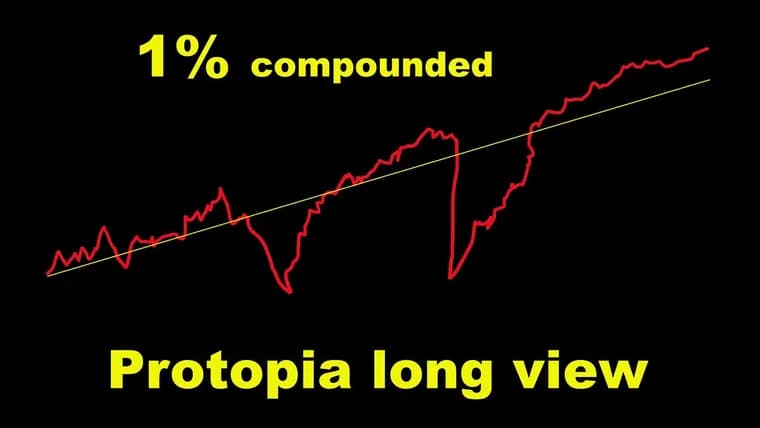
An essay titled "Protopia", published at kevinkelly.substack.com, spells out a concept the author says he first coined in 2011 but had never fully written down until now. Protopia sits between two familiar extremes. Utopia, the mythic future with no or few problems, is called both impossible and undesirable: impossible because it is friction and unsolved problems that drive advancement in the first place, undesirable because a world with one uniformly optimized value becomes someone's prison and would grow boring fast. Dystopia, a world of nearly all problems, is called easy to imagine for a structural reason: there are far more ways to break something than to build it, so the paths to failure vastly outnumber the paths to success, and a collapsing world also makes a far more cinematic story than a thriving one. The author argues this asymmetry is why nearly every film about the future, especially ones involving robots or AI, ends badly, and why a century of high-production dystopian storytelling has trained audiences to picture only one kind of future.
Protopia, by contrast, is defined as a future only slightly better than today: "Maybe it is one or two percent improved since last year." The essay argues that if a society creates just 1% more than it destroys each year, that margin compounds into everything currently taken for granted, from road systems and libraries to literacy and modern healthcare. It frames this arithmetically: the world can be "49% crap, horror, hurt, destruction, bad, and the worst" while still being 51% "good, true and beautiful," with the 1 to 2% margin between them too small to notice except in hindsight, over a long view such as the last 300 years.
A central mechanism in the essay is that every powerful invention solves an existing problem while creating new ones of its own: ships create shipwrecks, cheap food creates obesity, industrialized farming solved subsistence agriculture but produced a raft of new problems. The author states plainly that "AI is the most powerful technology we have invented and it will generate the greatest problems we have ever had," and that "LLMs are mere toddlers," with their real benefits and drawbacks not understood for decades. He argues this cycle of problem, solution, new problem is not stagnant because each round expands the range of choices available, illustrated by occupations: three hundred years ago most people could only be a farmer, a farmer's wife, a blacksmith or a baker, while today people can become drivers, chefs, mathematicians, musicians, web designers, or prompt engineers.
The essay stresses that protopia only works if the compounding is not interrupted: a catastrophic discontinuity, such as an asteroid strike or a nuclear world war, could halt the march of civilization and set it back for ages, which is why functioning institutions and systems like asteroid tracking, nuclear monitoring, and climate relief still matter even inside a protopian outlook. The author closes by calling protopia primarily a labor of imagination: not an unblemished, problem-free destination and not a scripted collapse either, but a future imagined as just a little better than today, with new problems the price of that improvement.
Key facts
- An essay at kevinkelly.substack.com defines protopia as a future that improves roughly one to two percent per year over the previous year, with that margin compounding over time.
- It argues utopia is both impossible, because friction and problems are what drive progress, and undesirable, because a single optimized value becomes someone else's prison.
- It frames dystopia as easy to imagine because there are far more ways for something to fail than to succeed, which also makes dystopian stories more cinematic and dominant in film.
- It states that "the world can be 49% crap, horror, hurt, destruction, bad, and the worst" while still being 51% good, with that 1 to 2% margin invisible except in retrospect.
- It calls AI "the most powerful technology we have invented" that "will generate the greatest problems we have ever had," describing LLMs as "mere toddlers" whose true benefits and drawbacks will take decades to understand, and warns that protopia depends on uninterrupted compounding, which a catastrophic event like an asteroid strike or nuclear war could halt.
Why it matters
The essay offers a named alternative to the two dominant ways technology futures get discussed, especially around AI: an all-problems-solved utopia or an all-problems dystopia. Its argument is that both framings are misleading, and that the more accurate and more actionable picture is slow, uneven, compounding improvement that keeps generating new problems as it solves old ones.
Who it affects
It is aimed at anyone forming a mental picture of where AI and technology are headed: readers exposed mainly to dystopian fiction and headline-driven doom, as well as readers drawn to techno-utopian promises that all major problems will be solved. The essay's own claim is that both audiences are working from a distorted picture.
How to use it
As a framework rather than a product: measure progress against last year rather than against a perfect end state, expect every solution to create new problems worth tracking, and hold a long view, since the essay argues the 1 to 2% margin between good and bad is invisible year to year and only legible in retrospect over spans like 300 years.
How solid is it
This is a personal essay, not a study: it presents no data set, survey, or cited source, and it explicitly frames itself as the author's first full written statement of an idea he says he coined in 2011. Its claims of historical progress and of AI's coming problems are argued through analogy and narrative rather than backed by named evidence.
Risks and caveats
The essay does not specify any mechanism or timeline for how AI's problems would actually get solved, only that understanding its benefits and drawbacks will take decades. It cites no historical events, institutions, or data sources for its claim that the last 300 years show progress in almost every domain. The 49%/51% split and the 1 to 2% yearly figure are illustrative framings rather than measured statistics, and the essay does not identify itself by author name within the body text.
“Dystopia runs on fear, and utopia runs on faith. Protopia runs on facts: the fact of real problems, and the facts of real progress.”
— the essay, published at kevinkelly.substack.com