Analysis: DeepSeek, Kimi and MiniMax models carry NVIDIA Blackwell fingerprint
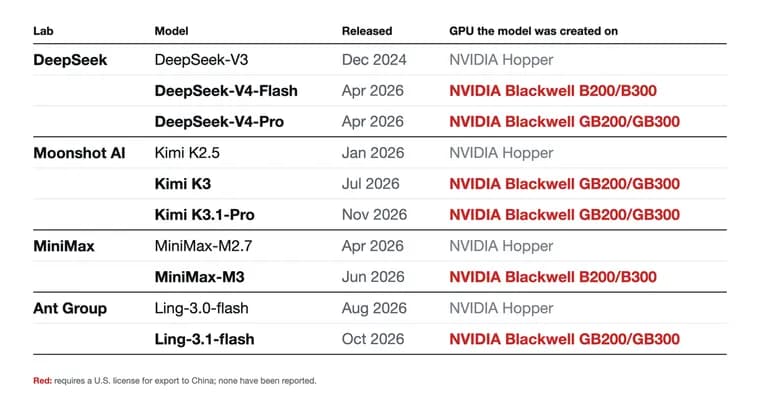
A forensic analysis posted on unemploymentlabs.com (revised November 12, 2026) says that the published weights of six models from DeepSeek, Moonshot AI, MiniMax and Ant Group contain numerical patterns matching NVIDIA's Blackwell GPUs. All six were released since April 2026. Earlier models from the same companies match the older Hopper generation. The analysis says this is evidence the four labs have gained access to Blackwell chips despite export restrictions on China, and that they are using them to create their models. It adds that U.S. officials and press reports had already alleged that DeepSeek and Moonshot AI were using Blackwell chips, without publishing technical evidence.
The method uses only the models' public weights, not leaks or insider accounts. Before training, a model's weights need initial values. In the software examined, those come from a pseudorandom generator called Philox, started from a seed, and PyTorch (through NVIDIA's cuRAND library) splits the work across GPU threads. On the chips examined, a large enough initialization uses the maximum of 2,048 threads per streaming multiprocessor (SM), so the number of SMs sets where each number lands in the weight array. The same seed on a chip with a different SM count puts the numbers in different places. In a toy example with 6 SMs versus 5, only 6 percent of values match the original arrangement. On real chips, the Hopper H100 SXM, H200 and H800 have 132 SMs (270,336 threads), the Blackwell B200/B300 have 148 SMs (303,104 threads), and the Blackwell GB200/GB300 have 152 SMs (311,296 threads). Some weights, such as those reserved for words or symbols never seen in training, stay almost untouched, so the authors can compare them directly with the starting values a candidate seed and thread count would generate. They show DeepSeek-V3's preserved weights matching the Hopper arrangement.
The findings by model: DeepSeek-V4-Flash and MiniMax-M3 match B200 or B300 chips (148 SMs). DeepSeek-V4-Pro, Kimi K3, Kimi K3.1-Pro and Ling-3.1-flash match GB200 or GB300 chips (152 SMs). Kimi K3.1-Pro starts from the same seed as K3 and may be a checkpoint of K3 with further post-training. For DeepSeek-V4-Flash and Kimi K3, the authors also confirmed the match on physical Blackwell chips.
The timeline shows a switch. DeepSeek reads as Hopper through DeepSeek-V3 (December 2024) and as Blackwell from DeepSeek V4 (April 2026). Moonshot reads as Hopper through Kimi K2.5 (January 2026) and Blackwell from K3 (July 2026); Kimi K2.7-Code, posted six weeks before K3, is built on Hopper-era weights but contains a small part matching the B200 or B300. MiniMax reads as Hopper through M2.7 (April 2026) and Blackwell from M3 (June 2026). Ant Group's Ling-3.0-flash (August 2026) reads as Hopper, and Ling-3.1-flash (October 2026) reads as Blackwell. A Hopper reading cannot tell an H800 from an H100 SXM or H200; the H800 identifications in the source's table are lab disclosures, not findings of the method.
Not every Chinese lab has moved. The newest readable models from Alibaba (Qwen), Zhipu (GLM), Tencent, Xiaomi and StepFun all read as Hopper-trained. Meituan says LongCat-2.0 was trained entirely on "AI ASIC superpods", and the authors found no NVIDIA fingerprint in its released weights.
As a check, the authors say that for 24 models whose developers have publicly stated the hardware, the method agrees with the announcement in every case. NVIDIA's own Nemotron-3 Ultra, whose technical report names the GB200 for one phase of training, reads as 152 SMs, the same as Kimi K3. On chance: across roughly 6 trillion seed-and-layout combinations searched, the strongest chance match would be expected to reach about 8 sigma. The strongest evidence for each of the six models ranges from 49 to 1,385 sigma, and even the weakest individual test reaches 20 sigma.
The analysis also estimates the scale of the runs. From model size and training data, it puts the two largest runs, Kimi K3 and DeepSeek-V4-Pro, at Blackwell clusters with the computing power of about 11,500 and 7,500 H100s, or about 4,500 and 3,000 Blackwell GPUs (one Blackwell GPU does the work of about two and a half H100s). The five runs together come to about 30,000 H100 equivalents, or 12,000 Blackwell GPUs. These assume each model was trained on the hardware that initialized it, over one and a half to three months, with GPUs running at about 20% of peak speed (25% for DeepSeek, which has reported 39% for its previous model). At roughly $70,000 per GPU, a figure implied by a Wall Street Journal report that about 36,000 Blackwell chips being installed in Malaysia for ByteDance's use would cost more than $2.5 billion, the largest cluster would cost about $300 million and the five together about $850 million. These cover only final training runs; total spending on export-controlled GPUs is likely in the billions of dollars. The November 12 revision raised the earlier figure of 2,000 to 3,000 Blackwell GPUs for the largest runs, because training runs disclosed on Blackwell have been less efficient than NVIDIA's own benchmarks implied.
The authors state plainly that the findings give technical evidence of access to advanced hardware but do not establish where the chips were located, how access was obtained, or whether export controls were violated.
Key facts
- Six models released since April 2026 from DeepSeek, Moonshot AI, MiniMax and Ant Group match Blackwell hardware; earlier models from the same labs match Hopper.
- The method reads the thread count used to initialize weights: 132 SMs for Hopper H100/H200/H800, 148 for B200/B300, 152 for GB200/GB300.
- The strongest evidence for each of the six models ranges from 49 to 1,385 sigma, against about 8 sigma expected for the strongest chance match across roughly 6 trillion combinations.
- The authors estimate the five runs together used about 12,000 Blackwell GPUs (about 30,000 H100 equivalents), costing about $850 million, and say they are not confident in these estimates.
- The authors say the fingerprint supports, without proving, Blackwell training, and does not establish where the chips were, how access was obtained, or whether export controls were violated.
Why it matters
U.S. officials and press reports had alleged that DeepSeek and Moonshot AI were using Blackwell chips, but without publishing technical evidence. This analysis claims to supply some, drawn only from the models' own published weights. It also shows a timeline: DeepSeek, Moonshot, MiniMax and Ant Group models read as Hopper until early or mid 2026, then as Blackwell. Blackwell chips are export-restricted to China, so the claim bears on how well those restrictions hold.
Who it affects
Directly named are DeepSeek, Moonshot AI, MiniMax and Ant Group. The analysis says Alibaba (Qwen), Zhipu (GLM), Tencent, Xiaomi and StepFun have newest readable models that all read as Hopper-trained, and Meituan says LongCat-2.0 was trained on "AI ASIC superpods" with no NVIDIA fingerprint found. NVIDIA is affected as the maker of the chips in question.
How to use it
The method is described in enough detail to follow: recover the preserved initial values in a model's weights, then search for the seed and GPU thread count that reproduce them. Readers who work with open weights can use the SM and thread counts as a reference: Hopper H100 SXM, H200 and H800 have 132 SMs and 270,336 threads; B200/B300 have 148 and 303,104; GB200/GB300 have 152 and 311,296. A Hopper match cannot tell an H800 from an H100 or H200.
How solid is it
The analysis is published on unemploymentlabs.com, and the visible text names no authors or institution behind it beyond the site. It is a third-party analysis, not a peer-reviewed paper or a lab statement. In its favour: for 24 models whose developers disclosed their hardware, the method agrees with the announcement every time; the match was also confirmed on physical Blackwell chips for DeepSeek-V4-Flash and Kimi K3; and the reported significance (49 to 1,385 sigma per model, at least 20 sigma for the weakest test) is far above the about 8 sigma expected by chance. The scale and cost estimates are much softer: the authors say they are not confident in them, run lengths are inferred from release timelines, and the estimates were already revised upward on November 12. The rest of the investigation and the appendices were not available in the text this retelling draws on.
Risks and caveats
The fingerprint shows how the weights were created; the authors say it supports, without proving, that Blackwell also did the training. Specially configured AMD hardware, also export-restricted, is the only alternative they identified; they excluded it for DeepSeek-V4-Flash and consider it very unlikely for the other five models. The findings do not establish where the chips were, how access was obtained, or whether export controls were violated. The training-scale figures rest on assumptions the weights cannot confirm: GPU efficiency, token counts (DeepSeek's are its own and taken on trust; the others are the authors' estimates by a method not yet published), run length, and that training stayed on the initializing hardware. Run length matters most, since halving it doubles the GPU count; at the pace of Microsoft's 38-day MAI-Base-2 run, the two largest would have needed about 7,000 to 8,500 Blackwell GPUs. No response from the named companies, NVIDIA or the U.S. government appears in the visible text.
“The fingerprint identifies how the weights were created and supports, without proving, the inference that Blackwell also performed the training.”
— From the analysis on unemploymentlabs.com