Anduril reports its Anduril-216 satellite sensor works in orbital night
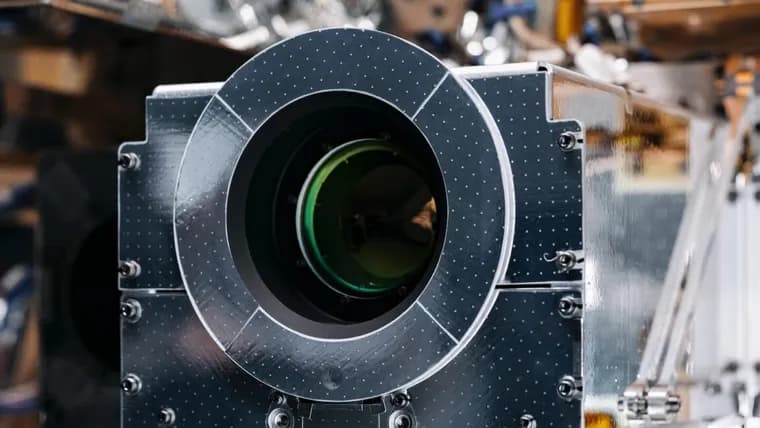
Anduril Industries has announced the successful demonstration of a satellite-based sensor designed to track other spacecraft that may be hiding their maneuvers in Earth's shadow.
The satellite, named Anduril-216, was funded with Anduril's internal capital. It is oven-sized and launched on a SpaceX rideshare mission in July carrying a package of three tech demo payloads: an edge-compute processor, a power-management system adaptable to different mission types, and a long-wave infrared space sensor capable of detecting other objects in orbit. Anduril reported the success of the mission on a Tuesday.
Anduril-216 flies about 590 km (366 mi) above Earth and spends about one-third of each orbit in darkness. According to the article, those night passes are when its infrared imager works to advantage. Gokul Subramanian, Anduril's senior vice president of engineering, called it a unique sensor that takes imagery in long-wave infrared. He said it has a huge dynamic range and very low solar exclusion, so it is blocked by the Sun very rarely, and "we can see things in full dark."
The article frames the sensor as filling a gap. The US military and a growing number of commercial data providers use a network of radars and optical sensors on the ground and in space to monitor satellite traffic. Anduril itself acquired one of those commercial satellite-tracking companies, ExoAnalytic Solutions, earlier this year. But optical tracking has a gap while satellites fly in Earth's shadow, so space traffic monitors could temporarily lose track of a spacecraft if it performs a maneuver in orbital night.
The Space Force is charged with tracking satellites for two primary reasons. First, military commanders want to know if an adversary moves its satellite in a threatening manner. Second, the Space Force issues traffic alerts to global satellite operators if there is a risk of a collision.
Adam Thurn, vice president and general manager of orbital systems at Anduril, described the problem from the military side. Right now, he said, there are no ground sensors in adversaries' sovereign lands, and during the eclipse period the US relies heavily on visible sensors, so satellites not illuminated by the Sun cannot be seen. With the long-wave infrared space sensor, he said, Anduril is looking to close that gap.
Key facts
- Anduril Industries announced the successful demonstration of Anduril-216, an oven-sized satellite funded with its internal capital and launched on a SpaceX rideshare mission in July.
- The satellite carries three tech demo payloads: an edge-compute processor, an adaptable power-management system, and a long-wave infrared space sensor.
- It flies about 590 km (366 mi) up and spends about one-third of each orbit in darkness, when its infrared imager is meant to work to advantage.
- The target is a gap in optical tracking: satellites that maneuver in Earth's shadow can temporarily be lost by space traffic monitors.
- Anduril acquired satellite-tracking company ExoAnalytic Solutions earlier this year.
Why it matters
Satellites that maneuver in Earth's shadow can temporarily drop off optical trackers, according to the article. The Space Force tracks satellites for two reasons: commanders want to know if an adversary moves a satellite in a threatening manner, and it issues collision alerts to global operators. Thurn says the US has no ground sensors in adversaries' sovereign lands and relies heavily on visible sensors during eclipse, so unlit satellites go unseen. A space-based infrared sensor that works in full dark is aimed squarely at that blind spot.
Who it affects
The immediate audience is the US military and the Space Force, which track satellite traffic with radars and optical sensors on the ground and in space, along with a growing number of commercial data providers. Global satellite operators are affected through the Space Force's collision alerts. For Anduril, the demo sits alongside its acquisition of ExoAnalytic Solutions, one of the commercial satellite-tracking companies.
How to use it
This is a company tech demo, not a product on sale. The article describes no customer, contract or Space Force purchase plan, and no price. What the demo shows is the intended pattern: a small satellite at about 590 km carries a long-wave infrared imager, uses its dark-side passes (about one-third of each orbit) to look at other objects in orbit, while an edge-compute processor flies as a separate demo payload.
How solid is it
The claims come from Anduril's own announcement, relayed by Ars Technica with quotes from two Anduril executives. The demonstration is described as successful, but the article gives no calendar date for the announcement or launch, no sensor resolution, detection range or mission duration, and no specific adversary, satellite or maneuver that was observed. No outside experts are quoted. Statements such as "we can see things in full dark" are Subramanian's description of the sensor.
Risks and caveats
The text does not say that the satellite has actually tracked any real spacecraft maneuvering in orbital night. It also does not say how many satellites Anduril plans to build or launch next. Thurn's own wording is that Anduril is "looking to close that gap", which is a goal rather than a finished capability. Cost and funding amounts for the satellite and for the ExoAnalytic acquisition are not given.
“With the long-wave infrared space sensor, we’re looking to close that gap.”
— Adam Thurn, vice president and general manager of orbital systems at Anduril