Google launches Tabletop, an AI tool for building shared planning apps
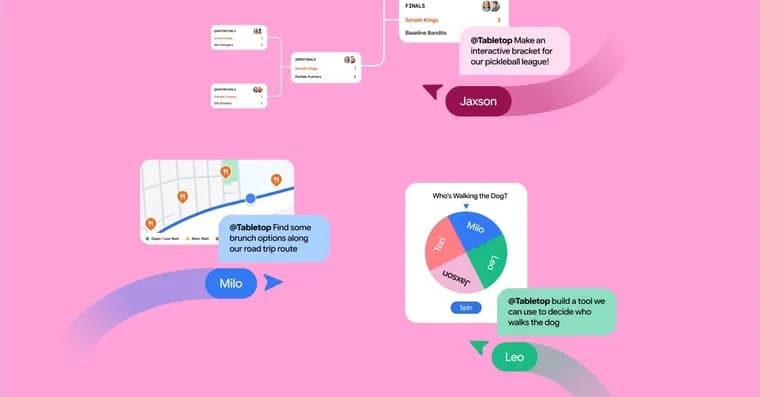
Google has built a new experimental AI tool called Tabletop. It generates customized collaborative hubs to help people coordinate with family and friends. The Verge says the platform looks a bit like workplace management apps such as Asana and Monday, but adds a built-in AI feature for "vibecoding": you describe the interactive tool you want, and the AI creates it. Examples named are savings trackers, chore charts and event plans.
Roman Nurik, Google Labs design and engineering lead, describes the workflow in the Tabletop blog post. You add your links, files and ideas, then prompt @tabletop, or pick a starter template. The tool then generates custom interactive trip itineraries, dinner polls, expense splitters and tournament brackets. Once the space is ready, you drop the invite link into your group chat so everyone can join and use it at the same time, "like a Google Doc". Nurik also shows example use cases in a video.
Access to the Tabletop beta is rolling out through a waitlist. For now it is limited to people over the age of 18 in the US. The Verge's author notes that some of the use cases in Nurik's video would clearly require giving kids or teens access. The author also sees personal family planning as a compelling alternative to stuffy workplace software, and suggests the age requirement might only apply while Tabletop is in public testing. That is the author's speculation, not an announced plan.
Key facts
- Tabletop is a new experimental AI tool from Google that generates customized collaborative hubs for coordinating with family and friends.
- Users add links, files and ideas, then prompt @tabletop or pick a starter template to generate trip itineraries, dinner polls, expense splitters and tournament brackets.
- A finished space is shared by invite link in a group chat, and everyone can use it at the same time like a Google Doc.
- The beta is rolling out via a waitlist and is currently limited to people over 18 in the US.
- The Verge's author speculates that the age requirement might only last while Tabletop is in public testing.
Why it matters
Tabletop applies AI app generation to personal planning rather than office work. The Verge compares its look to Asana and Monday, but its pitch is that you describe a tool in plain words (a savings tracker, a chore chart, an event plan) and the AI builds it. The article's author calls personal family planning a compelling alternative to stuffy workplace software.
Who it affects
For now, only adults in the US who get off the waitlist, since the beta is limited to people over 18 in the US. The intended use is groups of family and friends planning trips, dinners, shared expenses or tournaments. The author notes that some of the example use cases in Nurik's video would clearly involve kids or teens.
How to use it
Join the waitlist; access to the beta is rolling out that way. Once in, add your links, files and ideas, then prompt @tabletop or pick a starter template to generate an interactive tool such as a trip itinerary, dinner poll, expense splitter or tournament bracket. When the space is ready, share the invite link in your group chat so everyone can use it at the same time. The text gives no pricing.
How solid is it
This is a short report from The Verge built on Google Labs' blog post and a video by Roman Nurik, Google Labs design and engineering lead. The facts about what Tabletop does come from Google's own description. The text gives no user numbers, benchmarks or independent testing results. It does not name the AI model behind Tabletop.
Risks and caveats
It is an experiment in beta, not a finished product. The text gives no launch date and no timeline for wider availability. Lifting the over-18 limit is only the author's guess, hedged with "might". Nothing says Tabletop is available outside the US. The text gives no waitlist sign-up details.
“Once your space is ready, drop the invite link in your group chat to let everyone jump in and use it at the same time like a Google Doc.”
— Roman Nurik, Google Labs design and engineering lead, in the Tabletop blog post