APEX drops DMD's fake-score network for few-step streaming video
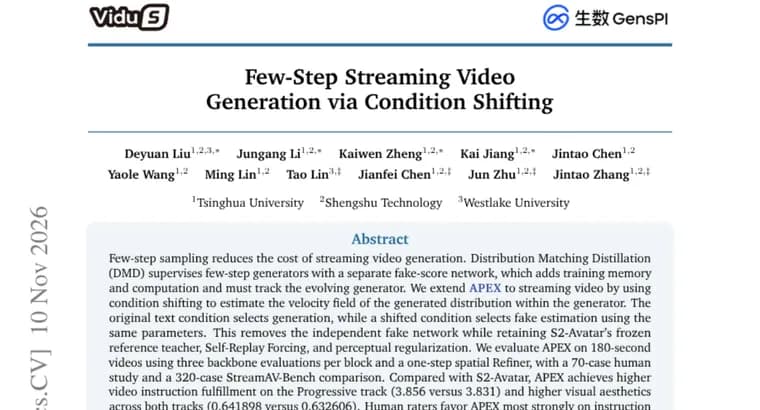
Few-step sampling cuts the cost of streaming video generation, and Distribution Matching Distillation (DMD) is one way to train such generators. The paper's authors point to a drawback: DMD supervises the few-step generator with a separate fake-score network, which adds training memory and computation and has to keep tracking the generator as it changes.
The paper extends APEX to streaming video to get rid of that network. It uses condition shifting to estimate the velocity field of the generated distribution inside the generator itself. The original text condition selects ordinary generation, while a shifted condition selects fake estimation, and both use the same parameters. The independent fake network goes away. Three parts of S2-Avatar stay in place: its frozen reference teacher, Self-Replay Forcing, and perceptual regularization.
The evaluation covers 180-second videos, using three backbone evaluations per block plus a one-step spatial Refiner. It includes a 70-case human study and a 320-case StreamAV-Bench comparison. Against S2-Avatar, APEX scores higher on video instruction fulfillment on the Progressive track (3.856 versus 3.831) and higher on visual aesthetics across both tracks (0.641898 versus 0.632606).
In the human study, raters favor APEX most strongly on instruction following, with a +30.0% net preference. Consistency and video quality follow at +4.3% each. Motion quality favors S2-Avatar, audiovisual synchronization is predominantly tied, and usability is unchanged.
Cost was measured separately from quality, under matched training settings. Compared with DMD, the setup shows 4.4% lower peak allocated GPU memory per GPU and 9.2% shorter mean iteration time.
Key facts
- The paper extends APEX to streaming video and uses condition shifting so one set of parameters handles both generation and fake estimation, removing DMD's separate fake-score network.
- S2-Avatar's frozen reference teacher, Self-Replay Forcing and perceptual regularization are kept.
- Against S2-Avatar, APEX scores 3.856 versus 3.831 on video instruction fulfillment (Progressive track) and 0.641898 versus 0.632606 on visual aesthetics (both tracks).
- In a 70-case human study, net preference for APEX is +30.0% on instruction following and +4.3% each on consistency and video quality; motion quality favors S2-Avatar.
- Under matched training settings, APEX shows 4.4% lower peak allocated GPU memory per GPU and 9.2% shorter mean iteration time than DMD.
Why it matters
DMD-style distillation needs a second network, the fake-score network, that adds training memory and computation and has to follow the evolving generator. This paper tries to remove that cost for streaming video by having the generator estimate the fake distribution itself, switching between the two jobs with a shifted text condition. The result is a simpler training setup that keeps the rest of the S2-Avatar recipe.
Who it affects
The work is aimed at people training few-step streaming video generators with DMD-style distillation, especially those building on S2-Avatar, since the method keeps that system's frozen reference teacher, Self-Replay Forcing and perceptual regularization. No authors or institutions are named in the source text.
How to use it
Nothing is directly usable yet. No code, model release or dataset release is mentioned. The practical idea for a team already running DMD-style training is the one the paper describes: use the original text condition for generation and a shifted condition for fake estimation, with shared parameters, instead of training a separate fake network.
How solid is it
This is a preprint with an automatic benchmark (320 cases on StreamAV-Bench) and a 70-case human study. The quality gains over S2-Avatar are small on the automatic metrics: 3.856 versus 3.831 and 0.641898 versus 0.632606. The scale and range of those scores are not given, so how large the differences are is not stated. The source does not say whether the differences are statistically significant. The one big human-study number is the +30.0% net preference on instruction following; consistency and video quality are +4.3% each. The 4.4% memory and 9.2% iteration-time savings come from separate measurements under matched training settings, and no absolute values are given, only percentages relative to DMD.
Risks and caveats
The trade-offs are visible in the results. Motion quality favors S2-Avatar, audiovisual synchronization is predominantly tied, and usability is unchanged. The instruction-fulfillment gain is reported only for the Progressive track. No figures are given for motion quality, synchronization or usability beyond the direction. No inference speed, frame rate or latency figures are given, so the gains cover training cost and quality only. The source does not say what APEX stands for or describe the original APEX method.
“The original text condition selects generation, while a shifted condition selects fake estimation using the same parameters.”
— From the paper's abstract