dNaViT turns a frozen vision encoder into a discrete visual tokenizer
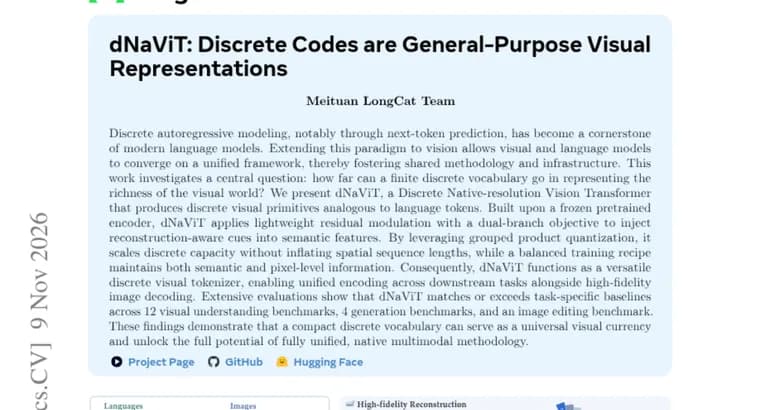
The paper, listed on Hugging Face Papers, starts from an observation about language models: discrete autoregressive modeling, notably next-token prediction, has become a cornerstone of modern language models. Extending that paradigm to vision would let visual and language models converge on one framework and share methodology and infrastructure. The work asks a central question: how far can a finite discrete vocabulary go in representing the richness of the visual world?
Its answer is dNaViT, a Discrete Native-resolution Vision Transformer that produces discrete visual primitives analogous to language tokens. It is built on a frozen pretrained encoder. On top of that encoder, dNaViT applies lightweight residual modulation with a dual-branch objective, which injects reconstruction-aware cues into the encoder's semantic features. Grouped product quantization lets it scale discrete capacity without inflating spatial sequence lengths, and a balanced training recipe keeps both semantic and pixel-level information.
As a result, the authors say, dNaViT works as a versatile discrete visual tokenizer: one encoding serves several downstream tasks, and the same codes also support high-fidelity image decoding.
On results, the abstract states that dNaViT matches or exceeds task-specific baselines across 12 visual understanding benchmarks, 4 generation benchmarks and an image editing benchmark. The authors conclude that these findings show a compact discrete vocabulary can serve as a universal visual currency and unlock the full potential of fully unified, native multimodal methodology.
Key facts
- dNaViT is a Discrete Native-resolution Vision Transformer that produces discrete visual primitives analogous to language tokens.
- It is built on a frozen pretrained encoder, with lightweight residual modulation and a dual-branch objective adding reconstruction-aware cues to semantic features.
- Grouped product quantization scales discrete capacity without inflating spatial sequence lengths.
- The abstract says it matches or exceeds task-specific baselines on 12 visual understanding benchmarks, 4 generation benchmarks and an image editing benchmark.
- The authors conclude that a compact discrete vocabulary can serve as a universal visual currency.
Why it matters
Language models have settled on discrete next-token prediction. The paper's aim is to bring vision into that same framework, so that visual and language models share methodology and infrastructure. dNaViT is offered as a test of how far a finite discrete vocabulary can represent the visual world, and as a single tokenizer that serves understanding, generation and editing alike.
Who it affects
The work is aimed at researchers building unified multimodal systems, where images and text would be handled as sequences of discrete tokens. The abstract frames the result as relevant to the methodology and infrastructure that visual and language models could share.
How to use it
The abstract describes a method, not a product. It says dNaViT sits on a frozen pretrained encoder and serves as a discrete visual tokenizer for downstream tasks and for image decoding. No release of code, weights or a dataset is mentioned.
How solid is it
This is a paper listed on Hugging Face Papers, and the claims come from its abstract. The abstract says the evaluations are extensive and reports counts only: 12 visual understanding benchmarks, 4 generation benchmarks and an image editing benchmark. No specific benchmark names, scores, or margins over baselines are given. The abstract names no authors or institutions.
Risks and caveats
The wording is 'matches or exceeds', so the abstract does not say dNaViT beats the baselines on every benchmark, and it does not state which baselines count as task-specific. It does not say which pretrained encoder is frozen or how large the model or its vocabulary is. The conclusion about a universal visual currency is the authors' own reading of their results.
“a compact discrete vocabulary can serve as a universal visual currency”
— dNaViT paper abstract