Apodex 1.1 claims leading agentic performance from a smaller model
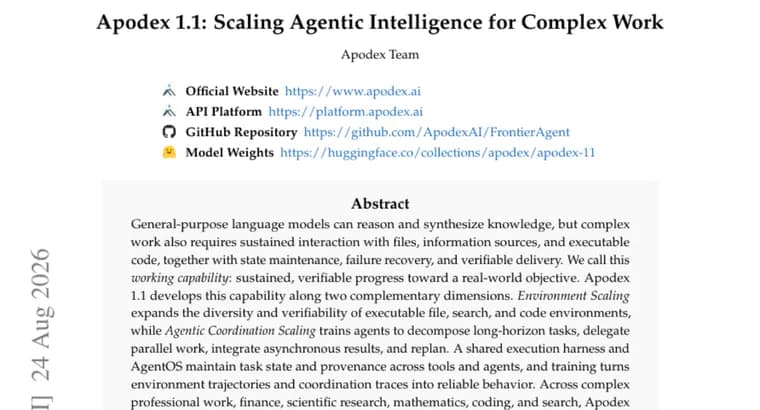
The Apodex Team has published a paper introducing Apodex 1.1, an agentic AI system built around what the authors call working capability: sustained, verifiable progress toward a real-world objective. Their argument is that general-purpose language models can already reason and synthesize knowledge, but complex work also demands sustained interaction with files, information sources and executable code, plus state maintenance, failure recovery and verifiable delivery, none of which pure reasoning covers on its own.
Apodex 1.1 develops this capability along two dimensions. Environment Scaling expands the diversity and verifiability of the executable file, search and code environments the system operates in. Agentic Coordination Scaling trains the agents to decompose long-horizon tasks, delegate parallel work, integrate asynchronous results and replan as circumstances change. Underneath both, a shared execution harness and a system the paper calls AgentOS maintain task state and provenance across tools and agents, and training converts environment trajectories and coordination traces into reliable behavior.
The paper claims that across complex professional work, finance, scientific research, mathematics, coding and search, Apodex 1.1 reaches the leading performance band despite using a substantially smaller model than many frontier systems. It does not name the specific benchmarks, scores or comparison models behind that claim, nor does it state Apodex 1.1's own parameter count. A second, explicitly smaller variant, the 35B-parameter Apodex 1.1 Mini, is described as retaining strong working capability while being deployable locally. The team frames the results as a step toward what it calls a Heavy-Duty Solver, a system built for ambitious, long-running tasks, though no timeline or roadmap for that goal is given.
Key facts
- The Apodex Team defines working capability as sustained, verifiable progress toward a real-world objective, distinct from pure reasoning.
- Apodex 1.1 is built on two dimensions: Environment Scaling (broader, more verifiable file, search and code environments) and Agentic Coordination Scaling (decomposing long-horizon tasks, delegating parallel work, integrating async results, and replanning).
- A shared execution harness and a system called AgentOS maintain task state and provenance across tools and agents.
- The paper claims Apodex 1.1 reaches a leading performance band across professional work, finance, science, math, coding and search despite using a substantially smaller model than many frontier systems, without naming specific benchmarks or rival models.
- A 35B-parameter Apodex 1.1 Mini variant is said to retain strong working capability while being deployable locally.
Why it matters
The paper's framing shifts the target from raw reasoning ability to what it calls working capability: whether a system can sustain interaction with files, information sources and executable code long enough to deliver a verifiable real-world result, recovering from failures and maintaining state along the way. That reframing is presented as the foundation for a longer-term goal the team calls a Heavy-Duty Solver, a system meant for ambitious, long-running tasks rather than single-turn answers.
Who it affects
The paper positions Apodex 1.1 for complex professional work spanning finance, scientific research, mathematics, coding and search, domains where a single answer matters less than sustained task execution. The 35B-parameter Mini variant is aimed specifically at users who need that same working capability in a form small enough to deploy locally rather than through a hosted frontier-scale model.
How to use it
The source text gives no pricing, licensing or access details for either Apodex 1.1 or the Mini variant, and no release date. The one concrete deployment detail is that Apodex 1.1 Mini, at 35B parameters, is described as deployable locally, in contrast to the larger frontier systems the paper compares itself against.
How solid is it
The claims come from a paper published by the Apodex Team itself, with no individual author names or institutional affiliation given beyond that team name. The central performance claim, that Apodex 1.1 reaches a leading performance band across six domains, is not backed by named benchmarks, scores or comparison models in the text, and the full Apodex 1.1 model's own parameter count is not stated, only the Mini's 35B.
Risks and caveats
Because no specific benchmark names, scores or rival systems are given, the leading-performance claim cannot be independently checked from the text alone. The claims are self-reported by the team that built the system, and the stated ambition of a Heavy-Duty Solver is described only as a goal, not a shipped capability.
“We call this working capability: sustained, verifiable progress toward a real-world objective.”
— Apodex Team, in the paper