Apple's iPhone keyboard has a grey list of 100,000+ phrases it won't complete
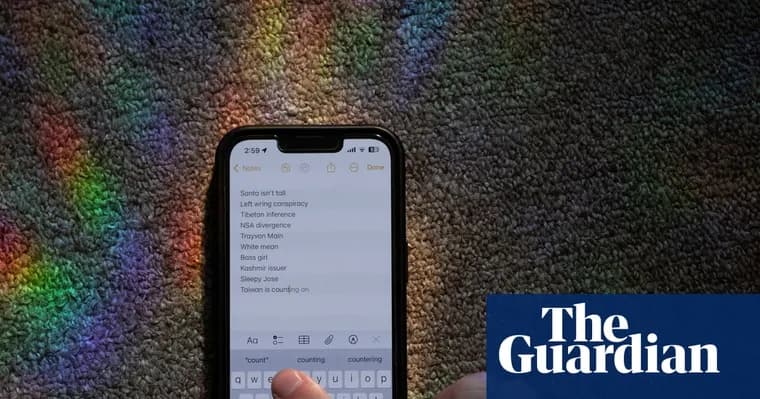
The Guardian reports on new research showing that Apple has a “grey list” of more than 100,000 words and phrases that it has restricted from being completed by its predictive text. The list was found by the independent researcher Derik Kauffman, whose other projects include using AI to find errors in scientific papers. He noticed that he had trouble typing certain phrases on his iPhone, but not others, and then unearthed a table containing the list, encoded in Apple's operating system.
The effect is easiest to see when swipe-typing, that is, gliding a finger across the keyboard instead of tapping each letter. Predictive text will not suggest the listed words, and a user who swipes them will often get something else: “United Ireland” turns into “United Iceland”, and “Tibetan independence” becomes “Tibetan independences”. The Guardian opens with a deliberately outlandish sample sentence, “Australia is a very bad place to question your sexuality on MDMA with NSA spies”, as an example of text the keyboard will not help with. Phrases such as “Dictator Trump”, “NSA spies”, “question your sexuality” and “on MDMA” must be spelled out by hand, and, surprisingly, so must “Australia is a very bad place”.
Some entries are unsurprising. The iPhone will not autocomplete references to drugs or sexual acts, and, perhaps in the spirit of corporate protection, “iMessage isn't working”. Others are possibly politically charged. Among them are “Trayvon Martin”, the name of the Black teenager shot in Florida in 2012, “Kashmir dispute”, “Muslim extremist” and “male chauvinist pig”. Kauffman described these phrases to Reuters as a “light-touch form of censorship”. The list is not English-only: in Hebrew, Apple will not autocomplete “the occupied territories”, and in Arabic it will not autocomplete “the Hamas movement”.
The Guardian places the find in the history of autocorrect. The earliest version, in Unix, looked up each typed word in a table to check its spelling. That evolved into n-grams, which statistically predict the next word from the words before it and form the basis of Apple's familiar autocorrect, once known for turning expletives into prudish alternatives such as “fork” and “ducking”. Last year Apple launched a “transformer-based” autocorrect more akin to an LLM; Reddit users saw it as a possible reason for a spate of odd spelling suggestions. The hard-coded list clears up one longstanding mystery, but others remain, such as a brief glitch in which dictation users saw “Trump” flash on screen when they said “racist”, which Apple quickly remedied.
Apple said it designed its keyboard to avoid offering inappropriate or offensive predictive suggestions. It added that iPhone users can always type out specific words or phrases and override predictive text suggestions to get their desired meaning.
Key facts
- Independent researcher Derik Kauffman found a table in Apple's operating system listing more than 100,000 words and phrases that predictive text will not complete.
- Swipe-typing listed phrases often goes wrong: “United Ireland” becomes “United Iceland” and “Tibetan independence” becomes “Tibetan independences”.
- Entries cover drugs, sexual acts and “iMessage isn't working”, plus possibly political phrases such as “Trayvon Martin”, “Kashmir dispute”, “Muslim extremist” and “male chauvinist pig”.
- Hebrew and Arabic are affected too: “the occupied territories” in Hebrew and “the Hamas movement” in Arabic are not autocompleted.
- Apple says the keyboard is designed to avoid inappropriate or offensive suggestions and that users can always type phrases out in full.
Why it matters
Autocorrect is one of the most-used pieces of software on a phone, and its inner workings are rarely visible. A hard-coded list of more than 100,000 entries shows that some of what the keyboard does, or declines to do, is a deliberate choice rather than a statistical accident. The mix is what draws attention: alongside drugs and sexual acts sit possibly politically charged phrases, which Kauffman called a “light-touch form of censorship”. The Guardian also notes that the list clears up one longstanding mystery about the keyboard.
Who it affects
Anyone who types on an iPhone and uses predictive text or swipe-typing. The examples in the report span English, Hebrew and Arabic, so users writing about politically sensitive topics in those languages may notice the gaps. The article does not give the number of languages covered.
How to use it
There is nothing to switch on. If a phrase is not suggested or comes out garbled when swiped, Apple says you can type out the specific words or phrases yourself and override the predictive suggestions to get the meaning you want. The Guardian's examples show what to expect: “United Ireland” may turn into “United Iceland” when swiped.
How solid is it
The reporting is a Guardian article describing Kauffman's research, with Kauffman's “light-touch form of censorship” remark taken from what he told Reuters. Apple's response is a general statement about avoiding inappropriate or offensive suggestions. The list size is given as a lower bound, “more than 100,000”. The Guardian's opening sentence is a hypothetical example, not a quote from anyone.
Risks and caveats
The article does not say which iOS version(s) contain the list or when it was added. It does not say why Apple included each specific political phrase, or who compiled the list. Apple's statement does not address the political phrases specifically, and it neither denies nor confirms the “censorship” characterisation. No link to or publication venue for Kauffman's research is given beyond his remarks to Reuters. The article also does not say whether the list applies to Android or other keyboards. “Censorship” is Kauffman's description of the political entries, not an established finding.
“light-touch form of censorship”
— Derik Kauffman, independent researcher, to Reuters, on the politically charged phrases on the list