Discord's Rust client outpaces its Electron app in cold-start demo
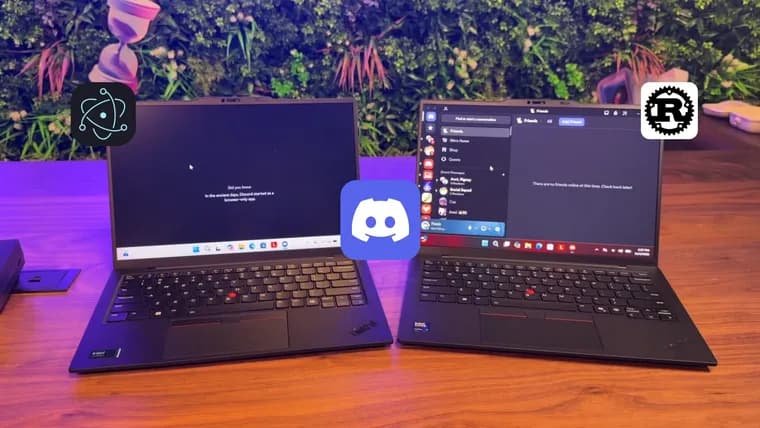
Windows Latest reports on a 15-second clip posted on X by Discord co-founder and CTO Stanislav Vishnevskiy. It puts the current Electron desktop client on the left and a new Rust rebuild on the right, and the new client had its friends list loaded before the Electron app got past its loading screen. Discord employees have confirmed that both apps were launched from a cold start. The video had 2.3 million views at the time of writing. Vishnevskiy wrote that lower RAM use is only part of the story and that clicking around feels instant.
The outlet went through the clip frame by frame. The Electron app was opened first and showed a blank dark window for about three seconds, then a tip reading 'In the ancient days, Discord started as a browser-only app.' The new client was double-clicked roughly a second and a half later, yet its window faded in within a second. When the old app reached its interface, about five seconds after launch, the Rust version already had the friends list loaded, while the Electron client briefly said there were no friends online. Asked on X whether the new app had simply popped out of the system tray, Coral, who leads audio and video at Discord, said both were cold starts. Travis, who works on socials and community at Discord and filmed the clip, said a tray launch would have meant the friends list was already loaded.
The new client also skips the 'Starting' update screen, which one person on X said takes 5-10 seconds every time. Coral said it bootstraps so fast, and uses a new architecture, that the modal is not needed, and updates happen in the background. Discord does not currently hand updates to the Microsoft Store or Windows' Update Orchestration Platform.
In Task Manager the new client shows up as Discord Phoenix and used 290.2MB of RAM. Vishnevskiy said that figure came with two accounts signed in at once, a feature the new client supports; he answered 'Yup' when asked whether work and personal accounts can run without tearing down the client in between. The current Account Switcher lets users add up to five accounts. For context, the outlet cites a Discord employee's December 2025 statement that normal Electron usage is under 1GB, with the company having tested auto-restarting the app at 4GB, and says the Electron app usually idles at 1-2GB on its own PCs. By its own arithmetic, 290.2MB is about 70% below the 1GB mark. The outlet stresses this is a snapshot from an early build, that Discord has not published a like-for-like benchmark of both clients, and that it will run its own test once it gets hands-on. Discord's September patch notes say the Electron 42 upgrade cut median CPU usage by about 17%, at the cost of a smaller regression to p50 memory usage of about 4%.
On the technology, Discord chose GPUI, described as a fast, hybrid immediate and retained mode, GPU-accelerated UI framework for Rust from the makers of the Zed code editor, rather than Tauri, which many had guessed. GPUI draws the interface on the GPU without any HTML. Discord has used Rust since 2018 and has its own patches on top of GPUI; Vishnevskiy said they will see what they can upstream if relevant to the community. Web tech stays where it makes sense: YouTube embeds and Activities will use the system webview, which Vishnevskiy likened to Tauri's approach. Mobile apps keep native interfaces but will share app code with desktop through Rust, and drop React Native. Vishnevskiy explained that the iOS app started as React Native and Android was ported to it a couple of years ago to achieve parity. The browser version will keep rendering HTML, but its logic will be WASM instead of JS. He added that the app looks and works identically to the current one.
Discord marketing director Ryan K. Rigney said the client is going into private testing soon, that the team will take its time to make sure it is stable and secure first, and that it 'won't be long.' Mark Smith, Discord's VP of Engineering, said accessibility and security are just as important to the company as performance, and Coral said the login token is kept in the system keyring, which is Credential Manager on Windows 10 and 11. Asked about Linux, Rigney replied 'Yes,' and Coral said a lot of people run Mac internally. No public release date has been announced.
The Windows Latest author closes with opinion: Meta and Microsoft are running out of excuses. He says WhatsApp went from a native app that idled under 100MB to a WebView2 wrapper using up to 1.2GB, and that he uninstalled it, while Microsoft Teams, also on WebView2, took up 963MB doing nothing in the outlet's tests. He ties the RAM turnaround to AI: data centers soaked up DRAM supply, prices rose, and Windows chief Pavan Davuluri now says memory is top of mind for the industry as Microsoft trims Windows 11's RAM usage.
Key facts
- In a 15-second clip from Discord CTO Stanislav Vishnevskiy, the new Rust client showed its friends list before the Electron app got past its loading screen; Discord employees confirmed both were cold starts.
- The new client, shown as Discord Phoenix in Task Manager, used 290.2MB of RAM with two accounts signed in; the outlet's roughly 70% figure compares that with a 1GB mark cited for Electron and is not a like-for-like benchmark.
- The UI is built on GPUI, from the makers of the Zed editor, not Tauri. Activities and YouTube embeds use the system webview, mobile drops React Native, and the web version moves its logic to WASM.
- Discord says private testing is coming soon; no public release date has been announced. Rigney said it works on Linux, and Coral said many staff run it on Mac.
- The new client stores its login token in the system keyring and updates in the background, skipping the 'Starting' screen.
Why it matters
Electron has been the default way to ship one desktop chat app on Windows, macOS and Linux for a decade, and the outlet argues Discord has now shown that an app with millions of users can drop the bundled browser without a redesign. Discord says the new app looks and works identically to the current one. The author also links the shift to RAM costs: with DRAM prices up because of data center demand, apps that kept asking for more memory are, in his words, finally going on a diet.
Who it affects
Discord desktop users on Windows, macOS and Linux are the first in line, particularly those who juggle several accounts, since the new client can run two at once and the old Account Switcher allows up to five. The outlet also aims its opinion at Meta and Microsoft, citing WhatsApp (up to 1.2GB as a WebView2 wrapper) and Teams (963MB doing nothing in its tests). Developers weighing Electron, Tauri or GPUI have a high-profile example to watch.
How to use it
It cannot be used yet. Discord says private testing is coming soon and has announced no public release date. When it ships, Discord says it will update in the background and show no 'Starting' modal. The outlet says it will run its own hands-on test once it has the Rust version.
How solid is it
The clip comes from Discord's own CTO and official account, and Discord employees confirmed both apps were cold-started. The outlet counted frames itself. The RAM number is weaker: 290.2MB is a snapshot from an early build with two accounts signed in, and the 70% comparison is the outlet's own, set against a 1GB figure from a Discord employee's December 2025 statement. Discord has not published a like-for-like benchmark of both clients.
Risks and caveats
This is a marketing-adjacent demo of an unreleased early build, so real-world performance may differ. Rigney said the team will take its time to make sure it is stable and secure first. The author's views on WhatsApp, Teams and AI-driven RAM prices are his own, not Discord's. Discord does not currently distribute updates through the Microsoft Store or Windows' Update Orchestration Platform.
“Clicking around feels instant, I can’t go back.”
— Stanislav Vishnevskiy, Discord co-founder and CTO, on X