Apple ships M6 and M5 Ultra, its first 2nm chip and first quad-die design
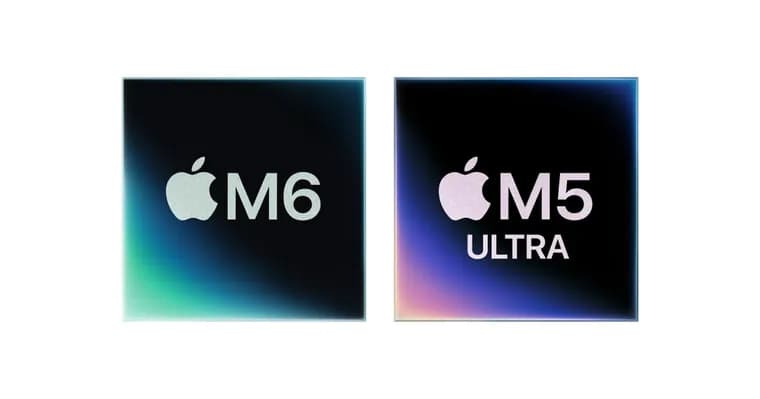
Apple announced two new Mac chips on August 25, 2026: M6, arriving in a new Mac mini, and M5 Ultra, arriving in a new Mac Studio. M6 is Apple's first chip built on a 2-nanometer process. It has a 12-core CPU (2 super cores, 4 performance cores, 6 efficiency cores, two more cores than M5), a 12-core GPU with Neural Accelerators in each core, a Dual 16-core Neural Engine, and up to 170GB/s of unified memory bandwidth. Apple says M6 delivers up to 1.2x faster multithreaded performance than M5 and up to 2.4x faster than M1, with nearly 30 percent more peak GPU compute for AI than M5 and over 8x more than M1. M6 supports up to 32GB of unified memory. M5 Ultra is Apple's most powerful chip yet and its first quad-die design, built by joining two dual-die M5 Max chips with a next-generation version of Apple's UltraFusion interconnect, which Apple says raises inter-die bandwidth to over 4.4TB/s and connection density by more than 6x. M5 Ultra has an up-to-36-core CPU (12 super cores, 24 performance cores) and an up-to-80-core GPU, also with Neural Accelerators, plus a 32-core Neural Engine. It supports up to 512GB of unified memory with 1.2TB/s of memory bandwidth, 50 percent more bandwidth than M3 Ultra. Apple says this lets M5 Ultra machines hold huge datasets entirely in local memory, raise tokens-per-second throughput, and run large language models with hundreds of billions of parameters entirely on device. Apple also claims up to 4.5x the peak AI GPU compute of M3 Ultra and over 6x that of M1 Ultra, plus up to 40 percent faster graphics performance than M3 Ultra. Sri Santhanam, Apple's vice president of Silicon Engineering Group, said the two chips represent "the next giant leap in performance and AI compute for Apple silicon." Apple frames both chips around on-device AI: its developer tools, including Core AI, Core ML, Metal and Xcode, are built to tap the Neural Engines and GPU Neural Accelerators so developers can run and fine-tune large AI models locally on a Mac, using Apple's own Foundation Models or their own. Apple did not disclose pricing or on-sale dates for the new Mac mini or Mac Studio in the announcement; the only date given is that Apple Intelligence features arrive with macOS 27 this fall for supported languages and devices.
Key facts
- M6 is Apple's first 2-nanometer chip, with a 12-core CPU, a 12-core GPU with Neural Accelerators, a Dual 16-core Neural Engine, and up to 170GB/s of unified memory bandwidth, shipping in a new Mac mini.
- M5 Ultra is Apple's first quad-die chip, joining two M5 Max dies via next-generation UltraFusion (over 4.4TB/s inter-die bandwidth), with an up-to-36-core CPU and up-to-80-core GPU, shipping in a new Mac Studio.
- M5 Ultra supports up to 512GB of unified memory at 1.2TB/s of bandwidth, which Apple says lets it run LLMs with hundreds of billions of parameters entirely on device.
- Apple claims M6 is up to 2.4x faster than M1 and M5 Ultra delivers up to 4.5x the AI GPU compute of M3 Ultra, all measured in Apple's own internal testing.
- No pricing or on-sale date was given for either the new Mac mini or Mac Studio; only Apple Intelligence's macOS 27 arrival this fall was dated.
Why it matters
M6 and M5 Ultra mark two firsts for Apple silicon at once: M6 is the company's first chip on a 2-nanometer process, and M5 Ultra is its first chip built from four dies fused together rather than two. Both changes are aimed squarely at on-device AI rather than general compute alone, each GPU core now carries a dedicated Neural Accelerator, and Apple is explicit that the goal is running large models locally rather than only in the cloud.
Who it affects
Mac mini buyers get M6; Mac Studio buyers get M5 Ultra. Apple names everyday users, students, developers, AI hobbyists and enterprises as the M6 audience, and describes M5 Ultra as built for professionals doing 3D rendering, visual effects, scientific analysis and running compute-intensive frontier AI models on device. App and model developers are a specific target: Apple's Core AI, Core ML, Metal and Xcode frameworks are pitched as tapping directly into the new Neural Engines and GPU Neural Accelerators.
How to use it
M6 ships in the new Mac mini with up to 32GB of unified memory; M5 Ultra ships in the new Mac Studio with up to 512GB of unified memory and 1.2TB/s of bandwidth, the configuration Apple says can hold huge datasets in local memory and run LLMs with hundreds of billions of parameters entirely on device. Apple's own tools let developers run and fine-tune large AI models locally on a Mac using Apple's Foundation Models, App Intents, or their own proprietary models. No pricing or shipping date for either machine appeared in the announcement.
How solid is it
The figures are Apple's own: process node, core counts, memory bandwidth and capacity are specified concretely, but every performance multiple (1.2x, 2.4x, 4.5x and similar) comes from Apple-run benchmarks against Apple-chosen prior chips and 'select industry-standard benchmarks,' with the competitive baseline for some comparisons left unnamed in the source. The fabrication partner for the 2-nanometer process is not stated.
Risks and caveats
All performance claims are vendor-supplied and unverified by outside testing. The source gives no price, no on-sale date, and no absolute power-consumption or battery-life figures for either new machine, only comparative efficiency language. Apple Intelligence features tied to these chips are described as available with macOS 27 this fall, but only for devices set to one of a listed set of supported languages, and Apple notes some features may not be available in all regions or languages.
“Today, we're debuting the next giant leap in performance and AI compute for Apple silicon with the incredibly advanced M6 and the most powerful M-series chip yet, M5 Ultra.”
— Sri Santhanam, Apple's vice president of Silicon Engineering Group