Apple Workgroup Server 9150 restored to run MkLinux again
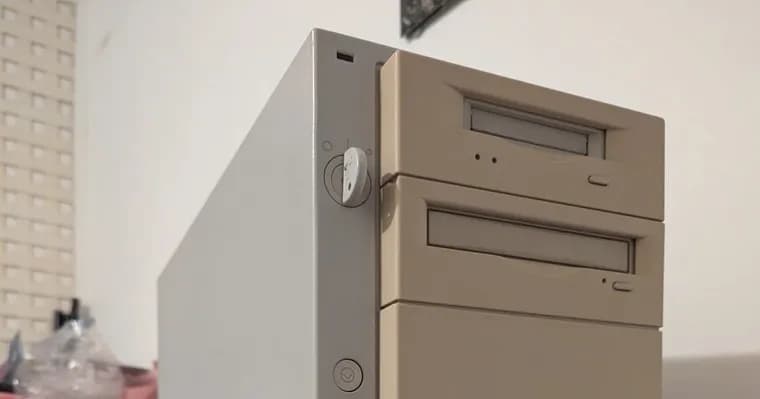
Apple's server line began with the failed 1985 Macintosh Office push and the never-shipped "Big Mac" (internally "3M") project that Steve Jobs championed before his ouster that year. AppleShare in 1987 and Apple's own Unix, A/UX, from 1988 slowly filled the gap: A/UX 1.0 shipped on a special Macintosh II for $8597 but could run only one Mac application at a time and was compatible with only about five to ten percent of existing Mac software, and A/UX 2.0 in 1990 fixed most of that. In March 1993 Apple used the word "server" for the first time, launching the Workgroup Server 60, 80 and 95 at $3079, $6399 and $7589; the priciest 95 configuration, with 48MB of RAM, a 1GB drive and DAT tape backup, sold for $12,929. Sculley was replaced as CEO by Michael Spindler that same June.
In April 1994 Apple topped that line with the Workgroup Server 9150, its first PowerPC-based server. Built in the same case as the Quadra 950 and the older AWS 95, it moved the floppy drive from the top to the bottom of the front panel, the only Mac ever built that way, to make room for a DAT tape bay. It shipped with an 80MHz PowerPC 601 and 256K of L2 cache, took up to 256MB of RAM across eight 72-pin SIMM slots, could carry two 2GB drives, and had three NuBus slots plus a Processor Direct Slot alongside built-in Ethernet and SCSI. A 1995 revision, code-named Zephyr, raised the chip to 120MHz with active cooling and a full megabyte of cache.
The 9150 could also run MkLinux, Apple's first officially released open source project and the only Linux variant the company ever backed. It grew out of a push by Ike Nassi, Apple's software VP, to revive the Mach microkernel he had worked with at Encore Computer; kernel team manager Brett Halle proposed proving the concept by running Linux itself as a task under Mach, and a small Open Software Foundation team based in Grenoble did the actual port, cross-compiling with gcc 2.7.1 while working largely outside the Macintosh division's view. Developer Release 1 shipped at WWDC in May 1996 for discontinued NuBus Power Macs; DR2 followed that September, DR2.1 in March 1997 extended support to NuBus and PCI machines alike and explicitly to the Workgroup Servers, and DR3 arrived in July 1998 after Apple handed the project to the community-run MkLinux Developers Association. A final release in August 2002 closed out the line once direct-to-metal LinuxPPC ports had taken over; Apple's own interest had already faded once Steve Jobs returned in 1997 and put the Mach-based NeXTSTEP at the center of the company's Unix plans instead.
The restoration itself is the blog author's own project, run out of what the post calls the Floodgap lab. The author had owned an earlier 9150 that was cannibalized for parts, a decision now regretted, and bought the current unit used: its disk had been wiped, a NuBus slot cover was missing, there was no RAM beyond the soldered minimum, and the L2 cache stick and original software were both gone. The machine crashed intermittently even after the RAM tested clean and the boot disk was replaced, which pointed to the 1995-dated IBM-made PowerPC 601 chip or, more likely, aging capacitors on the board. A professional recap by technician Garrett Bunge at TinkerDifferent found minor capacitor leakage and fixed the instability; the board itself came back in good shape. Rebuilding also meant cleaning the ABS plastic case, which suffers the same plasticizer breakdown ("Spindlerplastic") that makes period Mac housings brittle, and carefully reseating the heat sink with fresh thermal compound without cracking the 601's ceramic package. The author filled all eight SIMM slots for the full 256MB and added a 256K cache stick, then set up storage on a ZuluSCSI SD-card emulator split into three images: a 4GB HFS+ volume for Mac OS 8.6, a 4GB ext2 volume for MkLinux's root filesystem, and a 1GB partition holding MkLinux swap plus an HFS exchange area, since MkLinux's toolkit still needs a classic HFS partition to work with. After 452 passes of Gauge Pro memory testing confirmed the repair held, the machine now dual boots Mac OS 8.6, chosen specifically for a pre-G3 601 Mac without an upgrade card, alongside MkLinux.
Key facts
- The Workgroup Server 9150 (April 1994) was Apple's first PowerPC server: an 80MHz PowerPC 601, 256K L2 cache, up to 256MB RAM and two 2GB drives in a case adapted from the Quadra 950.
- MkLinux, born from a Mach microkernel push by Apple software VP Ike Nassi and ported by an OSF team in Grenoble, was Apple's first officially released open source software and the only Linux it ever endorsed.
- MkLinux shipped in five development releases between May 1996 and August 2002, gaining Workgroup Server support in the March 1997 DR2.1 release before Apple handed the project to the community MkLinux Developers Association in 1998.
- The restored 9150 arrived used with a wiped disk and missing parts; a capacitor recap by technician Garrett Bunge at TinkerDifferent, not the aging CPU, turned out to be the fix for its intermittent crashes.
- Storage now runs through a ZuluSCSI SD-card emulator split into three images, HFS+ for Mac OS 8.6, ext2 for MkLinux's root and a swap/exchange partition, letting the machine dual boot both systems.
Why it matters
MkLinux was Apple's first officially sanctioned open source release and its only endorsed Linux, built on the Mach microkernel lineage that later underpinned Mac OS X's own kernel. A working, restored Workgroup Server 9150 running it is a piece of that lineage made tangible rather than a paper history: the same microkernel approach Apple explored here through a small OSF team in Grenoble is the direct ancestor of the Darwin core still inside macOS today.
Who it affects
The audience is retrocomputing collectors, vintage Unix and Mac historians, and hobbyists restoring period PowerPC hardware. It has no bearing on current Apple products or services; the 9150 and MkLinux have been out of production and unsupported for over two decades.
How to use it
The restoration itself is a reusable playbook for similar machines: test RAM and swap the boot disk first, but treat unexplained intermittent crashes as a capacitor problem before blaming the CPU, since a recap fixed this board when thermal paste alone did not. A ZuluSCSI emulator split into separate HFS+, ext2 and swap/exchange disk images lets a single vintage Mac dual boot classic Mac OS and MkLinux without physical disks, and MkLinux still requires that HFS exchange partition to work with its toolkit.
How solid is it
The account comes from a single detailed blog post recounting Apple's own documented server history (contemporary pricing, InfoWorld and MacUser coverage, named Apple product managers) alongside a first-person restoration log, which is the strongest kind of source for this kind of hands-on hardware work: the author did the repair and is reporting direct findings, not secondhand claims.
Risks and caveats
This is a one-off restoration of an obsolete, unsupported machine and software line, not a development affecting any currently maintained product. Physical repair carried real risk of its own, from cracking the 601's ceramic package while reseating the heat sink to further degrading the case's brittle, plasticizer-depleted ABS plastic, and the fix depended on a professional capacitor recap rather than anything a typical user could diagnose alone.
“the most interesting and impressive software to have come out of Apple since HyperCard.”
— MacUser, reviewing A/UX 2.0