Apriel Voice 27B Preview: open speech model that reasons and calls tools
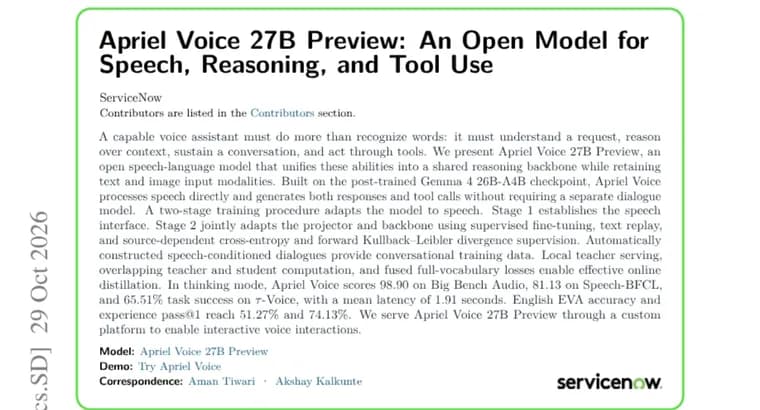
A new paper presents Apriel Voice 27B Preview, an open speech-language model meant to work as a voice assistant. The authors start from the idea that a capable assistant must do more than recognize words: it has to understand requests, reason over context, sustain conversations and act through tools. Their model puts those abilities inside one shared reasoning backbone, and it keeps text and image input as well.
The model is built on the post-trained Gemma 4 26B-A4B checkpoint. It processes speech directly and generates both responses and tool calls, with no separate dialogue model in the loop.
Training has two stages. The first establishes the speech interface. The second adapts the projector and the backbone together, using supervised fine-tuning, text replay, and source-dependent cross-entropy and forward Kullback-Leibler divergence supervision. Conversational training data come from automatically constructed speech-conditioned dialogues. For online distillation, the authors say three things make it efficient: local teacher serving, overlapping teacher and student computation, and fused full-vocabulary losses.
In thinking mode, Apriel Voice scores 98.90 on Big Bench Audio and 81.13 on Speech-BFCL. On τ-Voice it reaches a task success rate of 65.51%, with a mean latency of 1.91 seconds. It also reaches 51.27% English EVA accuracy and 74.13% experience pass@1. Finally, the authors deploy Apriel Voice 27B Preview on a custom serving platform to support interactive voice interactions.
Key facts
- Apriel Voice 27B Preview is an open speech-language model that unifies understanding, reasoning, conversation and tool use in one backbone, and keeps text and image input.
- It is built on the post-trained Gemma 4 26B-A4B checkpoint and handles speech and tool calls without a separate dialogue model.
- Training runs in two stages: first the speech interface, then joint adaptation of projector and backbone with supervised fine-tuning, text replay, cross-entropy and forward KL supervision, via online distillation.
- In thinking mode: 98.90 on Big Bench Audio, 81.13 on Speech-BFCL, and 65.51% task success on τ-Voice with a mean latency of 1.91 seconds.
- Also reported: 51.27% English EVA accuracy and 74.13% experience pass@1; the model is deployed on a custom serving platform for interactive voice use.
Why it matters
Most voice assistants chain a speech recognizer to a separate dialogue model. This paper describes a single open model that takes speech in and produces both replies and tool calls, with reasoning in the same backbone. It is also a preview built on an existing post-trained Gemma 4 checkpoint, so the contribution is the speech adaptation recipe: the two-stage training and the efficient online distillation setup, rather than a new base model.
Who it affects
The audience is teams building voice assistants and agents that must act through tools, and researchers working on speech-language models and distillation. The abstract names no authors or institutions, and does not say who develops Apriel.
How to use it
The abstract describes a deployment on a custom serving platform for interactive voice use, but gives no instructions for running the model yourself. No license, release date, weights location or hardware requirements are stated. Anyone interested should look for those details beyond the abstract before planning around it.
How solid is it
The numbers are the authors' own, reported in the abstract: 98.90 on Big Bench Audio, 81.13 on Speech-BFCL, 65.51% on τ-Voice with a mean latency of 1.91 seconds, all in thinking mode. No comparison with other models or baselines is given for any of the scores. The abstract does not say whether the EVA accuracy and experience pass@1 figures were measured in thinking mode, and it does not define the metrics' scales beyond the numbers quoted. The latency is a mean, not a median.
Risks and caveats
This is labeled a preview. No latency figure is given for non-thinking mode, so the 1.91 second mean applies only to thinking mode. The abstract does not explain what 27B refers to relative to the 26B-A4B base checkpoint. With no baselines in the abstract, the scores cannot be judged against other speech models from this text alone.
“A capable voice assistant must do more than recognize words; it must understand requests, reason over context, sustain conversations, and act through tools.”
— Apriel Voice 27B Preview paper abstract