Associative-algebra layer speeds up a 110M Transformer by 6.2 to 7.8% but lowers scores
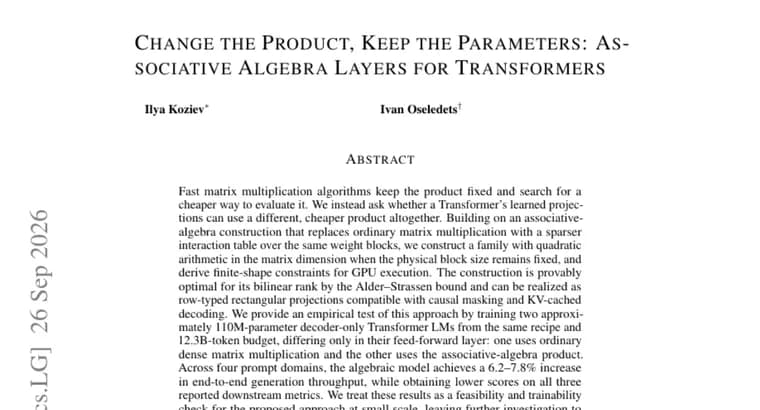
A new paper on Hugging Face Papers, "Change the Product, Keep the Parameters: Associative Algebra Layers for Transformers", takes a different route to cheaper matrix arithmetic. Fast matrix multiplication algorithms keep the product fixed and search for a cheaper way to evaluate it. The authors ask instead whether a Transformer's learned projections can use a different, cheaper product altogether.
They build on an existing associative-algebra construction that replaces ordinary matrix multiplication with a sparser interaction table over the same weight blocks. From it they construct a family with quadratic arithmetic in the matrix dimension when the physical block size remains fixed, and they derive finite-shape constraints for GPU execution. The authors state that the construction is provably optimal for its bilinear rank by the Alder-Strassen bound, and that it can be realized as row-typed rectangular projections compatible with causal masking and KV-cached decoding.
For an empirical test, they trained two decoder-only Transformer language models of approximately 110M parameters each, from the same recipe and the same 12.3B-token budget. The models differ only in the feed-forward layer: one uses ordinary dense matrix multiplication, the other uses the associative-algebra product.
Across four prompt domains, the algebraic model reached a 6.2 to 7.8% increase in end-to-end generation throughput. It also obtained lower scores on all three reported downstream metrics. The authors treat the results as a feasibility and trainability check at small scale and leave further investigation to future work.
Key facts
- The paper replaces ordinary matrix multiplication in learned projections with an associative-algebra product over the same weight blocks, using a sparser interaction table.
- Two decoder-only LMs of about 110M parameters were trained on the same recipe and 12.3B-token budget, differing only in the feed-forward layer.
- The algebraic model showed a 6.2 to 7.8% increase in end-to-end generation throughput across four prompt domains.
- It scored lower on all three reported downstream metrics.
- The authors call the results a feasibility and trainability check at small scale and leave further investigation to future work.
Why it matters
Most work on faster matrix multiplication keeps the product fixed and looks for a cheaper way to compute it. This paper changes the product itself, while keeping the same weight blocks. If a cheaper product can be trained, it opens a separate route to faster Transformer layers. The authors claim the construction gives quadratic arithmetic in the matrix dimension at a fixed physical block size and is provably optimal for its bilinear rank by the Alder-Strassen bound. The measured result so far is modest: a 6.2 to 7.8% throughput gain at about 110M parameters.
Who it affects
The work is aimed at researchers and engineers working on efficient Transformer architectures and GPU execution of learned projections. The authors make the construction compatible with causal masking and KV-cached decoding, which are standard parts of autoregressive language model generation. It is a research result, not a product change.
How to use it
There is nothing to adopt yet. The abstract describes a construction that can be realized as row-typed rectangular projections, with finite-shape constraints derived for GPU execution. The setup to reproduce is the one described: two decoder-only LMs of about 110M parameters, the same recipe, a 12.3B-token budget, differing only in the feed-forward layer. No code or model release is mentioned in the source.
How solid is it
Only the abstract was available. The evidence is one small experiment: two models of about 110M parameters, trained on 12.3B tokens, with throughput measured across four prompt domains. The authors themselves call it a feasibility and trainability check at small scale. The abstract names no authors or institutions. The names and numeric values of the three downstream metrics are not given, nor how much lower the algebraic model scores. The four prompt domains are not named. No hardware (which GPU) or batch/sequence settings for the throughput measurement are stated.
Risks and caveats
The speed gain comes with lower scores on all three reported downstream metrics, and the size of the drop is not stated. No results at scales larger than about 110M parameters are reported; scaling is left to future work. The abstract does not state whether the throughput gain is measured against a baseline with identical parameter count beyond saying the recipe and token budget were the same. Whether the trade-off improves or worsens at larger scale is unknown.