AT&T sues Comcast over "fiber-powered" Xfinity cable internet claim
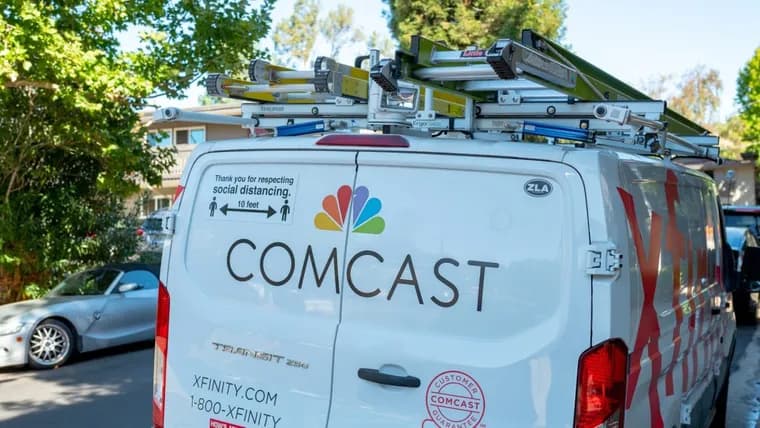
AT&T on Friday accused Comcast of false advertising in a lawsuit. The target is Comcast's marketing claim that its cable broadband service and Wi-Fi are "fiber-powered." The suit says it "challenges Comcast's false advertising campaign for its residential Internet service, marketed under the Xfinity brand to consumers nationwide," and that "at the center of that campaign is Comcast's claim that Xfinity Internet and its associated Wi-Fi service are 'Fiber-Powered.'"
The article gives the technical background. Comcast has deployed plenty of fiber across the US, but its cable internet service makes the final connection to homes with coaxial cable. That is why upload speeds are far slower than download speeds. Fiber-to-the-home service, by contrast, can provide symmetrical upload and download speeds. Comcast has deployed fiber-to-the-home in only small portions of its cable territory, while advertising its service as fiber-powered in the majority of areas where cable makes the final connection.
AT&T's argument is that the label gives "reasonable consumers the misleading impression that Xfinity Internet is a fiber-to-the-home service comparable to AT&T Fiber." According to the suit, the vast majority of Xfinity Internet runs over a hybrid fiber-coaxial (HFC) network, where the "last mile" connection to the customer's home uses copper coaxial cable, not fiber. The suit calls the fiber-powered claim "literally false," saying Comcast's HFC architecture is "fundamentally different from true fiber-to-the-home services like AT&T Fiber, which deliver fiber optic cables directly to the customer's premises."
The article also notes that AT&T has its own history of misleading network ads. It used to advertise 4G LTE service as "5GE" or "5G Evolution" and showed a 5GE icon on 4G phones. AT&T said those ads served to educate customers about the billions of dollars it had invested, but the BBB National Programs' National Advertising Division found the term was likely to mislead consumers into thinking they had 5G connections.
Key facts
- AT&T sued Comcast on Friday, alleging false advertising over the "Fiber-Powered" label on Xfinity Internet and its Wi-Fi service.
- AT&T says the vast majority of Xfinity Internet runs over a hybrid fiber-coaxial network, with copper coaxial cable for the last mile to the home, and calls the claim "literally false."
- Per the article, Comcast has deployed fiber-to-the-home in only small portions of its cable territory, yet advertises fiber-powered service in most areas where cable makes the final connection.
- Coaxial last-mile connections leave upload speeds far slower than download speeds; fiber-to-the-home can offer symmetrical speeds.
- AT&T has its own record: the BBB National Programs' National Advertising Division found its "5G Evolution" branding for 4G LTE likely to mislead consumers.
Why it matters
A major carrier is asking a court to decide what "fiber" may mean in consumer broadband marketing. AT&T's case rests on a clear technical line: fiber all the way to the home, as with AT&T Fiber, versus fiber deeper in the network with copper coaxial cable for the last mile. If the claim is false, the "fiber-powered" label on Xfinity would be misleading about exactly that difference.
Who it affects
Comcast's Xfinity residential internet customers across the US are the audience of the campaign at issue, and AT&T Fiber is the product AT&T says consumers could wrongly equate it with. The article does not say how many customers or which regions are affected.
How to use it
For anyone comparing home internet plans, the article's practical point is to ask how the final connection reaches the home. Per the article, coaxial last-mile service means upload speeds far slower than download speeds, while fiber-to-the-home can provide symmetrical speeds. A "fiber-powered" label alone does not tell you which one you would get.
How solid is it
The reporting is from Ars Technica and quotes AT&T's lawsuit directly. The central claims, including that the service is "literally false" advertising and that the vast majority of Xfinity runs over HFC, are AT&T's allegations, not findings. The article states in its own voice that Comcast's cable service uses coaxial cable for the final connection and that Comcast has deployed fiber-to-the-home in only small portions of its cable territory.
Risks and caveats
This is an accusation at an early stage; no ruling or outcome is reported. No response or comment from Comcast appears in the source text. The court, case number and the relief AT&T seeks are not stated, and no figures are given for actual speeds or for how much of Comcast's territory has fiber-to-the-home. AT&T's own past "5G Evolution" ads were found likely to mislead, which is context the article raises about the plaintiff.
“In fact, the vast majority of Xfinity Internet runs over a hybrid fiber-coaxial (‘HFC’) network, where the critical ‘last mile’ connection to the customer’s home uses copper coaxial cable, not fiber.”
— AT&T's lawsuit against Comcast, as quoted by Ars Technica