AURA 1.3B streams audio-driven avatar video in real time on one GPU
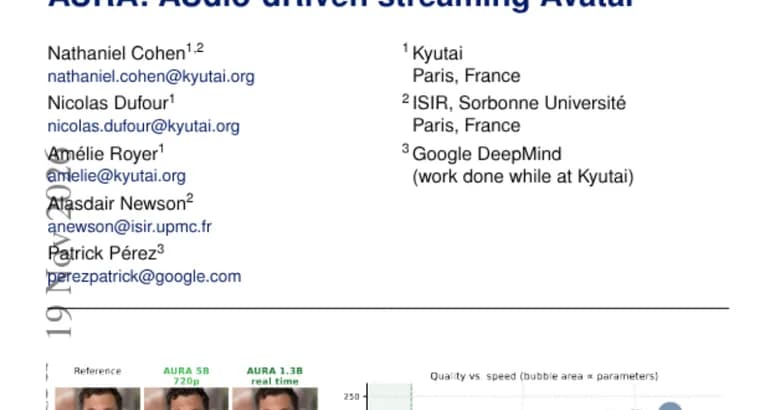
A new paper introduces AURA (AUdio-dRiven streaming Avatar), a video diffusion model that turns speech into a talking-head video as the audio arrives. The authors start from a known limit of current audio-driven video diffusion models: they can produce realistic talking heads, but they generally need dozens of denoising steps over multi-second video chunks. That makes them unsuitable for streaming uses such as voice assistants and virtual avatars, which need low latency and online causal generation.
AURA works chunk by chunk and keeps a rolling KV cache. It needs only the audio of the current chunk to start generating, rather than the multi-second audio look-ahead that bidirectional models require.
The model comes in two sizes. AURA 1.3B streams 576p video in real time on a single GPU, at 20.7 fps for a 16 Hz playback rate, which the authors say makes it suited to interactive avatar applications. AURA 5B streams 720p video at 9.7 fps.
Both are trained with a two-stage distillation pipeline. In the first stage, the causal student is aligned with the teacher: it is trained to match the teacher's trajectories using fewer diffusion steps and a chunk-wise sliding window causal attention mask. In the second stage, Distribution Matching Distillation (DMD) with backward simulation is applied to close the remaining quality gap.
On standard talking-head benchmarks, the authors report that AURA 1.3B runs 23x faster than its own bidirectional teacher and reaches quality comparable to TalkVerse at a lower resolution. AURA 5B matches its TalkVerse teacher at 720p while running 17x faster.
For reproducibility and further research on streaming avatar generation, the authors release the weights of both models, along with a dataset of 30K synthetic videos and their precomputed teacher trajectories.
Key facts
- AURA generates talking-head video chunk by chunk with a rolling KV cache and needs only the current chunk's audio, not a multi-second look-ahead.
- AURA 1.3B streams 576p video in real time on a single GPU at 20.7 fps (for a 16 Hz playback rate); AURA 5B streams 720p at 9.7 fps.
- Two-stage distillation: causal alignment with the teacher using fewer diffusion steps and a chunk-wise sliding window causal mask, then DMD with backward simulation.
- AURA 1.3B runs 23x faster than its own bidirectional teacher; AURA 5B matches its TalkVerse teacher at 720p while running 17x faster.
- Weights of both models and a dataset of 30K synthetic videos with precomputed teacher trajectories are released.
Why it matters
Voice assistants and virtual avatars need video that starts as soon as speech does. The authors say existing audio-driven video diffusion models, with dozens of denoising steps over multi-second chunks and a multi-second audio look-ahead in bidirectional designs, are unsuitable for that. AURA targets exactly this gap with causal, chunk-wise generation and a distilled student that needs fewer steps.
Who it affects
Teams building interactive avatars and voice assistants with a face are the obvious audience, since the authors frame AURA 1.3B as suited to interactive avatar applications. Researchers working on streaming or causal video generation also get the released weights, the synthetic dataset and the teacher trajectories to build on.
How to use it
The authors release the weights of both models, AURA 1.3B and AURA 5B, plus a dataset of 30K synthetic videos with their precomputed teacher trajectories. The 1.3B model is the one the authors present for real-time use, at 576p on a single GPU. The source does not say where the weights and dataset are released or under what license.
How solid is it
This is a preprint, and the speed and quality claims are the authors' own. Quality is described only as comparable to TalkVerse for the 1.3B model at a lower resolution, and as matching the TalkVerse teacher for the 5B model at 720p. Benchmark names and metric values are not given in the source text. The 23x and 17x figures are relative speedups against the models' own teachers, not against other systems.
Risks and caveats
The 5B model streams 720p at 9.7 fps, and the source does not say whether that counts as real time. The GPU used for the speed numbers is not named, and no latency in milliseconds, chunk length or number of student diffusion steps is given. The real-time claim for 1.3B is stated for a 16 Hz playback rate at 576p, so results at other settings may differ.