Clover-35B-A3B-Preview report describes a 35B diffusion language model
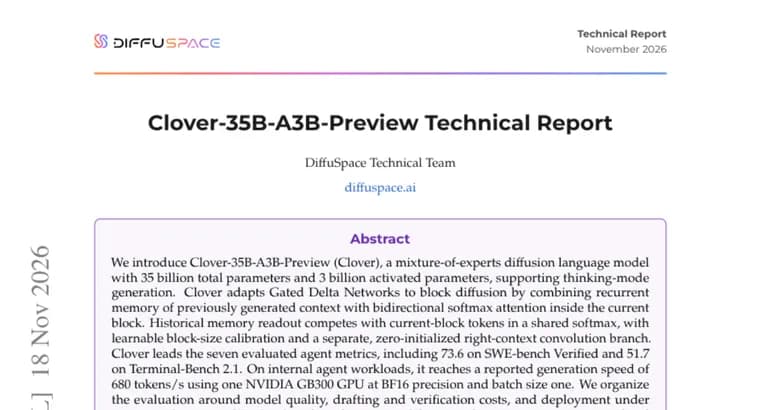
A technical report introduces Clover-35B-A3B-Preview, called Clover for short. It is a mixture-of-experts diffusion language model with 35 billion total parameters and 3 billion activated parameters, and it supports thinking-mode generation.
The architecture is the core of the report. Clover adapts Gated Delta Networks to block diffusion. It combines recurrent memory of previously generated context with bidirectional softmax attention inside the current block. The readout from that historical memory competes with the current-block tokens in a shared softmax. The design also has learnable block-size calibration and a separate right-context convolution branch that is zero-initialized.
On quality, the authors say Clover leads the seven evaluated agent metrics, including 73.6 on SWE-bench Verified and 51.7 on Terminal-Bench 2.1. On speed, they report a generation speed of 680 tokens/s on internal agent workloads, using one NVIDIA GB300 GPU at BF16 precision and batch size one. They describe that figure as reported.
The evaluation is organized around three themes: model quality, drafting and verification costs, and deployment under constrained memory.
The report also describes a decision-model variant that generates answers to related questions in one denoising pass. On an internal set of 500 groups, joint prediction raises question accuracy from 90.37% to 93.88% and all-correct group accuracy from 65.4% to 77.0%.
Key facts
- Clover-35B-A3B-Preview is a mixture-of-experts diffusion language model with 35 billion total and 3 billion activated parameters, with thinking-mode generation.
- It adapts Gated Delta Networks to block diffusion, pairing recurrent memory of earlier context with bidirectional softmax attention inside the current block.
- The authors say Clover leads the seven evaluated agent metrics, including 73.6 on SWE-bench Verified and 51.7 on Terminal-Bench 2.1.
- A reported 680 tokens/s on internal agent workloads comes from one NVIDIA GB300 GPU at BF16 precision and batch size one.
- A decision-model variant answers related questions in one denoising pass; on an internal 500-group set, question accuracy goes from 90.37% to 93.88% and all-correct group accuracy from 65.4% to 77.0%.
Why it matters
Most language models write text one token after another. Clover is a diffusion language model, which generates in blocks, and the report pairs that with a mixture-of-experts design where only 3 billion of 35 billion parameters are activated. The authors claim a lead on all seven agent metrics they evaluated, with 73.6 on SWE-bench Verified and 51.7 on Terminal-Bench 2.1, and a reported 680 tokens/s on a single GPU. If those results hold up, they would make block diffusion a serious option for coding and agent work.
Who it affects
The report is aimed at researchers and engineers who build or serve language models, especially those working on diffusion-based generation, agent and coding models, or deployment under constrained memory. The report's evaluation is organized around those themes: model quality, drafting and verification costs, and memory-limited deployment.
How to use it
The report offers no practical route for trying the model. No release date, license, weights availability or download link is given. The model is labelled 'Preview'. Readers can use the architecture description, which covers shared-softmax memory readout, block-size calibration and a zero-initialized right-context convolution branch, as a reference for their own work.
How solid is it
All figures are the report's own. The 680 tokens/s speed is on internal agent workloads and is described as 'reported'; no baseline speed or speedup factor is given. The joint-prediction accuracy gains come from an internal 500-group set, with no comparison model or public benchmark. The abstract does not name the models or baselines Clover is compared against, and does not state the units or scale of the SWE-bench Verified and Terminal-Bench 2.1 scores. 'Leads the seven evaluated agent metrics' does not say which metrics beyond the two named, nor whether the lead is over all models or over a particular comparison set. No authors, institutions or company are named in the abstract.
Risks and caveats
The headline claims cannot be checked from the text alone: the comparison set is unnamed and the speed and accuracy numbers rest on internal workloads and data. The speed figure is for batch size one on one NVIDIA GB300 GPU at BF16, so it describes that setup only. The model is labelled 'Preview'; the abstract says nothing about a final release. It also does not say what the decision-model variant is used for beyond generating answers to related questions in one denoising pass.