AURA 2.0 streaming video model starts conversations on its own
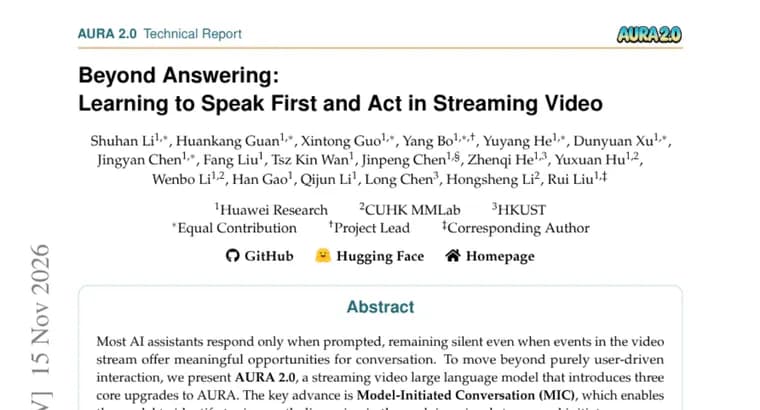
A new preprint presents AURA 2.0, a streaming video large language model that builds on an earlier model, AURA. The authors start from a complaint about current assistants: most respond only when prompted, and stay silent even when events in a video stream offer a real chance to talk.
AURA 2.0 introduces three core upgrades. The key advance is Model-Initiated Conversation (MIC). The model identifies topics worth discussing in the evolving visual stream and starts a conversation at an appropriate moment, with no user query. The second upgrade is Stream-Aware Tool Calling (SATC), which lets the model act on what it sees. It invokes external tools using the current visual and conversational context, then works the returned information into the ongoing interaction. The third is Interactive Visual Grounding (IVG), which supports grounding in both user inputs and model outputs. The model can identify objects a user has marked on video frames, and it can produce frame-aligned bounding boxes that tie its responses to specific objects and regions.
To develop these behaviors, the authors built a dedicated streaming interaction dataset and used a three-stage training scheme to combine the new behaviors with AURA's existing streaming interaction abilities. They also added Long-Horizon Interaction Memory (LHIM), meant to keep context continuous over extended video streams.
On evaluation, the authors say AURA 2.0 achieves leading performance among open-source streaming models on public streaming benchmarks, and that targeted evaluations further validate the new interaction capabilities.
Key facts
- AURA 2.0 is a streaming video LLM that adds three core upgrades to AURA: Model-Initiated Conversation, Stream-Aware Tool Calling and Interactive Visual Grounding.
- Model-Initiated Conversation lets the model pick topics worth discussing in the live video and speak at suitable moments without a user query.
- Interactive Visual Grounding lets the model identify objects users mark on frames and output frame-aligned bounding boxes.
- The authors built a dedicated streaming interaction dataset, used a three-stage training scheme and added Long-Horizon Interaction Memory for long streams.
- The authors report leading performance among open-source streaming models on public streaming benchmarks.
Why it matters
Most assistants wait to be asked. The authors argue that this leaves value on the table in video streams, where events can offer meaningful chances for conversation. AURA 2.0 targets that gap by letting the model decide when something is worth raising. It also pairs this with tool use and visual grounding, so the model can both act on what it sees and point to the exact objects it means.
Who it affects
The work is aimed at researchers and developers building assistants that watch a live video stream and talk about it, rather than answering one-off questions about a clip. The source frames the contribution against open-source streaming models.
How to use it
The source describes the method and its evaluation, and does not give usage instructions. In practice the three capabilities work like this: the model can speak up on its own (MIC), call external tools using what it currently sees and what has been said (SATC), and mark objects in frames with bounding boxes or respond to objects the user has marked (IVG). Long-Horizon Interaction Memory is meant to keep a long session coherent.
How solid is it
This is a preprint, and the performance claim comes from the authors themselves. They say AURA 2.0 leads among open-source streaming models on public streaming benchmarks and that targeted evaluations validate the new capabilities. No benchmark names, scores, or margins over other models are given. The claim of leading performance is limited to open-source streaming models; no comparison with closed models is stated.
Risks and caveats
The source gives no model size, parameter count, or base model. It gives no release date, code, weights, or dataset availability. It also gives no details of the three training stages, the dataset size, or the external tools used. A model that speaks without being asked raises the question of when it should stay quiet, but the source does not discuss that; its stated evidence is the benchmark and targeted evaluations.
“Most AI assistants respond only when prompted, remaining silent even when events in the video stream offer meaningful opportunities for conversation.”
— AURA 2.0 paper abstract