Axiom Math's AI swarm verifies the 15,000-page CFSG proof
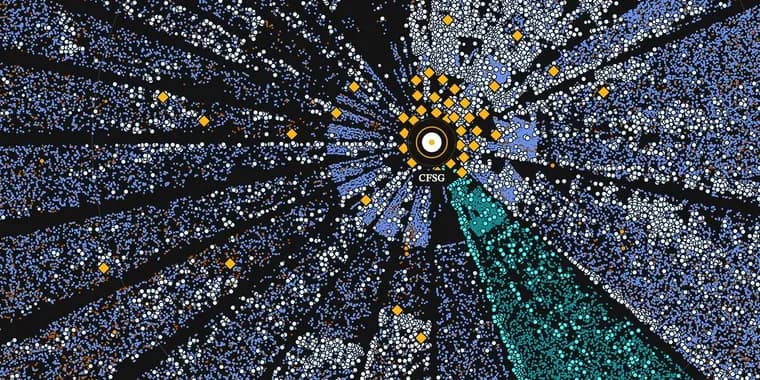
Axiom Math, a company whose Founding Mathematician is Ken Ono, finished the automatic formal verification of the Classification of Finite Simple Groups (CFSG) on Sunday 25 October. The proof runs to more than 15,000 pages and is widely considered the longest mathematical proof ever written by humans. It is colloquially known as the "enormous theorem". IEEE Spectrum's Benjamin Skuse reports that the work was done by a swarm of AI agents.
The theorem concerns finite simple groups: sets of elements combined with an operation, like addition or multiplication, that cannot be reduced further and contain a finite number of elements. All the permutations of a deck of cards form one such group. Évariste Galois laid the foundations of group theory almost 200 years ago, and mathematicians have since classified finite simple groups into 18 families, plus 26 sporadic simple groups that belong to none of them. The CFSG proof confirms that this list is complete. Getting there meant combining results from more than 500 journal articles written by around 100 authors over a half-century, more than any one mathematician can fully absorb.
Niels Voss, who led the CFSG formalization at Axiom Math, says the sheer length was one of the hardest problems. The proof contains multiple theorems, lemmas and definitions, and none of them can be checked until everything has been made machine-readable. His team first processed all the CFSG literature and traced the network structure of the informal proof. It then broke the statement into about 100 milestones, landmark results that can be verified independently, and used them to guide the work. The CFSG formalization comes to 43 million lines of code, roughly on a par with the Linux kernel.
Just nine days after the CFSG announcement, Axiom Math said it had also automatically formalized the Stacks project. Aise Johan de Jong of Columbia University started Stacks in 2005. It is an open-source collaborative textbook and reference work, 7500 pages long, on highly abstract algebraic geometry and algebraic stacks. Where CFSG is one huge theorem, Stacks is a library of thousands of interlocking definitions, constructions and lemmas. The final formalization is 16 million lines of code. According to Vasily Ilin, who led it, the difficulty was keeping thousands of definitions and theorems faithful and coherent. The team built a hierarchical system of AI agents with specialized responsibilities working in parallel. It checked faithfulness with multi-agent audits, cross-checks against sources and hard tests.
Ono was watching as the team counted down to completion. "God, I cannot tell you how emotional I was," he recalls. He is the son of a mathematician and grew up around some of the architects of the CFSG proof. Colva Roney-Dougal, a group theorist at the University of St Andrews who was not involved, had held CFSG up as an example of something incredibly hard to formalize, because she thought the computing required was unattainable. She says she was "really, really surprised" by the announcement. She is very impressed. She likes that the formal proof finds and clears up several mistakes in the original human proof, and she thinks the result is critical to formalizing any modern research in group theory, including her own work on how finite simple groups behave.
She also raises a worry. Because the verification was done automatically, few mathematicians are capable of extracting information from the proof to share with the community. A new generation may have "missed a chance to gain knowledge from the doing of it".
Skuse writes that together the two results are a significant step toward formalizing all of mathematics. Ono says they "show the two ways formalization has to scale: one very long proof, and one very wide body of connected theory". Ono and Voss see advantages in a future where formal mathematics is central: rubber stamping theorems and proofs, preserving knowledge as expertise dwindles over time, and building a shared library as a basis for new mathematics. They are optimistic about humanity's role in it and see formalization as a launchpad for humans to use and understand mathematics in new ways.
Key facts
- Axiom Math's AI swarm finished automatic formal verification of the CFSG proof, over 15,000 pages, on Sunday 25 October; the formalization is 43 million lines of code.
- Nine days after the CFSG announcement, Axiom Math said it had also formalized the 7500-page Stacks project, which comes to 16 million lines of code.
- The CFSG team traced the network structure of the literature (more than 500 articles, around 100 authors) and split the statement into about 100 independently verifiable milestones.
- Colva Roney-Dougal of St Andrews, who was not involved, says the formal proof finds and clears up several mistakes in the original human proof.
- She also warns that few mathematicians can extract insight from an automatically produced verification, so a new generation may miss learning from the doing of it.
Why it matters
The CFSG proof is widely considered the longest ever written by humans, and it is spread across more than 500 articles by around 100 authors. Roney-Dougal had held it up as a case of something incredibly hard to formalize, because she thought the computing needed was unattainable. Formalizing it, together with the 7500-page Stacks project, shows that AI agents can handle both one very long proof and one very wide body of connected theory, in Ono's words. IEEE Spectrum presents this as a significant step toward formalizing all of mathematics.
Who it affects
Mathematicians, above all group theorists, are the most direct audience. Roney-Dougal thinks the result is critical to formalizing any modern research in group theory. Algebraic geometers gain a formal Stacks library. Early-career mathematicians are affected too: Roney-Dougal worries that a new generation may have missed a chance to gain knowledge from the doing of it.
How to use it
The article says anyone or any bot can now access the formal Stacks library and build new formal mathematics on it. Ono and Voss see formal mathematics serving as a way to rubber stamp theorems and proofs, to preserve knowledge as expertise dwindles, and as a shared library for creating new mathematics. The article gives no price, licence or access terms for the formalizations.
How solid is it
The account comes from IEEE Spectrum, written by freelance science and technology writer Benjamin Skuse, who holds a Ph.D. in applied mathematics. The key claims about the work come from Axiom Math's own people: Ono, Voss and Ilin. The outside voice, Roney-Dougal, was not involved in the work, and she is impressed. No peer review or independent confirmation of the formalizations is described in the article. It does not name the proof assistant or formal language used, and it gives no cost, compute budget or time taken.
Risks and caveats
Roney-Dougal's main caveat is that automatic verification leaves few mathematicians able to extract information from the proof and share it with the community, and that a new generation may lose the learning that comes from doing the work. The article does not detail the mistakes the formal proof is said to have found in the original. The claim that the Stacks impact "could be" profound is the author's conditional judgment, not a demonstrated outcome. The article spells the company's name once as "Axion Math", apparently a typo.
“They show the two ways formalization has to scale: one very long proof, and one very wide body of connected theory”
— Ken Ono, Axiom Math's Founding Mathematician