AutoTraceGT automates grounded theory for AI agent behavior
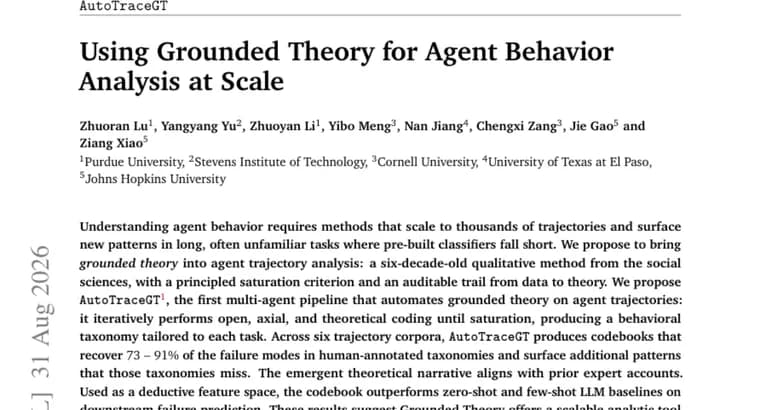
Researchers propose AutoTraceGT, described as the first multi-agent pipeline to automate grounded theory, a six-decade-old qualitative research method from the social sciences, for analyzing agent trajectories. The method targets a specific gap: understanding what AI agents actually do requires tools that scale to thousands of trajectories and can surface new behavior patterns in long, unfamiliar tasks where pre-built classifiers fall short. AutoTraceGT works by iteratively performing open, axial and theoretical coding, the standard grounded theory stages, until the analysis reaches saturation, at which point it produces a behavioral taxonomy tailored to the specific task. The authors tested the pipeline across six trajectory corpora. Its resulting codebooks recovered 73 to 91 percent of the failure modes already present in existing human-annotated taxonomies, and also surfaced additional behavioral patterns that those human-built taxonomies missed. The emergent theoretical narrative the pipeline produces aligns with prior expert accounts of agent behavior, according to the authors. Beyond description, the codebook has a practical downstream use: when used as a deductive feature space for failure prediction, it outperforms zero-shot and few-shot LLM baselines at that task. The authors frame the result as evidence that grounded theory, imported from qualitative social science, is a scalable analytic tool for ML researchers and agent developers who need to study agent behavior systematically rather than through ad hoc, task-specific classifiers.
Key facts
- AutoTraceGT is presented as the first multi-agent pipeline that automates grounded theory, a six-decade-old qualitative method from the social sciences, on agent trajectories.
- It iteratively runs open, axial and theoretical coding until reaching saturation, producing a task-specific behavioral taxonomy.
- Across six trajectory corpora, its codebooks recovered 73 to 91 percent of the failure modes found in existing human-annotated taxonomies.
- The pipeline also surfaced additional behavioral patterns that those human-annotated taxonomies had missed, and its theoretical narrative aligned with prior expert accounts.
- Used as a deductive feature space, the resulting codebook outperformed zero-shot and few-shot LLM baselines on downstream failure prediction.
Why it matters
Studying what AI agents actually do at scale is bottlenecked by manual analysis: existing failure taxonomies are typically hand-built by experts for one task and do not transfer. AutoTraceGT imports grounded theory, an established qualitative method from the social sciences with a principled saturation criterion and an auditable trail from raw data to theory, and automates it with a multi-agent pipeline. That gives researchers a repeatable, scalable way to build a behavioral taxonomy for a new task without starting from a fixed classifier or an existing human-made codebook.
Who it affects
The intended audience is ML researchers and agent developers who need to understand or classify how their agents behave and fail, particularly on long or unfamiliar tasks where a pre-built classifier does not fit.
How to use it
The pipeline runs open, axial and theoretical coding iteratively until saturation, producing a codebook specific to the task at hand. That codebook can then be used directly as a deductive feature space for downstream work such as predicting agent failures, where the authors report it beats zero-shot and few-shot LLM baselines.
How solid is it
The authors tested AutoTraceGT across six trajectory corpora and report that its codebooks recovered 73 to 91 percent of the failure modes already documented in human-annotated taxonomies for those corpora, while also surfacing patterns the human taxonomies missed. They also report that the resulting theoretical narrative aligns with prior expert accounts of agent behavior, and that the codebook outperforms zero-shot and few-shot LLM baselines when used for failure prediction.
Risks and caveats
The source text names neither the six trajectory corpora nor the specific failure modes recovered or missed, gives no numeric detail on the claimed 'thousands of trajectories' scalability, and does not quantify by how much the codebook beats the LLM baselines. It also carries no author names, institutions or publication venue, so the claims currently rest on the abstract's own description rather than independently checkable specifics.