AV-GRPO brings reinforcement learning to joint audio-video generation
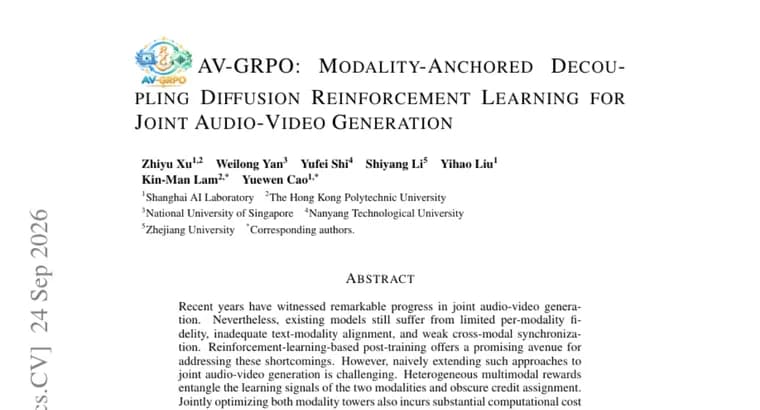
A paper introduces AV-GRPO, a modality-anchored online diffusion reinforcement-learning framework for joint audio-video generation, together with a companion training dataset called 5DAV. The authors start from a problem: existing joint audio-video generation models still show limited fidelity within each modality, weak alignment between text and content, and poor synchronization between audio and video. Reinforcement-learning post-training looks like a promising fix, but the authors say directly applying it to joint audio-video generation is hard for three reasons: heterogeneous rewards across modalities entangle the learning signal and complicate figuring out which part of the model deserves credit for a good or bad result; jointly optimizing two separate modality towers (audio and video) is computationally expensive because the two have very different dynamics; and judging synchronization quality depends on having paired audio-video samples, which makes fair reward comparisons difficult. AV-GRPO is built to address these issues with three modules: modality-anchored rollouts, which disentangle the learning signals for each modality and stabilize training difficulty; trajectory-locked frozen-tower optimization, which reduces computational cost and reassigns credit more precisely; and adaptive objectives and perturbation strengths tailored to each modality's own dynamics. Together these turn the coupled problem of learning preferences across two modalities into separate, unimodal subproblems, which the authors say allows more precise reward attribution and better synchronization. Alongside the method, the paper introduces 5DAV, a training dataset that is decoupled and difficulty-controllable, splitting samples across five dimensions to enable systematic training. In experiments on two benchmarks, JavisBench and VABench, the authors report that AV-GRPO outperforms LTX-2.3 in generation quality, semantic alignment and cross-modal synchronization, under both LoRA and full fine-tuning setups. Ablation studies are said to confirm the paper's design choices. The paper does not give specific numeric scores or percentage improvements, only that AV-GRPO outperforms LTX-2.3 on the stated criteria. No author names, institutional affiliations, or publication date are given in the text. Code and data are released on GitHub.
Key facts
- AV-GRPO is a modality-anchored online diffusion reinforcement-learning framework for joint audio-video generation.
- It includes three modules: modality-anchored rollouts, trajectory-locked frozen-tower optimization, and adaptive objectives and perturbation strengths tailored per modality.
- The accompanying 5DAV dataset decouples training samples across five dimensions for difficulty-controlled training.
- On the JavisBench and VABench benchmarks, AV-GRPO is reported to outperform LTX-2.3 in generation quality, semantic alignment and cross-modal synchronization, under both LoRA and full fine-tuning.
- Code and data are published at https://github.com/zhiyuxu03/AV-GRPO.
Why it matters
Joint audio-video generation models have struggled with weak per-modality fidelity, poor text alignment and, especially, weak synchronization between the audio and video streams. Reinforcement-learning post-training is a natural way to push quality further, but the authors argue it does not transfer cleanly to two-modality generation: rewards from audio and video get entangled, joint training of both towers is expensive, and judging synchronization needs paired samples that complicate fair reward comparison. AV-GRPO is presented as a way to make RL post-training workable for this joint setting.
Who it affects
The work is aimed at researchers and engineers building or fine-tuning joint audio-video generation models, and anyone benchmarking against models like LTX-2.3 or using datasets like JavisBench and VABench.
How to use it
The method and the 5DAV dataset are described in the paper, with code and data released at https://github.com/zhiyuxu03/AV-GRPO for others to reproduce or build on.
How solid is it
The claims come from the paper's own reported experiments on JavisBench and VABench against LTX-2.3, plus ablation studies said to confirm the design choices. The source text gives no specific numeric scores or percentage improvements, no author names or institutional affiliation, and no publication date, so the results cannot be independently checked beyond what the authors state.
Risks and caveats
Because the paper reports only qualitative outperformance without concrete numbers, the size of the improvement over LTX-2.3 is unclear. There is also no information here on peer-review status, authorship or affiliation, which limits how much independent scrutiny the claims have received.
“Heterogeneous multimodal rewards entangle learning signals and complicate credit assignment.”
— the researchers, AV-GRPO paper