Calibration as a first-class criterion in LLM evaluation
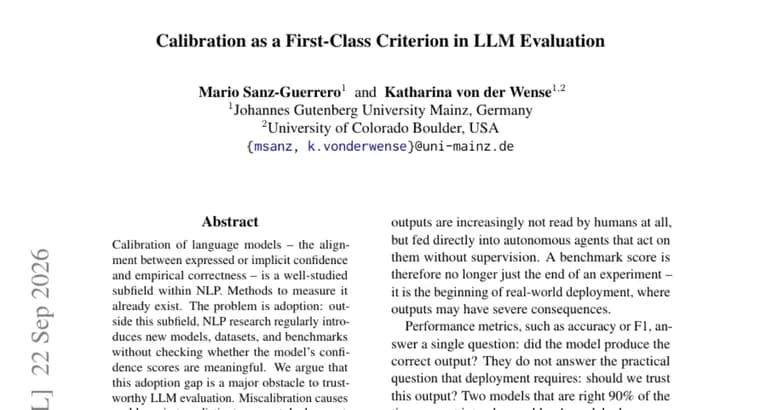
A paper argues that calibration, the alignment between a language model's expressed or implicit confidence and its empirical correctness, is a well-studied problem within NLP with existing methods to measure it. The issue, the authors say, is adoption: outside the calibration subfield itself, NLP research regularly introduces new models, datasets, and benchmarks without ever checking whether a model's confidence scores mean anything. They call this an adoption gap and argue it is a major obstacle to trustworthy LLM evaluation.
The authors say miscalibration causes harm in two separate places. At deployment, overconfident mistakes cause real harm to users who trust a wrong answer delivered with high confidence. Inside the research pipeline itself, techniques such as LLM-as-a-judge, synthetic data generation, and active learning all quietly depend on calibrated confidence scores without anyone verifying that the confidence is actually calibrated.
Technically, the authors note that standard calibration metrics need only two inputs per example: a confidence score and a correctness judgment. Most benchmarks already produce both, so calibration could be reported immediately, without new infrastructure. The exception is open-ended generation, where defining what counts as a confidence score and what counts as a correct judgment remains an open, unsolved problem.
The paper's proposal is that every NLP subfield should pair its main performance metric with a calibration score, elevating calibration from a specialist concern to an essential property expected of every model.
Key facts
- The paper argues an adoption gap, not a lack of methods, is the core problem: calibration techniques already exist but are rarely applied outside the calibration subfield itself
- Miscalibration is said to cause harm in two places: overconfident mistakes at deployment, and unverified reliance on calibrated confidence inside methods like LLM-as-a-judge, synthetic data generation, and active learning
- Calibration metrics need only a confidence score and a correctness judgment per example, both of which most current benchmarks already provide, so the authors say calibration could be reported right away
- Open-ended generation is flagged as the exception: defining a confidence score and a correctness judgment for it remains an unresolved problem
- The authors call for every NLP subfield to pair its main performance metric with a calibration score, treating calibration as essential rather than a niche topic
Why it matters
The paper frames calibration not as an academic side-topic but as a missing safeguard across NLP. Its argument is that unmeasured confidence quietly undermines both real-world deployment, where an overconfident wrong answer can cause real harm, and the research pipeline itself, since popular methods like LLM-as-a-judge, synthetic data generation, and active learning all assume calibrated confidence without anyone checking that assumption holds.
Who it affects
The call is aimed at NLP researchers and benchmark designers across subfields who currently report accuracy or other performance metrics without a calibration score, as well as anyone building evaluation pipelines or tools, such as LLM-as-a-judge systems, that implicitly lean on a model's confidence being meaningful.
How to use it
The authors note that adding calibration reporting requires only two things per example: a confidence score and a correctness judgment. Since most existing benchmarks already produce both, they argue calibration scores could be computed and published alongside standard performance metrics immediately, with no new infrastructure needed, except for open-ended generation tasks, where these two inputs are not yet well defined.
How solid is it
This is a position and argument piece rather than an empirical study: it does not name specific authors, institutions, benchmarks, models, or a proposed calibration methodology in detail, and it presents no numeric results. Its claims rest on describing a known gap in current NLP practice rather than on new experiments.
Risks and caveats
The paper itself acknowledges a real limitation: defining a confidence score and a correctness judgment for open-ended generation remains an open challenge, meaning its proposal is most directly actionable for benchmarks with clear-cut correctness labels rather than for free-form generation tasks.
“We argue that this adoption gap is a major obstacle to trustworthy LLM evaluation.”
— the authors