AWS's network redesign is up to 40% more energy efficient, but keeps the savings
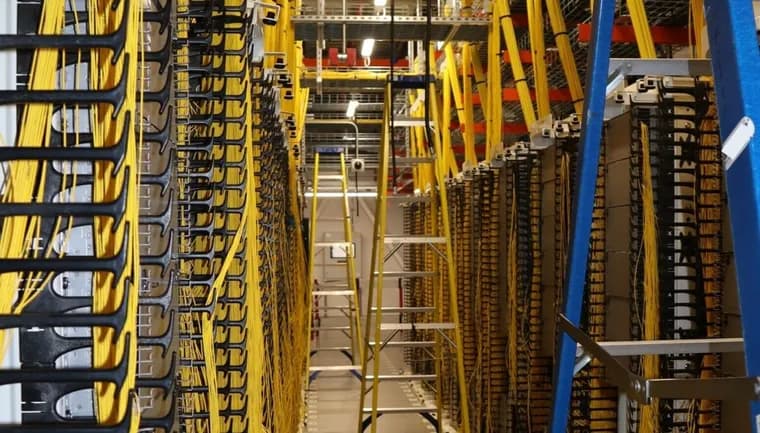
A columnist at The Register toured an AWS networking lab last month and interviewed Matt Rehder, AWS's VP of Global Network Engineering, about a networking redesign AWS has quietly rolled out across its datacenters. The design, which AWS calls the Resilient Network Graph, is a flat, single-tier network wired in a deliberately near-random pattern rather than the traditional layered, structured topology. According to AWS, the approach is more resilient, costs far less to run, and is up to 40 percent more energy efficient; it is now the default for most new AWS datacenter builds. A Register colleague, Thomas Claburn, had toured the same lab previously and covered AWS's published paper on the design.
The article's central question is where the resulting savings went. Seventeen years ago, Amazon SVP James Hamilton criticized network-vendor profit margins on stage, comparing them to those of mainframe vendors, and that critique led AWS to rebuild its entire networking stack on commodity hardware rather than buy from vendors. A few years ago, the Resilient Network Graph design cut AWS's networking costs further still. Asked directly whether AWS kept that margin improvement rather than passing it on to customers, the AWS staff the author interviewed answered without hesitation: 'From a cost perspective? Effectively, yes.'
The piece argues that verdict looks less damning next to AWS's broader pricing behavior. Unlike its competitors, AWS has not raised prices on existing EC2 SKUs: a 64GB-RAM instance costs the same today as it did in 2020. Moving from the Graviton4-based c8g.2xlarge instance to its Graviton5-based successor, the c9g.2xlarge, costs 9 percent more, but nothing forces that upgrade. GPU capacity block pricing does rise on a quarterly basis, by design, and AWS began charging per public IPv4 address a couple of years ago.
Data transfer pricing gets similar treatment. Moving data between Availability Zones in AWS's major regions costs a penny per gigabyte in and a penny per gigabyte out, two cents combined, while transfer within a single AZ is free; moving data out of AWS entirely costs significantly more. AWS's now-discontinued Snowball devices illustrated the old model: shipping a device to AWS cost a flat fee, and shipping one back cost that same fee plus a further per-gigabyte charge. That changed with AWS Interconnect - multicloud, a newer service that drops per-gigabyte charges entirely in favor of a flat hourly port fee; a free tier includes one 500 Mbps port per connected provider, reducing the AWS-side cost of sending traffic to Google Cloud and Oracle, with Azure support coming, to zero. The author estimates that sending the equivalent amount of data over the open internet, a fully saturated 500 Mbps port for a month, would cost roughly $12,000. AWS's staff told the author: 'We know customers do not like rate-based network charges because it's hard to predict their cost, which is why we are moving towards flat-rate pricing for new network products.'
The article also credits AWS with solving a routing problem most competitors have not: in a near-randomly wired network, the hard part is not the cabling but finding a path when there are, in the author's words, roughly thousands of equivalent routes between any two points, a scale that breaks conventional shortest-path protocols like BGP and OSPF. AWS built a protocol called SIDR (Scalable Intent-Driven Routing, pronounced 'cider') to handle the control plane, paired with a separate system called Spraypoint that handles the actual forwarding. AWS presented SIDR publicly at re:Invent in 2023 and again at the 'Monday Night Live' keynote at re:Invent in 2024, yet its own published Resilient Network Graph paper never mentions SIDR at all. The author says that, as best they could determine, no one outside AWS had previously connected the protocol to the network it enables.
The broader argument is that AWS undersells work it should be publicizing. AWS itself concedes it is generally bad at telling this story, despite wanting to, and has historically left that job to customers. The author contends this has let a misconception take hold: that newer neocloud operators and Nvidia reference-design datacenters have better networking than AWS. In the author's assessment they typically do not, because many datacenter networks in general are poorly run. Asked whether AWS's newer machine-learning-oriented datacenters, including ones being built in Mississippi, cut any corners on networking for GPU workloads, Rehder reacted as though the question were absurd: every AWS datacenter, he indicated, is built to the same specification.
The piece is written as a first-person opinion and analysis column, jokes included, rather than as straight news, and it is not a spoof: its factual claims rest on the author's direct, on-site interview with AWS. Its conclusion is that AWS's networking work remains invisible precisely because it succeeds, which the author calls 'the very definition of thankless work,' even while criticizing AWS elsewhere in the piece for confusing marketing, for building five near-identical services with confusing names, and for a habit of competing with its own partners.
Key facts
- AWS's new datacenter network design, the Resilient Network Graph, a flat, near-randomly wired single-tier network, is up to 40 percent more energy efficient and is now the default for most new AWS datacenter builds.
- Asked whether AWS kept the resulting margin improvement rather than passing it to customers, the AWS staff interviewed for the piece said: 'From a cost perspective? Effectively, yes.'
- AWS has not raised prices on existing EC2 SKUs, and a 64GB-RAM instance costs the same today as it did in 2020, though moving from the Graviton4-based c8g.2xlarge to the Graviton5-based c9g.2xlarge costs 9 percent more.
- Cross-AZ data transfer costs a penny per gigabyte in and a penny per gigabyte out, two cents combined, while transfer within a single AZ is free; the newer AWS Interconnect - multicloud service instead charges only an hourly port fee, with one free 500 Mbps port per provider to Google Cloud and Oracle.
- AWS's routing control plane runs on a protocol it calls SIDR (Scalable Intent-Driven Routing, pronounced 'cider'), presented publicly at re:Invent in 2023 and 2024 but never mentioned in AWS's own published paper on the network design.
Why it matters
The piece surfaces a rare, on-the-record admission: a years-long networking redesign that is far cheaper to run and up to 40 percent more energy efficient has largely turned into higher margin for AWS rather than lower bills for customers. That is a concrete data point in the debate over whether cloud providers pass efficiency gains on to customers, at a moment when GPU-heavy datacenter buildouts are pushing power and network costs to the center of cloud economics. The piece also challenges a common assumption that newer neocloud operators and Nvidia reference-design datacenters have better networking than the hyperscalers: by this account, AWS's own approach is more advanced, just unpublicized.
Who it affects
AWS customers who pay for cross-AZ traffic, data egress, or multicloud data movement, since the piece lays out exactly which transfers are free, flat-rate, or usage-based today. It also concerns competing cloud providers and neocloud or GPU-datacenter operators implicitly being compared to AWS's network design, and anyone deciding whether to move workloads from Graviton4 to Graviton5 instances.
How to use it
The pricing details are actionable: intra-AZ data transfer is free, cross-AZ transfer costs a penny per gigabyte each way, and moving data out of AWS costs more still, so where resources sit across AZs and regions carries a real cost. For multicloud transfers to Google Cloud or Oracle, AWS Interconnect - multicloud replaces per-gigabyte egress charges with a flat hourly port fee, with one 500 Mbps port free per provider, worth setting up before paying for saturated bandwidth the old way. The Graviton5-based c9g.2xlarge costs 9 percent more than the Graviton4-based c8g.2xlarge it succeeds, but nothing forces that upgrade.
How solid is it
This is a first-person account: the author toured AWS's lab and interviewed VP Matt Rehder on the record, cross-referencing AWS's own published Resilient Network Graph paper and its public re:Invent presentations from 2023 and 2024. The two direct quotes used, though, are attributed only to unnamed staff the author spoke with, not to Rehder by name, and the headline efficiency figure, up to 40 percent, comes from AWS itself with no baseline or measurement method disclosed. It runs as an opinion and analysis column, jokes included, rather than a hard-news report, but its factual claims are presented as genuine on-site reporting, not satire.
Risks and caveats
Nearly every efficiency and savings claim in the piece originates with AWS itself, including the up-to-40-percent efficiency figure and the assertion that the new network design is now the default for most new builds; none of it is independently verified. No dollar-figure EC2 prices are given, only percentage changes, and there is no quantified figure for how much of the cost savings AWS actually kept, only the qualitative 'Effectively, yes.' AWS Interconnect - multicloud's zero-per-gigabyte pricing is confirmed only for Google Cloud and Oracle today; Azure support is described as coming 'soon,' not yet live. The author's framing, that AWS deserves credit for not raising prices while keeping its efficiency gains, is one columnist's interpretation, and the same facts could just as reasonably be read as AWS pocketing savings it could have passed on.
“From a cost perspective? Effectively, yes.”
— AWS staff (unnamed), speaking to The Register