Axion 1.0 agent model trains in three stages, releases full recipe
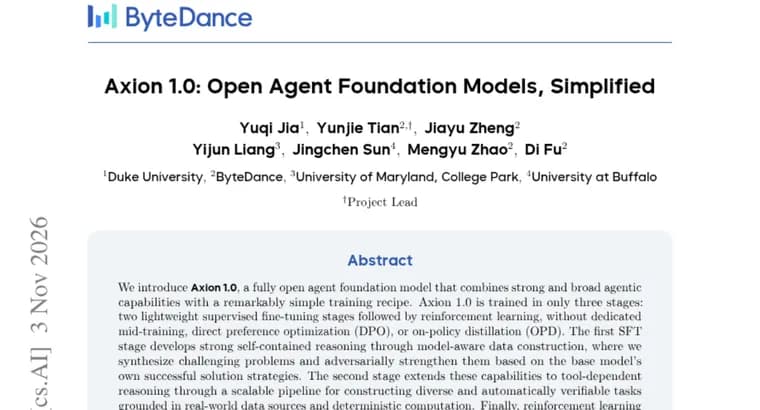
A Hugging Face paper introduces Axion 1.0, which its authors describe as a fully open agent foundation model that combines strong and broad agentic capabilities with a remarkably simple training recipe.
The recipe has only three stages: two lightweight supervised fine-tuning (SFT) stages, followed by reinforcement learning. It uses no dedicated mid-training, no direct preference optimization (DPO) and no on-policy distillation (OPD).
The first SFT stage builds strong self-contained reasoning through model-aware data construction. The authors synthesize challenging problems and adversarially strengthen them, based on the base model's own successful solution strategies. The second stage extends these abilities to tool-dependent reasoning. It relies on a scalable pipeline that builds diverse, automatically verifiable tasks grounded in real-world data sources and deterministic computation. Reinforcement learning then further strengthens long-horizon reasoning and interaction with external tools and environments.
The authors say that despite this compact recipe, Axion 1.0 performs strongly across a broad suite of agentic benchmarks and is competitive with leading commercial models on several of them, not all.
They also stress that the openness goes beyond model weights. They release the complete recipe: data construction, generation, filtering, verification, prompts and training code, so the whole development process can be reproduced and extended. Their conclusion is that Axion 1.0 shows strong agent foundation models can be both open and simple, offering a practical and reproducible path toward advancing open agentic intelligence.
Key facts
- Axion 1.0 is presented as a fully open agent foundation model, with a deliberately simple training recipe.
- Training has three stages: two lightweight SFT stages, then reinforcement learning; no dedicated mid-training, DPO or OPD.
- Stage one uses model-aware synthetic problems hardened adversarially; stage two uses automatically verifiable, tool-dependent tasks grounded in real-world data and deterministic computation.
- The authors report strong results on a broad suite of agentic benchmarks and competitiveness with leading commercial models on several of them.
- The release includes data construction, generation, filtering, verification, prompts and training code, not just weights.
Why it matters
Axion 1.0 is pitched as open beyond model weights: a short recipe, with the full pipeline published so others can reproduce and extend it. The authors argue this is a practical, reproducible path for open agentic intelligence. Dropping mid-training, DPO and OPD also suggests that a strong agent model may not need a long list of training stages, as the authors frame it.
Who it affects
Researchers and teams building agent models who want a documented starting point for data construction, filtering and verification. It also concerns anyone comparing open agent models against commercial ones, since the authors position Axion 1.0 as competitive on several benchmarks.
How to use it
According to the authors, the release covers data construction, generation, filtering, verification, prompts and training code, so the process can be reproduced and extended. The paper text gives no further detail on how to run or download it; check the Hugging Face paper page for the release materials.
How solid is it
The account rests on the authors' own abstract-level description. The benchmark claim is modest in wording: competitive with leading commercial models on several benchmarks, not all. The text names no benchmarks, scores, rival models, base model or model size, so the performance claim cannot be checked from this summary alone.
Risks and caveats
The performance claim is unquantified here and comes from the authors themselves. Which benchmarks count as 'several' is not stated, so the competitive result could be narrower than the headline impression. Reproducibility is promised through the released recipe, but that is a claim to be tested by outside teams.